★
Loading archive…
Loading archive…
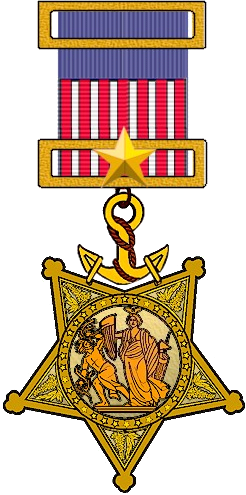
Captain of the Main Top, U.S. Navy
Support & adopt this hero ↓
George Prance was born in France in 1827. Details of his childhood, family background, and early years remain limited in surviving authoritative records, but by the time of the American Civil War he had entered the United States Navy and was serving as an experienced enlisted sailor. His military record became permanently associated with the steam sloop-of-war USS Ticonderoga and the Union Navy's campaign against one of the Confederacy's most important remaining coastal strongholds.
Prance served aboard USS Ticonderoga with the rating of Captain of the Main Top. In the nineteenth-century Navy, this was an enlisted naval rating rather than the commissioned rank of captain. A Captain of the Main Top was an experienced seaman entrusted with responsibility for men and duties associated with the ship's mainmast and upper rigging, while also taking part in the demanding work required during battle. During the engagements that brought Prance national recognition, he additionally performed important duties with one of Ticonderoga's guns.
USS Ticonderoga was a heavily armed steam sloop commissioned during the Civil War. By late 1864 she had been assigned to the enormous Federal naval force assembled against Fort Fisher, North Carolina. Fort Fisher protected the approaches to Wilmington, one of the Confederacy's last major Atlantic ports open to blockade-running vessels. As long as the fort remained operational, ships carrying military supplies could still attempt to reach Wilmington and sustain Confederate forces. Its destruction therefore became an important strategic objective for the Union.
The first major naval assault on Fort Fisher began on December 24, 1864. USS Ticonderoga joined other Union warships in an intense bombardment of the Confederate defenses. Prance remained at his station while enemy batteries returned fire. The engagement became especially dangerous aboard Ticonderoga when one of the ship's 100-pounder Parrott rifles exploded. The blast killed eight men and wounded a number of others, turning part of the ship's gun deck into a scene of sudden destruction.
Despite the explosion, casualties, and continuing Confederate fire, Prance remained at his duties. Serving as captain of a gun during the fighting, he demonstrated skill and courage while Ticonderoga continued its bombardment. The ship returned to the attack on December 25, but the first Union attempt to capture Fort Fisher ultimately failed. The naval bombardment had caused considerable damage, yet the accompanying ground assault was abandoned and the fort remained in Confederate hands.
The Union command did not abandon the objective. A second and much stronger expedition returned in January 1865. On January 13, USS Ticonderoga again moved into position with the Federal fleet and opened fire against Fort Fisher. Prance once more remained at his battle station as the ship delivered sustained and accurately placed fire against the Confederate batteries.
The bombardment continued through January 14 and into January 15. Ticonderoga's guns helped suppress enemy artillery, including weapons positioned on the fort's massive earthen defenses that threatened the Union assaulting columns. Prance continued performing his duties throughout the prolonged action despite the heavy fighting and the dangers that had already claimed the lives of his shipmates during the previous attack.
On January 15, 1865, Union ground forces launched their decisive assault. Sailors and Marines from the fleet also participated in operations against the fort while naval guns continued supporting the attack. After fierce fighting, Fort Fisher finally fell to Union forces. Its capture effectively closed Wilmington to the large-scale blockade-running traffic that had supplied the Confederacy and represented one of the most strategically important Union victories during the final months of the Civil War.
George Prance's conduct during both attacks on Fort Fisher—from December 24 and 25, 1864, through the renewed fighting of January 13 to 15, 1865—was subsequently recognized by the United States government. He received the Medal of Honor, the nation's highest military decoration, for his courage and steadfast performance aboard USS Ticonderoga under exceptionally dangerous combat conditions.
His official Medal of Honor recognition emphasized that he continued performing his duties skillfully and courageously despite heavy enemy fire and the catastrophic explosion of the Parrott rifle. When Ticonderoga returned for the second assault, he again remained steadfast as the ship engaged the Confederate batteries and helped reduce the effectiveness of guns firing upon Union assault troops. His award therefore reflected sustained courage across multiple days of combat rather than a single momentary act.
Prance's Medal of Honor was officially recorded in 1865, following the Fort Fisher campaign. For the medal database, his decoration belongs to the Medal of Honor 1862–1912 Navy period. His service was in the United States Navy, so the Navy version must be used rather than any Army Medal of Honor design. No separate device or clasp has been verified with his Medal of Honor.
The Medal of Honor is the only military decoration currently verified for inclusion in George Prance's final medal record. Although he was a Union Navy veteran of the Civil War, the separate Navy Civil War Medal cannot be added under the client's established eligibility rule. Prance died in 1885, well before the 1909 survival requirement applicable to that medal in the database workflow. Consequently, his verified medal record remains limited to the Medal of Honor.
After the Civil War, surviving records provide far less detail about Prance's civilian life than about his wartime service. He lived for approximately two decades after the conflict. Unlike many officers whose post-war careers were extensively documented, Prance was an enlisted sailor, and much of his later personal history has not survived in easily verifiable official records. For this reason, unsupported claims about his post-war occupations or activities should not be added to his biography.
George Prance died on April 2, 1885, in Temescal, California. He was buried at Mountain View Cemetery in Oakland, California. His life had taken him from his birthplace in France to service in the United States Navy and ultimately to California, but the defining historical record of his life remains his conduct aboard USS Ticonderoga during the attacks on Fort Fisher.
Prance's legacy is closely connected to one of the most important naval operations of the closing months of the American Civil War. Faced with heavy Confederate fire, the deaths and injuries of fellow sailors, and the violent explosion of one of his own ship's guns, he continued carrying out his responsibilities with courage and discipline. He returned to battle when USS Ticonderoga renewed the assault weeks later and helped sustain the naval fire that contributed to the fall of Fort Fisher. For that steadfast service under fire, George Prance was awarded the Medal of Honor and earned a permanent place among the decorated sailors of the United States Navy.
Become the named supporter for this profile and edit the tribute biography and portrait (Owner account required). Proceeds help keep the archive online.
$25 USD / year — annual sponsorship renewal. Keeps the page online and, where enabled, the family anniversary remembrance emails active.