★
Loading archive…
Loading archive…
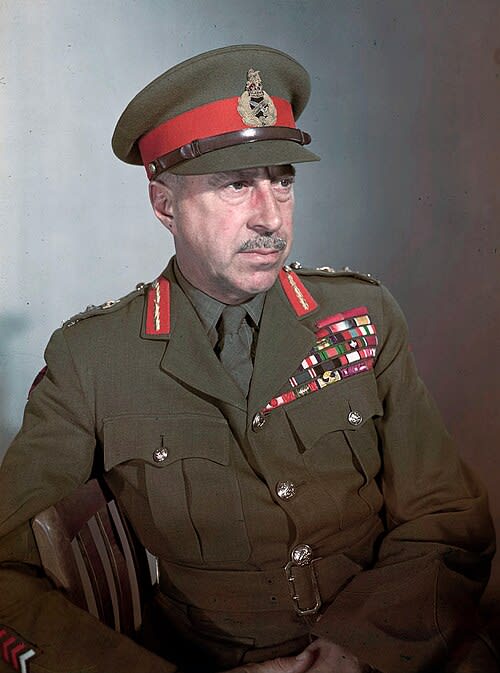
General, Canadian Army
Support & adopt this hero ↓
At the height of the Rhineland campaign in 1945, General Harry Crerar commanded approximately 450,000 Canadian and Allied troops. No Canadian had ever directed a field army of comparable size. Yet Crerar’s greatest achievement was not simply commanding troops in battle. It was ensuring that Canada’s army fought as a national force while operating successfully within a vast and often difficult Allied coalition.
Henry Duncan Graham “Harry” Crerar was born in Hamilton, Ontario, on 28 April 1888. He was educated at Upper Canada College and Highfield School before entering the Royal Military College of Canada in 1906. After graduating in 1909, he was unable to obtain one of the limited commissions then available in the British or Indian armies. Instead, he joined the 4th Battery, Canadian Field Artillery, in the Canadian militia. In civilian life, he worked as an electrical engineer with the Hydro-Electric Power Commission of Ontario.
The outbreak of the First World War transformed Crerar’s career. He volunteered for overseas service with the First Canadian Division and served on the Western Front as an artillery officer and staff officer. His wartime service included Neuve Chapelle, the Second Battle of Ypres, the Somme, Vimy Ridge, Amiens and Valenciennes. Crerar developed a reputation for careful planning and the effective coordination of artillery fire, rising to the rank of lieutenant-colonel before the Armistice.
For his First World War service, Crerar was appointed a Companion of the Distinguished Service Order and was mentioned in despatches. The Royal Military College of Canada associates his DSO with his distinguished artillery work during the Vimy Ridge campaign. He would again be mentioned in despatches during the Second World War.
Crerar joined Canada’s Permanent Force in 1920 and devoted the interwar years to professional military education and staff work. He attended the Staff College at Camberley and the Imperial Defence College in London, later becoming Director of Military Operations and Intelligence and Commandant of the Royal Military College of Canada. These appointments prepared him for the organizational challenge that would define his Second World War service.
In 1939, Crerar helped establish Canadian Military Headquarters in Britain. He subsequently returned to Ottawa, where he became Chief of the General Staff and supervised the rapid expansion, training and reorganization of the Canadian Army. In December 1941 he was appointed to command the 2nd Canadian Infantry Division, followed by I Canadian Corps in April 1942. He briefly led the corps in the Italian theatre before returning to Britain to succeed General A. G. L. McNaughton as commander of the First Canadian Army in March 1944.
When the First Canadian Army became operational in Normandy, it was far more than a purely Canadian formation. At various stages it included British, Polish, Czech, Belgian, Dutch, French and American troops. Crerar therefore had to coordinate soldiers from several nations while protecting the Canadian government’s authority over its own army. The Royal Canadian Artillery Museum describes this multinational force as the largest field army Canada has ever placed in battle.
Under Crerar’s overall command, the First Canadian Army fought through Normandy, helped close the Falaise Pocket and advanced across northern France into Belgium. It captured or isolated several Channel ports and was assigned the difficult task of opening the approaches to Antwerp. Crerar was hospitalized with dysentery in late September 1944, and Lieutenant-General Guy Simonds temporarily commanded the army during the decisive fighting to clear the Scheldt estuary. Crerar resumed command in November.
On 16 November 1944, he was promoted to full general, becoming the first Canadian officer to hold that rank while commanding troops in an active theatre of war. In early 1945, his enlarged army conducted Operations Veritable and Blockbuster, breaking through the formidable Rhineland defences. It then crossed into Germany while its Canadian formations helped liberate the northern and western Netherlands.
Crerar was not a flamboyant battlefield commander, and historians continue to debate his qualities as an operational general. His relationship with Field Marshal Bernard Montgomery was frequently strained, and he delegated much of the detailed conduct of operations to capable subordinates, particularly Guy Simonds. His strengths lay in strategic organization, coalition management, logistics and civil-military relations. Above all, he defended Canada’s right to control the employment of its national army while still cooperating effectively with senior Allied commanders.
His honours reflected both the scale of his responsibilities and the international character of his command. Crerar had been appointed a Companion of the Order of the Bath in 1943. In July 1945, he was appointed to the Order of the Companions of Honour for his “gallant and distinguished services in North West Europe,” as recorded in the official London Gazette announcement.
The United States appointed him a Commander of the Legion of Merit and awarded him the Army Distinguished Service Medal, which was presented by President Harry S. Truman. The presentation is documented by the Harry S. Truman Presidential Library. Poland awarded him the Silver Cross of the Order of Virtuti Militari, France made him a Commander of the Legion of Honour and awarded him the Croix de Guerre with Palm, and the Netherlands appointed him a Knight Grand Cross of the Order of Orange-Nassau with Swords.
Belgium appointed Crerar a Grand Officer of the Order of Leopold with Palm and awarded him the Belgian Croix de Guerre 1940 with Palm. These honours, together with his American Distinguished Service Medal, were officially announced in the London Gazette. He also received the Soviet Order of Kutuzov, 1st Class, and major Czechoslovak honours, including the Order of the White Lion, the Military Order of the White Lion for Victory and the Czechoslovak War Cross 1939. The Canadian government recorded these foreign awards in the House of Commons proceedings of 17 July 1947.
Crerar retired from the Canadian Army in 1946. He later undertook diplomatic missions on behalf of Canada and served as Aide-de-Camp General to King George VI and Queen Elizabeth II. In 1954, he was appointed a Knight of the Order of St John, as recorded in the London Gazette. Although this appointment may be mentioned in his biography, its postnominal is normally reserved for internal use within the Order of St John and should not be included in his public Canadian title. His Canadian Forces Decoration is correctly represented by the postnominal CD.
On 25 June 1964, Crerar was sworn into the Queen’s Privy Council for Canada, one of the country’s highest political honours. His appointment is recorded by the Privy Council Office.
General Harry Crerar died in Ottawa on 1 April 1965 and was buried with full military honours in Beechwood Cemetery. His reputation remains complex, but his central achievement is unmistakable. He built, preserved and commanded the largest Canadian field army in history, guiding a multinational force from Normandy through the Rhineland and helping secure the liberation of the Netherlands and the final defeat of Nazi Germany.
Become the named supporter for this profile and edit the tribute biography and portrait (Owner account required). Proceeds help keep the archive online.
$25 USD / year — annual sponsorship renewal. Keeps the page online and, where enabled, the family anniversary remembrance emails active.