★
Loading archive…
Loading archive…

His sudden charge captured two guns before dawn broke again.
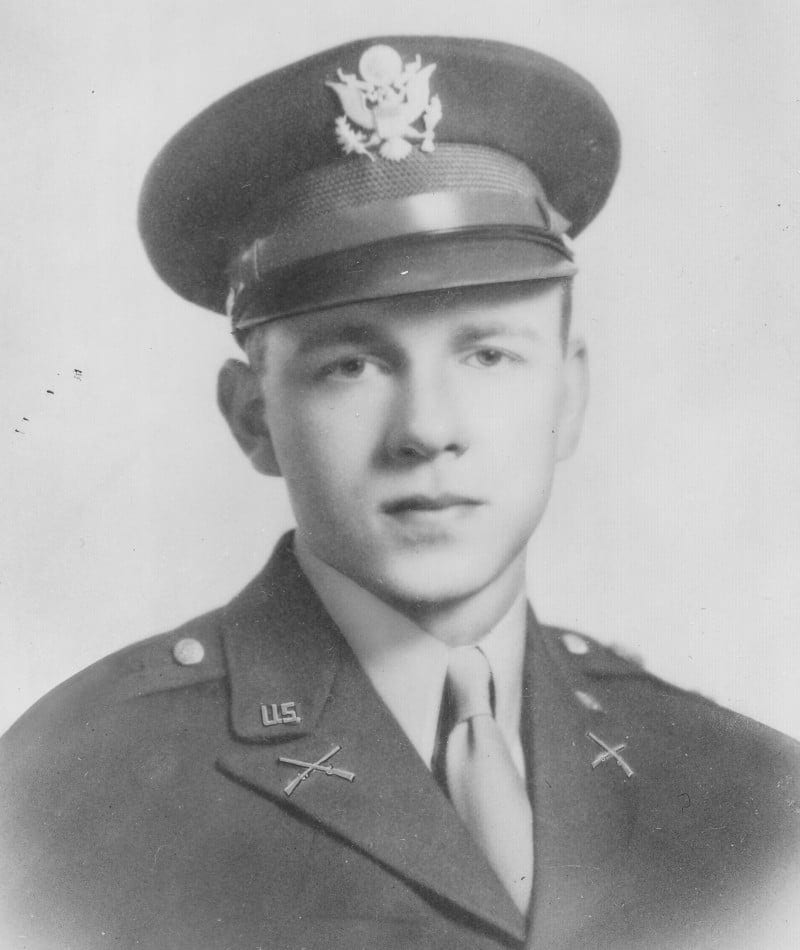
Harry J. Michael was born at Benton in Elkhart County, Indiana, on 13 March 1922. A farm boy from the Milford area, he attended Purdue University and joined Alpha Gamma Rho in 1942. He entered the United States Army in 1943 and became an infantry officer. By March 1945 he was a second lieutenant leading a rifle platoon in Company L, 318th Infantry Regiment, 80th Infantry Division. His unit was advancing into Germany during the final months of the European war.
Before daylight on 13 March, the company began climbing a wooded ridge northeast of Niederzerf. Hearing the bolt of a German machine gun, Michael stopped the men and slipped forward to investigate. He found two gun positions and suddenly charged, capturing both weapons and their crews. At daybreak he led a flanking attack against another enemy party, taking prisoners, artillery pieces and horses.
Michael continued to expose himself while establishing the company’s position. On two reconnaissance patrols he went into the woods alone, capturing additional prisoners and identifying threats to his platoon. During the afternoon he led an assault on a line of pillboxes and secured its objective. These actions combined personal reconnaissance with the direction of his men against successive defended positions.
The following morning, 14 March, German sniper fire troubled the company. Michael went forward to locate the marksman and was killed. He had turned twenty-three the previous day. His posthumous Medal of Honor was announced in General Orders No. 18 of 13 February 1946 and presented to his father, Plomer R. Michael, on 20 February 1946.
He was buried at Violett Cemetery in Goshen, Indiana. Purdue University later commemorated him in its military training facilities, dedicating the ROTC drill floor in his honour. The remembrance connected an officer killed near the end of the war with later generations preparing for military service.
Official Medal of Honor citation
He was serving as a rifle platoon leader when his company began an assault on a wooded ridge northeast of the village of Neiderzerf, Germany, early on 13 March 1945. A short distance up the side of the hill, 2d Lt. Michael, at the head of his platoon, heard the click of an enemy machinegun bolt. Quietly halting the company, he silently moved off into the woods and discovered 2 enemy machineguns and crews. Executing a sudden charge, he completely surprised the enemy and captured the guns and crews. At daybreak, enemy voices were heard in the thick woods ahead. Leading his platoon in a flanking movement, they charged the enemy with hand grenades and, after a bitter fight, captured 25 members of an SS mountain division, 3 artillery pieces, and 20 horses. While his company was establishing its position, 2d Lt. Michael made 2 personal reconnaissance missions of the wood on his left flank. On his first mission he killed 2, wounded 4, and captured 6 enemy soldiers single-handedly. On the second mission he captured 7 prisoners. During the afternoon he led his platoon on a frontal assault of a line of enemy pillboxes, successfully capturing the objective, killing 10 and capturing 30 prisoners. The following morning the company was subjected to sniper fire and 2d Lt. Michael, in an attempt to find the hidden sniper, was shot and killed. The inspiring leadership and heroic aggressiveness displayed by 2d Lt. Michael upheld the highest traditions of the military service.
Become the named supporter for this profile and edit the tribute biography and portrait (Owner account required). Proceeds help keep the archive online.
$25 USD / year — annual sponsorship renewal. Keeps the page online and, where enabled, the family anniversary remembrance emails active.