★
Loading archive…
Loading archive…
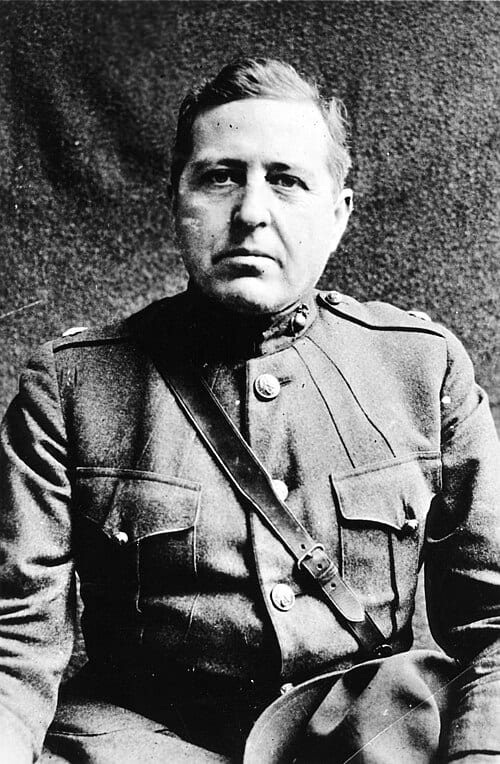
Brigadier General, U.S. Marine Corps
Support & adopt this hero ↓
A 200-foot cliff. Hidden traps. Enemy guns waiting above. In the jungles of the Philippines, one Marine captain led his men against a seemingly impregnable fortress. His name was Hiram Iddings Bearss, and his extraordinary courage would earn him the Medal of Honor and a lasting place in United States Marine Corps history.
Born on April 13, 1875, in Peru, Indiana, Bearss entered the Marine Corps during the Spanish-American War in 1898. Returning to the service in 1899, he deployed to the Philippines, where his long-distance reconnaissance patrols earned him the nickname "Hiking Hiram."
On November 17, 1901, near the junction of the Cadacan and Sohoton Rivers on Samar, Captain Bearss led an assault against heavily fortified positions. His Marines climbed approximately 200-foot volcanic cliffs using bamboo ladders, overcame concealed traps and defensive obstacles, captured enemy weapons, and destroyed fortified camps. His official Medal of Honor citation recognized his extraordinary heroism, exceptional leadership and additional distinguished service at the Quinapundan River on January 19, 1902. President Franklin D. Roosevelt presented Bearss with the Medal of Honor on April 5, 1934.
Bearss's military career continued through expeditions and assignments in Panama, Cuba, Mexico and the Dominican Republic. During the occupation of Veracruz in 1914 and the Dominican Campaign of 1916–1917, he demonstrated the same demanding style of leadership that had made him famous in the Philippines.
When the United States entered World War I, Bearss went to France with the American Expeditionary Forces. He served with Marine and Army formations, including the 6th Marines during the Battle of Belleau Wood, before assuming command of the 102nd Infantry Regiment of the 26th Division.
In September 1918, Bearss led his regiment during the Saint-Mihiel Offensive, helping secure the advance through Vigneulles. On September 26, during the fighting at Marcheville and Riaville, he displayed exceptional courage under intense machine-gun and artillery fire. Entering Marcheville ahead of his troops, he directed the battle and personally fought his way out when surrounded. His Distinguished Service Cross citation, published in War Department General Orders No. 143 of 1918, honored his extraordinary heroism in this action.
His leadership throughout the campaign earned both the Army Distinguished Service Medal, documented in General Orders No. 89 of 1919, and the Navy Distinguished Service Medal. Their citations recognized his effective command, tireless energy, determination and distinguished wartime service.
France, Belgium and Italy also recognized Bearss's military achievements through decorations that included the Légion d'honneur, French and Belgian Croix de Guerre, and Italian War Merit Cross.
Retired as a colonel in November 1919, Bearss was advanced to brigadier general on the retired list in January 1936. He died in an automobile accident in August 1938. The United States Navy later honored his memory by naming the destroyer USS Bearss (DD-654) after him.
From the fortified cliffs of Samar to the battlefields of France, Hiram Iddings Bearss built a career defined by courage, determination and exceptional battlefield leadership. His legacy demonstrates that a commander's greatness is measured not simply by rank, but by the willingness to lead when the danger is greatest.
Official Medal of Honor citation
For extraordinary heroism and eminent and conspicuous conduct in battle at the junction of the Cadacan and Sohoton Rivers, Samar, Philippine Islands, 17 November 1901. Col. Bearss (then Capt.), second in command of the columns upon their uniting ashore in the Sohoton River region, made a surprise attack on the fortified cliffs and completely routed the enemy, killing 30 and capturing and destroying the powder magazine, 40 lantacas (guns), rice, food and cuartels. Due to his courage, intelligence, discrimination, and zeal, he successfully led his men up the cliffs by means of bamboo ladders to a height of 200 feet. The cliffs were of soft stone of volcanic origin, in the nature of pumice, and were honeycombed with caves. Tons of rocks were suspended in platforms held in position by vine cables (known as bejuco) in readiness to be precipitated upon people below. After driving the insurgents from their position, which was almost impregnable, being covered with numerous trails lined with poison spears, pits, etc., he led his men across the river, scaled the cliffs on the opposite side, and destroyed the camps there. Col. Bearss and the men under his command overcame incredible difficulties and dangers in destroying positions which, according to reports from old prisoners, had taken three years to perfect, were held as a final rallying point, and were never before penetrated by white troops. Col. Bearss also rendered distinguished public service in the presence of the enemy at Quinapundan River, Samar, Philipine Islands, on 19 January 1902.
Become the named supporter for this profile and edit the tribute biography and portrait (Owner account required). Proceeds help keep the archive online.
$25 USD / year — annual sponsorship renewal. Keeps the page online and, where enabled, the family anniversary remembrance emails active.