★
Loading archive…
Loading archive…
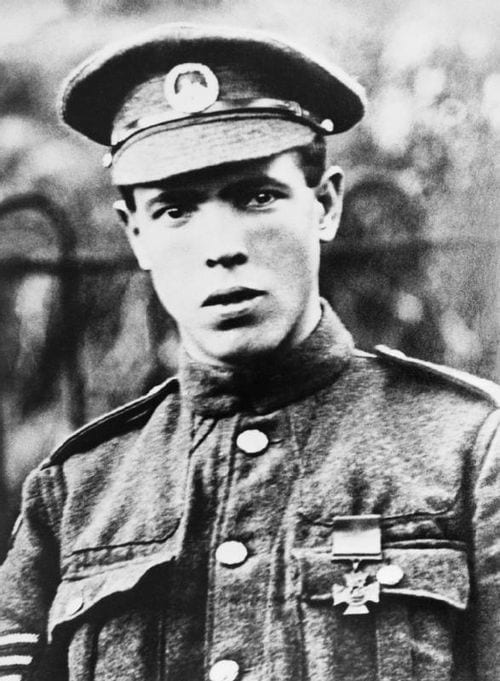
He rushed a machine gun and overcame both crew and position.
Ivor Rees was born at Felinfoel near Llanelli on 18 October 1893. He grew up in an industrial community and worked at the local steelworks before enlisting in the South Wales Borderers in November 1914. His battalion joined the 38th Welsh Division, and he advanced through the noncommissioned ranks during the war.
He survived the division's fighting at Mametz Wood in 1916. Illness brought a period in hospital early in 1917, but he returned to the battalion before the opening attack of the Third Battle of Ypres. By then he was a sergeant in the 11th Battalion and responsible for leading men through heavily defended ground.
On 31 July 1917 at Pilckem, a machine gun opened fire at close range and caused severe casualties. Rees moved his platoon toward its flank in short advances, gradually reaching the rear of the position. From about twenty yards he charged the gun, shooting one member of its crew and bayoneting the other. He then attacked a concrete emplacement with grenades, overcoming its defenders and taking thirty prisoners, including two officers. The machine gun was captured intact.
King George V presented his Victoria Cross in September. Rees later became a company sergeant major and served as an instructor before leaving the wartime Army in 1919. He also spent a further period with the Territorial Force.
He married Martha Jenkins in 1917 and raised a family. His postwar life included steelworks employment, barbering and unemployment before he obtained work with Llanelli Borough Council. He served as a water inspector and cleansing superintendent. A conviction for common assault in 1921 resulted in imprisonment.
During the Second World War he returned to local military service as a Home Guard company sergeant major. He retired from council employment in 1959 and died at Llanelli in March 1967. His ashes were scattered at Swansea, and his regiment acquired his surviving medals for its museum at Brecon.
Official Victoria Cross citation
For most conspicuous bravery in attack. A hostile machine gun opened fire at close range, inflicting many casualties. Leading his platoon forward by short rushes, Sjt. Rees gradually worked his way round the right flank to the rear of the gun position. When he was about twenty yards from the machine gun he rushed forward towards the team, shot one, and bayonetted another. He then bombed the large concrete emplacement, killing five and capturing thirty prisoners, of whom two were officers, in addition to an undamaged gun.
Second Supplement to The London Gazette of 14 September 1917. 14 September 1917, Numb. 30284, pp. 9532-33
Become the named supporter for this profile and edit the tribute biography and portrait (Owner account required). Proceeds help keep the archive online.
$25 USD / year — annual sponsorship renewal. Keeps the page online and, where enabled, the family anniversary remembrance emails active.