★
Loading archive…
Loading archive…
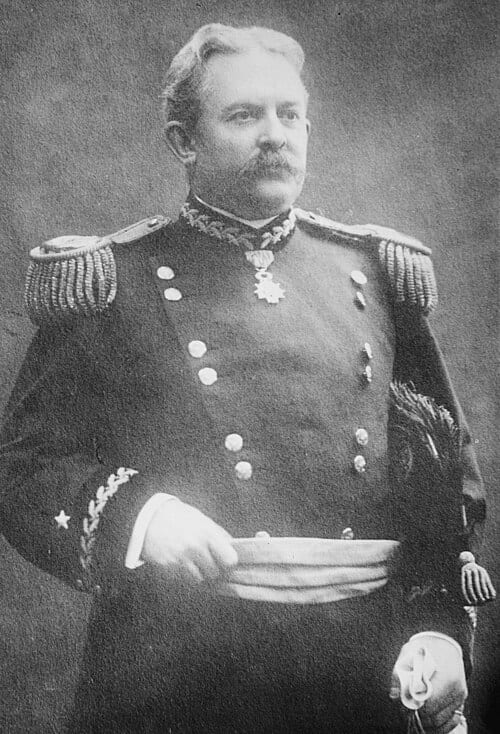
Major General, U.S. Army
Support & adopt this hero ↓
What kind of courage drives a soldier to charge seven armed enemies with nothing but a pistol? For Major General James Franklin Bell, that extraordinary moment on a Philippine battlefield would earn America's highest military decoration. Yet his story extended far beyond a single act of bravery. From dangerous reconnaissance missions to the highest levels of United States Army leadership, Bell became one of the most influential American soldiers of his generation.
Born on January 9, 1856, near Shelbyville, Kentucky, James Franklin Bell graduated from the United States Military Academy at West Point in 1878. He began his career on the American frontier, serving with the 7th Cavalry and participating in the Sioux Campaign of 1890–1891. His early service developed the determination and tactical judgment that would later define his military career.
Bell first distinguished himself during the Spanish-American War. On August 10, 1898, while serving as a major and engineer officer near Manila, he undertook a dangerous reconnaissance of Spanish defenses at Fort San Antonio de Abad. Disregarding his personal safety, he examined a creek to establish its depth and width, then swam into Manila Bay to observe enemy positions from behind. His discoveries helped American commanders plan the successful assault on Manila on August 13. For this extraordinary heroism, Bell was posthumously awarded the Distinguished Service Cross under War Department General Orders No. 3 of 1925.
But an even more remarkable test awaited him.
On September 9, 1899, near Porac, Luzon, during the Philippine-American War, Colonel Bell advanced ahead of his 36th U.S. Volunteer Infantry Regiment and encountered seven armed Filipino insurgents. Without waiting for reinforcements, he charged forward with his pistol, compelling an enemy captain and two soldiers to surrender while the remaining opponents fired from concealment in a bamboo thicket. His extraordinary gallantry earned him the Medal of Honor, issued on December 11, 1899.
Bell's reputation as a determined combat commander grew during subsequent operations in the Philippines. He directed American forces against Filipino resistance, including the campaign that ended with General Miguel Malvar's surrender in 1902. His methods, however, remain controversial. His counterinsurgency policies in Batangas and Laguna involved the forced relocation of civilians into controlled zones, causing widespread suffering and leaving a difficult chapter in his military legacy.
Bell later turned his attention to transforming the Army itself. As commandant of the Army schools at Fort Leavenworth, he strengthened professional military education. Appointed the fourth Chief of Staff of the United States Army in 1906, he championed reforms in military organization, training, pay and reserve forces. France also conferred upon him the rank of Commander of the Legion of Honour, although his authorization to accept and wear the foreign decoration remains uncertain.
When the United States entered World War I, Bell was again entrusted with major responsibilities. He commanded the newly organized 77th Division at Camp Upton, undertook duty with the American Expeditionary Forces in France, and later commanded the Eastern Department. His leadership earned the Army Distinguished Service Medal, awarded posthumously under War Department General Orders No. 73 of 1919, which recognized his exceptionally meritorious and distinguished service as a division, cantonment and department commander.
Major General J. Franklin Bell died in New York on January 8, 1919, just one day before his 63rd birthday. He was buried at Arlington National Cemetery.
From a pistol charge under enemy fire to shaping the future of the United States Army, Bell's career reflected both extraordinary personal courage and far-reaching military influence. His Medal of Honor, Distinguished Service Cross and Army Distinguished Service Medal preserve the record of his recognized achievements, while the controversies of his Philippine campaigns remind us that military history demands examination of both heroism and its human consequences.
Become the named supporter for this profile and edit the tribute biography and portrait (Owner account required). Proceeds help keep the archive online.
$25 USD / year — annual sponsorship renewal. Keeps the page online and, where enabled, the family anniversary remembrance emails active.