★
Loading archive…
Loading archive…
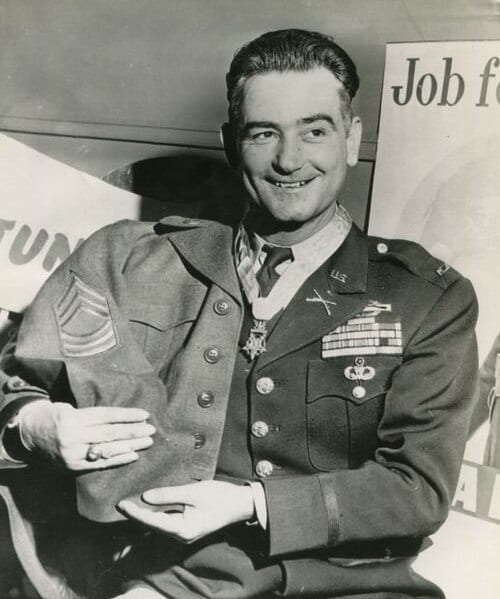
Six men remained. Five German tanks were advancing. And one American soldier refused to surrender the ground his platoon had fought so hard to capture. On November 16, 1944, near Hamich, Germany, Technical Sergeant Jake William Lindsey Sr. faced overwhelming enemy forces in one of World War II's extraordinary acts of battlefield courage. His actions would earn him the Medal of Honor, the United States' highest military decoration, and a lasting place in American military history.
Born on May 1, 1921, in Isney, Alabama, Lindsey entered the United States Army in 1940. Serving with Company C, 16th Infantry Regiment, 1st Infantry Division, the legendary Big Red One, he fought through campaigns in North Africa, Sicily, Normandy and Western Europe. His wartime service included the Silver Star, listed in 1st Infantry Division General Orders No. 51 of 1943, the Bronze Star Medal and the Purple Heart. Yet his most famous moment was still to come.
After days of brutal fighting in the Hürtgen Forest, Lindsey's platoon had been reduced from forty soldiers to just six. Having captured an enemy position, the survivors were preparing their defenses when a German infantry company supported by five tanks launched a powerful counterattack.
Rather than seek shelter, Lindsey positioned himself ahead of his remaining men. Armed with a rifle and grenades, he repeatedly repelled enemy advances, forced German tanks to withdraw and knocked out two machine-gun positions. Even after being painfully wounded, he continued fighting until his ammunition was exhausted.
When eight German soldiers attempted to establish another machine gun nearby, Lindsey charged them alone. In desperate hand-to-hand combat, he killed three with his bayonet, captured three and forced the remaining two to flee. His official Medal of Honor citation recognized his extraordinary gallantry, inspiring courage and determined leadership in securing his platoon's hard-won position against a numerically superior enemy.
On May 21, 1945, President Harry S. Truman personally presented Lindsey with the Medal of Honor before a joint session of the United States Congress. He became the 100th American infantryman recognized with the decoration during World War II. Truman praised the courage that had carried Lindsey beyond the ordinary demands of military duty, describing it as the very essence of victory.
But Germany was not Lindsey's last battlefield. He later volunteered for combat service during the Korean War, where accounts recorded in the Congressional Record celebrated his determination in another desperate defensive action. His service across two wars brought further campaign recognition, including eight European–African–Middle Eastern campaign credits and four Korean Service Medal campaign stars. He attained the rank of second lieutenant before later returning to enlisted service and completing his Army career in 1963.
Known as the "One-Man Army," Lindsey represented extraordinary determination under fire. His legacy was not defined simply by enemy positions captured or decorations received, but by the leadership he demonstrated when other lives depended upon his courage.
Jake William Lindsey Sr. died on July 18, 1988, in Waynesboro, Mississippi, aged 67. He was buried in White House Cemetery. His story remains a powerful example of American infantry valor, a soldier whose courage in World War II and Korea continued long after the moment that made him a Medal of Honor recipient.
Official Medal of Honor citation
For gallantry and intrepidity in action at the risk of his life above and beyond the call of duty. Technical Sergeant Jake W. Lindsey led a platoon, reduced to six of its original strength of forty, in the attack on an enemy position near Hamich, Germany, 16 November 1944. His men had captured their objective and were digging in when counterattacked by a German infantry company and five tanks. Armed with a rifle and grenades, TSgt. Lindsey took position on the left and in advance of the remnant of his platoon, and though exposed to heavy rifle, machine-gun and tank fire, beat off repeated enemy attacks. Tanks moved to within 50 yards of him but were forced to withdraw because of his accurate rifle and grenade fire. After driving off the tanks, he knocked out two machine guns to his front. Though painfully wounded, TSgt. Lindsey continued firing and throwing grenades until his ammunition was expended. An enemy squad attempted to set up a machine gun 50 yards from him. Unmindful of his wounds and enemy fire, he rushed these eight German soldiers, singlehandedly closed with them, killed three with his bayonet, and captured three, the two others escaping. In his fearlessness, inspiring courage and superb leadership, TSgt. Lindsey carried on a brilliant defense of his platoon's hard-won ground, securing the position and inflicting heavy casualties on the numerically superior enemy.
Become the named supporter for this profile and edit the tribute biography and portrait (Owner account required). Proceeds help keep the archive online.
$25 USD / year — annual sponsorship renewal. Keeps the page online and, where enabled, the family anniversary remembrance emails active.