★
Loading archive…
Loading archive…

He ran through heavy fire to bring the wagons out of danger.
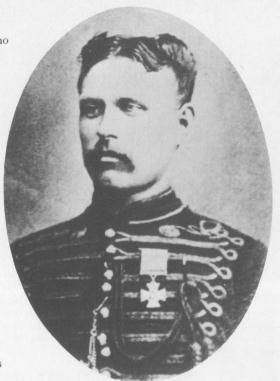
James Collis was born at Cambridge in 1856 and worked with horses before entering the Army in 1872. He transferred to the Royal Horse Artillery in 1877 and served in Afghanistan during the Second Anglo-Afghan War.
The British and Indian force suffered a disastrous defeat at Maiwand on 27 July 1880. During the retreat the following day, Collis helped the artillery train escape. When the gun teams were threatened by fire from nearby positions, he drew the enemy’s attention to himself so that the wagons could move away. His conduct enabled the wounded and transport to continue toward Kandahar and brought him the Victoria Cross.
Collis subsequently entered the reserve and worked as an inspector in the Bombay police. After returning to military service in 1887, he served with the Suffolk Regiment and then the Royal Artillery. Illness brought his discharge in 1891, followed by periods in hospital.
His later life was troubled. Convicted of bigamy in 1895, he received a prison sentence and his Victoria Cross was formally forfeited. After release he undertook a succession of civilian jobs, including work as a carman and drill instructor. His experiences illustrate how a conspicuous decoration did not ensure financial security or a settled life after service.
Despite his age, Collis enlisted again after the outbreak of the First World War and worked as a drill instructor with the Suffolk Regiment. He was medically discharged in August 1917 and found employment as a gatekeeper with the General Omnibus Company at Battersea. He also served as a special constable. He died on 28 June 1918.
His gallantry remained part of the history of Maiwand, although the forfeiture was never formally reversed.
Victoria Cross citation
For conspicuous bravery during the retreat from Maiwand to Kandahar, on the 28th July, 1880, when the Officer commanding the battery was endeavouring to bring on a limber, with wounded men, under a cross fire, in running forward and drawing the enemy’s fire on himself, thus taking off their attention from the limber.
The London Gazette of 17 May 1881, Numb. 24973, p. 2553
Become the named supporter for this profile and edit the tribute biography and portrait (Owner account required). Proceeds help keep the archive online.
$25 USD / year — annual sponsorship renewal. Keeps the page online and, where enabled, the family anniversary remembrance emails active.