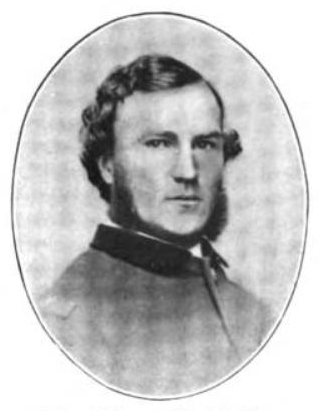
★
Loading archive…
Loading archive…
James G. Grindlay was born on February 14, 1840, in Scotland. He later came to the United States and became associated with Oneida County, New York. When the American Civil War created an enormous demand for volunteer soldiers, Grindlay entered Union service and began the military career that would eventually take him from company-level command to the leadership of an infantry regiment and, for distinguished wartime service, to the brevet rank of Brigadier General.
Grindlay joined the 146th New York Infantry, a regiment organized in Rome, New York, and mustered into Federal service in October 1862. The regiment was also known as the Fifth Oneida and later became famous among its soldiers as the Garrard Tigers.
He entered the regiment as an officer and served initially with Company D. The 146th New York became part of the Army of the Potomac and was eventually assigned to the Fifth Corps, an organization that participated in some of the hardest fighting of the Civil War.
The regiment's early service exposed Grindlay to the demanding conditions of active campaigning in Virginia. Its soldiers performed long marches, guarded strategic positions, endured difficult weather and camp conditions, and prepared for the large-scale battles that increasingly defined the Eastern Theater.
In 1863, the 146th New York participated in the Gettysburg Campaign. The regiment served with the Fifth Corps as Union forces moved north to confront General Robert E. Lee's invasion of Pennsylvania.
During the Battle of Gettysburg, the 146th New York fought in the critical southern portion of the battlefield around Little Round Top. The regiment operated in a sector where Union forces were attempting to protect the Army of the Potomac's vulnerable left flank.
The experience at Gettysburg formed part of the regiment's developing combat reputation, but even more severe fighting awaited Grindlay and his men during the following year.
In the spring of 1864, Lieutenant General Ulysses S. Grant began the Overland Campaign against Lee's Army of Northern Virginia.
The campaign opened with the Battle of the Wilderness in early May.
The Wilderness was fought in dense woodland and tangled undergrowth where visibility was extremely limited. Traditional battlefield formations were difficult to maintain, units frequently became separated or confused, and fires added another danger to the already violent fighting.
The 146th New York entered the Wilderness with approximately six hundred men available for combat.
The regiment suffered devastating losses.
Nearly four hundred of its soldiers were killed, wounded, or captured during the battle.
Among the officers lost were the regiment's commanding officers. Colonel David T. Jenkins was killed, and Lieutenant Colonel Henry H. Curran also fell.
The sudden loss of the regiment's senior leadership placed enormous responsibility on James G. Grindlay.
With the commanders above him gone, Grindlay assumed command of the surviving soldiers of the 146th New York.
The regiment had been badly damaged, but the campaign did not stop. Grant continued moving southward, forcing the Army of the Potomac into another major confrontation at Spotsylvania Court House.
Grindlay therefore had little opportunity to recover from the losses suffered in the Wilderness before leading the regiment back into combat.
At Spotsylvania, Union and Confederate troops fought around a complicated system of earthworks. The battle involved repeated infantry assaults, prolonged rifle fire, artillery, and some of the most intense close-range fighting of the entire war.
Grindlay continued commanding the 146th New York through these operations.
His responsibilities grew as the campaign progressed. He was promoted within the regiment and continued directing its soldiers through the battles of North Anna, Totopotomoy Creek, and Cold Harbor.
By this stage of the war, Grindlay had advanced from company command to responsibility for an entire infantry regiment.
The Overland Campaign eventually carried the armies toward Petersburg, Virginia.
Rather than continuing direct attacks against Richmond, Grant moved across the James River and attempted to capture Petersburg, an important railroad and supply center whose transportation network supported both Richmond and Lee's army.
The failure to take Petersburg immediately resulted in a prolonged campaign around the city.
Grindlay and the 146th New York participated in this new phase of the war.
The regiment served through operations associated with Petersburg and fought in engagements as Union forces steadily extended their lines westward in an effort to cut Confederate roads and railroads.
The 146th New York became a trusted regiment within the Fifth Corps. Years later, Grindlay himself recorded the pride that its officers and soldiers took in their battlefield performance and the confidence placed in the regiment by its commanders.
By early 1865, Grindlay's military rank continued to rise.
He received promotion to Lieutenant Colonel and then Colonel of the 146th New York Infantry.
On March 13, 1865, he also received the brevet rank of Brigadier General of U.S. Volunteers in recognition of gallant and meritorious wartime service.
Brevet Brigadier General therefore became the highest verified rank associated with his military career, while Colonel was his substantive rank at the time of the action that earned him the Medal of Honor.
The final campaign against Lee's army began only weeks later.
By the end of March 1865, Grant's armies were attempting to sever the remaining roads and railways west of Petersburg. Sheridan's cavalry operated aggressively on the Union left, and the Fifth Corps was sent to cooperate with his forces.
The struggle culminated at Five Forks, Virginia, on April 1, 1865.
Five Forks was strategically important because the crossroads helped protect Confederate transportation routes and the remaining line of retreat from Petersburg.
Confederate troops established defensive works across the area and prepared to resist the Union advance.
The Fifth Corps was ordered to attack the Confederate left flank while Sheridan's cavalry applied pressure from the front.
Grindlay's 146th New York Infantry was positioned in the leading line of the Union infantry advance.
The men had already endured exhausting marching and previous combat, but they moved forward against the entrenched Confederate position.
As the attack developed, Union infantry swept into the Confederate defenses.
Colonel James G. Grindlay personally advanced at the front of the assault.
He became the first soldier to enter the enemy's works.
Once inside the Confederate position, Grindlay captured two enemy battle flags.
The achievement was extraordinary both tactically and symbolically.
During the Civil War, regimental battle flags were among the most important objects on a battlefield. Soldiers used them as visible points around which formations could advance, rally, and reorganize amid smoke, noise, and confusion.
The colors also embodied the identity and honor of the regiment carrying them.
For this reason, flags were protected by dedicated color bearers and color guards. The men around the colors often suffered exceptionally high casualties because the flags were conspicuous targets.
Capturing an enemy battle flag normally required a soldier to reach the opposing formation at extremely close range, often penetrating the enemy's defensive line and confronting the soldiers assigned to protect the colors.
At Five Forks, Grindlay did precisely that.
He entered the Confederate works ahead of his men and captured two flags.
The 146th New York played a prominent role in the victory. The regiment advanced with the attacking line, helped break the Confederate defenses, and took prisoners as the position collapsed.
The wider battle became one of the decisive Union victories of the final days of the Civil War.
The defeat at Five Forks threatened the last important Confederate supply routes into Petersburg.
The following day, April 2, Grant launched a general assault against the Petersburg defenses.
Lee's lines broke, forcing the evacuation of both Petersburg and Richmond.
The Army of Northern Virginia retreated westward, beginning the final Appomattox Campaign.
Union forces pursued relentlessly.
Only eight days after Grindlay's action at Five Forks, General Robert E. Lee surrendered the Army of Northern Virginia to Lieutenant General Ulysses S. Grant at Appomattox Court House on April 9, 1865.
Grindlay had therefore performed the action that would define his national military recognition at one of the critical turning points immediately preceding the collapse of Lee's army.
The 146th New York remained in Federal service after the surrender.
Its soldiers continued carrying out military duties while the Union Army began the enormous process of ending wartime operations and sending volunteer regiments home.
The regiment was finally mustered out of service in Washington, D.C., on July 16, 1865.
By then James G. Grindlay had completed a remarkable progression.
He had entered the regiment as a company officer, assumed command after devastating losses in the Wilderness, led the unit through the Overland and Petersburg campaigns, risen to Colonel, received the brevet rank of Brigadier General, and personally led his soldiers during the final operations against the Army of Northern Virginia.
His courage at Five Forks did not immediately result in the nation's highest military decoration.
More than twenty-six years passed before the action received formal recognition.
On August 14, 1891, James G. Grindlay was awarded the Medal of Honor.
His official citation was concise but exceptionally clear: he was the first to enter the enemy's works at Five Forks, where he captured two flags.
The Medal of Honor had originated during the Civil War. Congress authorized the Army Medal of Honor in 1862, creating a national decoration for military conduct distinguished by exceptional courage and service.
At the time of the Civil War, the United States did not yet possess the extensive system of separate valor decorations that developed during later conflicts. The Medal of Honor therefore became the principal national recognition for extraordinary battlefield conduct.
Grindlay performed his Medal of Honor action in 1865 but received the decoration in 1891.
For the project database, the historically appropriate representation is Medal of Honor 1862–1895 Army — 1891.
No clasp, star, bar, oak leaf cluster, or other additional device has been verified with James G. Grindlay's Medal of Honor. His verified decoration therefore consists of one Medal of Honor without additional devices.
The long delay between Five Forks and the presentation of the Medal reflected a pattern seen among many Civil War recipients. Acts that had occurred during the confusion of wartime were sometimes reviewed and formally recognized years or even decades later as veterans, commanders, and official records preserved the circumstances of individual battlefield achievements.
For Grindlay, the 1891 award permanently connected his name with the breakthrough at Five Forks.
He continued to take an active interest in the history of the men he had commanded.
His relationship with the 146th New York did not end when the regiment was mustered out.
Decades after the war, Grindlay prepared a historical account of the regiment for New York's official commemoration of its Civil War service. His historical sketch described the organization of the 146th, its commanders, the devastating losses of the Wilderness, its later campaigns, and the pride its veterans retained in their unit.
The account is especially significant because it preserved the regiment's history through the words of the officer who had personally assumed command during one of its darkest moments and led it through the remainder of the war.
Grindlay wrote of the confidence placed in the 146th New York by its commanders and recorded the regiment's role in the final campaign.
He also preserved the memory of the men who had served before him and those who had been killed or wounded in the battles through which the regiment passed.
In this way, his postwar legacy extended beyond his own Medal of Honor.
He became one of the veterans responsible for preserving the institutional memory of the 146th New York Infantry for later generations.
Grindlay lived for more than four decades after the end of the Civil War.
He witnessed the transformation of the conflict from personal experience into national history, as battlefields were marked, monuments erected, veterans' organizations formed, and official state histories compiled.
His own life connected those two eras.
In 1865 he had stood inside the Confederate works at Five Forks during the violent final campaign of the war.
By the beginning of the twentieth century, he was helping ensure that the history of his regiment and the sacrifices of its soldiers would not disappear with the passing of the veteran generation.
James G. Grindlay died on October 19, 1907, in Troy, New York. He was sixty-seven years old.
He was buried at Forest Hill Cemetery in Utica, New York, the region closely associated with his Civil War service.
His military career had taken him from the command of a company to the leadership of one of New York's experienced infantry regiments.
He had assumed command during the catastrophic Battle of the Wilderness after the loss of the regiment's senior officers, continued leading it through Spotsylvania, North Anna, Cold Harbor, Petersburg, and the final campaign, and ultimately reached the rank of Colonel with the higher brevet rank of Brigadier General.
Yet the defining individual act of his military career occurred on April 1, 1865.
At Five Forks, Colonel James G. Grindlay advanced at the head of the Union assault, became the first soldier to enter the Confederate works, and captured two enemy battle flags.
That action took place only days before the fall of Petersburg and Richmond and eight days before Lee's surrender at Appomattox Court House.
Twenty-six years later, the United States formally recognized his courage by awarding him the Medal of Honor on August 14, 1891.
Medal of Honor 1862–1895 Army — 1891 remains James G. Grindlay's verified military decoration and the defining official recognition of his courage and leadership during the Battle of Five Forks.
Become the named supporter for this profile and edit the tribute biography and portrait (Owner account required). Proceeds help keep the archive online.
$25 USD / year — annual sponsorship renewal. Keeps the page online and, where enabled, the family anniversary remembrance emails active.