★
Loading archive…
Loading archive…
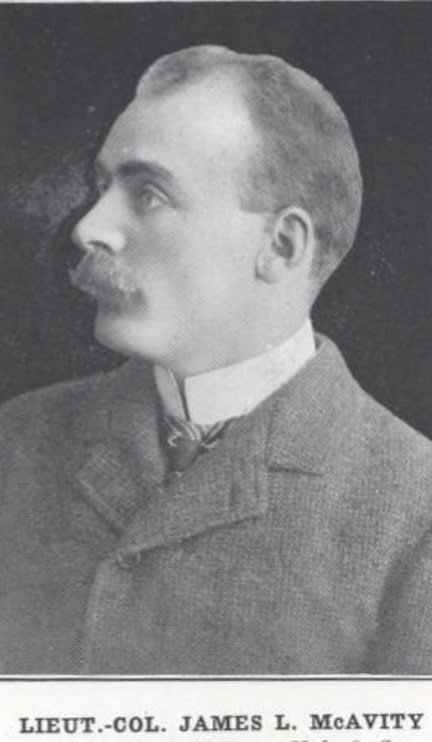
Lt Colonel, Canadian Army
Support & adopt this hero ↓
Founder of New Brunswick’s Fighting 26th Battalion
Before the 26th Battalion became known as New Brunswick’s “Fighting 26th,” Lieutenant-Colonel James Lupton McAvity had to recruit, organize and lead it overseas. A prominent Saint John manufacturer and experienced militia officer, McAvity commanded the battalion from its formation in Canada through its first months of service on the Western Front during the First World War.
James Lupton McAvity was born in Saint John, New Brunswick, on 8 October 1867. He entered the family manufacturing business, T. McAvity & Sons, during the 1880s and worked as a company manager and representative. The firm became one of Canada’s leading producers of valves, plumbing equipment and municipal waterworks products. Its first fire hydrants were manufactured in 1903 and were installed in communities across Canada, helping make the McAvity name familiar throughout the country.
McAvity also developed a lengthy career in the Canadian Militia. As commanding officer of the 62nd St. John Fusiliers, he was selected to organize the 26th Battalion of the Canadian Expeditionary Force. Official Library and Archives Canada records state that the battalion was organized in November 1914 under his command, mobilized at Saint John and recruited throughout New Brunswick. On 15 June 1915, McAvity sailed from Halifax aboard the Caledonia with 42 officers and 1,008 other ranks. The battalion reached England one week later and entered France on 15 September 1915 as part of the 5th Canadian Infantry Brigade, 2nd Canadian Division.
McAvity commanded the 26th during its introduction to trench warfare and its early operations on the Western Front, including the difficult fighting around St. Eloi in the spring of 1916. By that time, his health had deteriorated. Contemporary evidence describes gastritis, insomnia, tremors and other nervous symptoms. His removal was also part of a wider reorganization following St. Eloi, when several Canadian battalion commanders were judged by higher command to be too old for continued field command. Major Archibald Ernest Graham McKenzie succeeded him on 29 May 1916, and McAvity returned to Canada later that year.
His documented service in France during 1915 met the official eligibility conditions for the 1914–1915 Star, while his overseas and theatre service also supported the British War Medal and Victory Medal. These three ribbons form the First World War campaign group reconstructed for his profile. His personal medal card has not yet been examined for any notation concerning issue, return, forfeiture or restoration following his later dismissal from the service.
After returning to Canada, McAvity eventually commanded the 1st New Brunswick Depot Battalion at Camp Sussex. In 1919, he and several other officers were arrested and tried in connection with shortages and alleged fraud involving battalion canteen funds. McAvity denied knowing about the fraud and testified that he had repaid the shortage because he felt responsible. Senior officers, including Major-General Archibald Macdonell, gave evidence concerning his character. Nevertheless, the court convicted McAvity and sentenced him to be cashiered on 10 June 1919, ending his military career in disgrace.
The court martial cast a permanent shadow over his final years of service, but it did not erase his central role in creating the 26th Battalion. He had transformed a wartime recruiting effort into a field battalion of more than 1,000 officers and men and had taken it from Saint John to the trenches of France. The battalion continued fighting after his departure and eventually returned to Canada in May 1919 with an extensive combat record.
The wider McAvity enterprise also made a substantial contribution to Canada’s war effort. The company devoted much of its manufacturing capacity to munitions production. Five members of the McAvity family served in France, while company history records that 159 employees joined combatant units overseas and that 26 did not return. Many of those employees served with the 26th Battalion that James McAvity had helped raise.
James Lupton McAvity died in Saint John on 1 November 1932 at the age of 65. His legacy remains complex. He was a successful manufacturer, a senior Canadian militia officer, the founding commander of New Brunswick’s Fighting 26th Battalion and, ultimately, the central figure in a damaging postwar court martial. His life reflects both the achievements and the personal consequences of military command during one of the most demanding periods in Canadian history.
Become the named supporter for this profile and edit the tribute biography and portrait (Owner account required). Proceeds help keep the archive online.
$25 USD / year — annual sponsorship renewal. Keeps the page online and, where enabled, the family anniversary remembrance emails active.