★
Loading archive…
Loading archive…

He Crossed the Fire to Save a Wounded Comrade
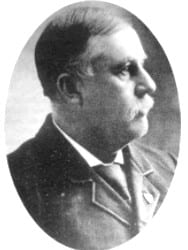
James May Rutter was born on May 13, 1841, in Wilkes-Barre, Pennsylvania. When the American Civil War placed the Union under enormous strain, he entered military service and became a soldier in Company C of the 143rd Pennsylvania Infantry. His hometown would also become closely connected with the regiment, which was organized at Wilkes-Barre in October 1862 before departing Pennsylvania for service with the Union Army.
The 143rd Pennsylvania initially served in the defenses of Washington before joining the Army of the Potomac in early 1863. By that spring, the regiment had entered active campaigning and participated in the Chancellorsville Campaign. Rutter served as a sergeant, a noncommissioned rank that carried responsibility for maintaining order and helping lead enlisted soldiers in camp, on the march, and in battle.
Only a few months later, the regiment moved north during the Gettysburg Campaign. It served in the Second Brigade of the Third Division, First Army Corps, alongside the 149th and 150th Pennsylvania Infantry. The brigade was associated with Pennsylvania’s “Bucktail” tradition and entered the Battle of Gettysburg on July 1, 1863, as Union forces struggled to contain the Confederate advance west and north of the town.
The fighting on the first day was severe. The 143rd Pennsylvania reached the battlefield west of Gettysburg and fought in the area of the Chambersburg Pike and McPherson farm. Union soldiers there faced Confederate forces advancing from more than one direction while artillery fire swept portions of their position. It was in this violent setting that Sergeant Rutter performed the action that would eventually bring him the Medal of Honor.
During the fighting, one of his comrades was wounded and left exposed under enemy fire.
Rutter went to him.
His later Medal of Honor citation recorded the act in straightforward language: at great risk to his own life, he went to the assistance of the wounded soldier and, while still under fire, removed him to a place of safety.
The citation does not identify the wounded man or supply dramatic details beyond what could be firmly documented. What it does establish is clear. Rutter deliberately exposed himself to battlefield fire in order to help another soldier who could not safely escape on his own.
The act took place during one of the most difficult moments of the Battle of Gettysburg. On July 1, Union First Corps formations west of town were heavily engaged and eventually forced to withdraw as Confederate pressure increased. In that environment, stopping to assist a wounded comrade carried an obvious risk. Rutter nevertheless chose to leave relative safety, reach the injured soldier, and bring him away from immediate danger.
His courage was not recognized immediately with the nation’s highest military decoration. Like many Civil War Medal of Honor recipients, Rutter waited decades before his wartime action received formal national recognition.
On October 30, 1896, more than thirty-three years after the Battle of Gettysburg, James May Rutter was presented with the Medal of Honor. The award formally recognized the decision he had made as a young sergeant on July 1, 1863—risking his life under fire to save another Union soldier.
The Medal of Honor had been created during the Civil War and became the United States’ highest decoration for military valor. In Rutter’s case, the award was not connected with capturing an enemy flag, taking a fortified position, or leading an assault. His distinction came from an act of battlefield rescue. His citation preserved a moment in which responsibility for a wounded comrade outweighed concern for his own safety.
Rutter’s service also places him within the wider history commemorated by the Army Civil War Campaign Medal. Established by the War Department in 1907, the medal recognized qualifying Army service during the Civil War. For veterans such as Rutter, it represented participation in the immense national conflict in which Union soldiers served across campaigns that ultimately preserved the United States.
The Army Civil War Campaign Medal therefore reflects a different part of his military story from the Medal of Honor. The Medal of Honor recognized one extraordinary act of personal courage at Gettysburg. The campaign medal represented his qualifying service as a Union Army soldier during the Civil War. Together, they mark both the individual act for which he became famous and the broader wartime service of which that act formed a part.
Rutter lived for more than four decades after the battle. Gettysburg changed from a battlefield into one of the most important sites of national remembrance, while the veterans who had fought there became increasingly involved in preserving the memory of the Civil War generation.
He remained associated with Wilkes-Barre, the Pennsylvania community where he had been born and from which his regiment had been organized. James May Rutter died there on November 23, 1907, at the age of sixty-six. He was buried in Hollenback Cemetery in Wilkes-Barre.
His death came in the same year the Army Civil War Campaign Medal was established, more than forty years after the fighting that had defined his military legacy.
Today, Rutter is remembered primarily for a single decision made amid the chaos of Gettysburg. On July 1, 1863, while serving as a sergeant in Company C of the 143rd Pennsylvania Infantry, he saw a wounded comrade in danger and went to help him despite the enemy fire surrounding them.
More than three decades later, the Medal of Honor ensured that the act would become part of the permanent record of American military valor. James May Rutter’s story is a reminder that courage on a battlefield is not always measured by an advance against the enemy. Sometimes it is measured by the willingness to turn toward danger because another soldier cannot escape it alone.
Become the named supporter for this profile and edit the tribute biography and portrait (Owner account required). Proceeds help keep the archive online.
$25 USD / year — annual sponsorship renewal. Keeps the page online and, where enabled, the family anniversary remembrance emails active.