★
Loading archive…
Loading archive…

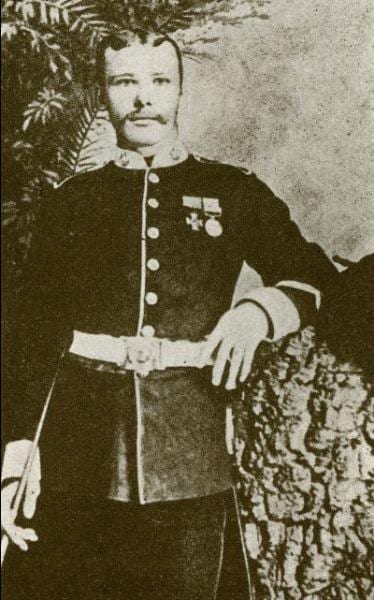
A wounded soldier lay exposed to the fire of 42 Boer marksmen. While others faced the danger from a distance, Private James Osborne rode straight into the enemy's line of fire to bring his comrade to safety. That extraordinary act of courage would earn him the Victoria Cross and secure his place in British military history.
James Osborne was born on 13 April 1857 in Wigginton, Hertfordshire, England. He served in the British Army with the 2nd Battalion, Northamptonshire Regiment, formerly the 58th Regiment of Foot. His military service took him to South Africa, where he participated in the Anglo-Zulu War of 1877–79 and subsequently the First Boer War. His campaign service in the Anglo-Zulu War is recognised by the South Africa Medal 1877–79 with the 1879 clasp.
Osborne's defining moment came on 22 February 1881 at Wesselstroom, South Africa. During an engagement with Boer forces, Private Mayes was wounded and left exposed to enemy fire. Osborne mounted his horse and rode towards a party of 42 Boers under heavy fire. Reaching Mayes, he lifted the wounded soldier and carried him safely back into camp, risking his own life to save a fellow soldier.
His extraordinary bravery was officially recognised in the London Gazette of 14 March 1882, Issue 25084. The citation praised his gallant conduct at Wesselstroom, specifically his courageous ride under heavy fire, the rescue of Private Mayes and his safe return to camp. For this remarkable act of selflessness, James Osborne was awarded the Victoria Cross, Britain's highest award for gallantry in the face of the enemy.
After leaving military service, Osborne returned to Wigginton and worked as a labourer on the Rothschild Estate for 26 years. A stroke in 1913 left him partially paralysed. He died on 1 February 1928 and was buried in the churchyard of St Bartholomew's Church, Wigginton.
His story carries a poignant final chapter. Following his death, his original Victoria Cross and South Africa Medal were entrusted to the Northamptonshire Regiment. Both were subsequently destroyed when the Ulster Bank in Belfast was damaged during an air raid on 4–5 May 1941. Although the original medals were lost, a replica group was later presented to his granddaughter in recognition of his service and sacrifice.
Today, James Osborne VC remains remembered not simply for the decoration he received, but for the courage, initiative and humanity he demonstrated when a fellow soldier's life depended on him. A commemorative stained-glass window installed at St Bartholomew's Church in 2019 continues to honour the Wigginton soldier whose remarkable act of bravery became part of the enduring legacy of the Victoria Cross.
Become the named supporter for this profile and edit the tribute biography and portrait (Owner account required). Proceeds help keep the archive online.
$25 USD / year — annual sponsorship renewal. Keeps the page online and, where enabled, the family anniversary remembrance emails active.