★
Loading archive…
Loading archive…
General, Indian Army
Support & adopt this hero ↓
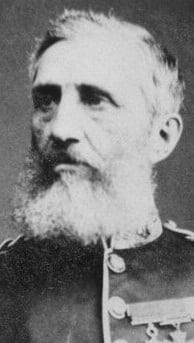
When the guns turned against the British Residency at Indore in July 1857, Colonel James Travers faced a decision that could have cost him his life. Rather than wait for the enemy to advance, he led a small group of men in a daring assault against a hostile artillery battery. His courage helped save those trapped in the Residency and earned him one of Britain's highest honours, the Victoria Cross. It was a defining moment in a military career shaped by decades of warfare, leadership and extraordinary personal bravery.
James Travers was born on 6 October 1820 in Cork, Ireland, into a military family. From an early age, he was prepared for a life of military service. He received his education at the East India Company's Military Seminary at Addiscombe, where he trained for an officer's career. In June 1838, he received his commission in the Bengal Army and arrived in India the following year, beginning a military career that would span more than four decades.
His early service brought him into the dangerous campaigns of the First Afghan War. Serving with the forces operating under General William Nott, Travers participated in the military operations around Kandahar, Ghazni and Kabul between 1840 and 1842. These campaigns tested the endurance and discipline of British Indian forces in some of the most challenging terrain of the region. Travers distinguished himself during these operations and was wounded at Babawali in 1841. His Afghan service earned him the Candahar, Ghuznee and Cabul Medal, recognising his participation in this important series of military operations.
The challenges of his military career did not end in Afghanistan. During the First Anglo-Sikh War of 1845–1846, Travers served with the Nasiri Gurkha Battalion and commanded it at the Battle of Sobraon on 10 February 1846. The battle was one of the decisive engagements of the Sutlej campaign, fought against the formidable forces of the Sikh Empire. His participation earned him the Sutlej Medal, marking another important chapter in his military service.
Travers continued to build his reputation as a capable officer and administrator. He became closely associated with the Bhopal Contingent, eventually rising to command the formation. His responsibilities extended beyond battlefield leadership, requiring him to maintain discipline, manage military operations and navigate the increasingly difficult political environment of central India.
Then came the crisis of 1857.
As the Indian Rebellion spread across northern and central India, British authority faced one of its most serious challenges. At Indore on 1 July 1857, troops serving with the Holkar's forces rose against the British Residency. The situation rapidly deteriorated, placing those inside the Residency in grave danger. Colonel Travers recognised the threat posed by a hostile artillery battery and understood that allowing the guns to remain in action could have devastating consequences.
He chose to act.
With only a small body of men, Travers charged the battery in a bold and dangerous attack. His action disrupted the enemy's position and helped create an opportunity for those at the Residency to escape. At a moment when hesitation could have proved disastrous, his determination and personal courage changed the course of events for those under threat.
For this conspicuous act of gallantry, James Travers was awarded the Victoria Cross. The decoration recognised his extraordinary bravery in confronting the hostile battery at Indore. His Victoria Cross citation became the defining recognition of a career already marked by service in Afghanistan and the Punjab frontier campaigns. General Sir Hugh Rose presented the decoration to him at Gwalior in June 1862.
His career continued long after the events of 1857. Travers held important military appointments in British India, including responsibilities associated with the Saugor district and the Meerut division. His professional advancement reflected the confidence placed in his experience and leadership. He was promoted to Major-General in 1865, Lieutenant-General in 1873 and General in 1877. In recognition of his distinguished service, he was appointed a Companion of the Order of the Bath in 1873.
After more than four decades of military service, Travers retired in 1881. He had served through the final years of East India Company military authority, the upheaval of the Indian Rebellion and the subsequent reorganisation of British rule in India. His career reflected the experiences of an entire generation of British Indian Army officers who witnessed some of the most consequential military and political changes of the nineteenth century.
James Travers died at Pallanza, on the shores of Lake Maggiore in Italy, on 1 April 1884, aged 63. Although his military career had ended several years earlier, his legacy remained closely connected to the extraordinary courage he displayed at Indore.
The Victoria Cross was awarded to James Travers for a moment when he placed himself and his men directly against enemy guns to protect others in desperate circumstances. From the Afghan campaigns to Sobraon and finally the crisis at Indore, his life was one of sustained military service and responsibility. His story is a reminder that military history is not shaped by rank and campaigns alone, but also by individuals whose courage, at a decisive moment, makes an enduring difference.
Become the named supporter for this profile and edit the tribute biography and portrait (Owner account required). Proceeds help keep the archive online.
$25 USD / year — annual sponsorship renewal. Keeps the page online and, where enabled, the family anniversary remembrance emails active.