★
Loading archive…
Loading archive…

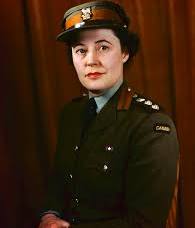
Founding Pioneer of the Canadian Women’s Army Corps
Before Canadian women were officially permitted to serve in the Army during the Second World War, Joan Barbara Kennedy was already preparing them to do it. At a time when military authorities remained deeply sceptical about women in uniform, Kennedy helped build, train and organize a voluntary women’s corps that demonstrated what women could contribute to Canada’s war effort. Her persistence helped lay the foundations for the Canadian Women’s Army Corps, and she would ultimately rise to the rank of lieutenant-colonel and lead the organization she had fought to create.
Joan Barbara Kennedy, née Fensham, was born in Middlesex, England, in 1908. She immigrated to Canada with her family and eventually settled in Victoria, British Columbia. Before entering military life, she worked as a telephone switchboard operator and later as an accountant. In 1929, she married Victoria engineer Norman R. Kennedy.
As war approached Europe in 1939, Kennedy became convinced that Canada would eventually need women to fill essential military support roles. Rather than wait for the government to act, she helped organize the British Columbia Women’s Service Corps, one of several voluntary women’s organizations established before women were formally accepted into Canada’s wartime armed forces.
The women received no official military funding and purchased their own uniforms. They nevertheless trained seriously in first aid, motor mechanics, transport, signalling, clerical work and other skills Kennedy believed would become essential if Canada entered a prolonged war. Their organization was more than a patriotic society. It was a practical demonstration that Canadian women could accept discipline, technical training and military responsibility.
Kennedy then spent approximately two years pressing politicians and military authorities to establish an official women’s army organization. Her campaign encountered considerable resistance. Many senior military figures still questioned whether women belonged in uniform at all. Kennedy continued to argue that properly trained women could perform vital military duties and release men for operational service.
Her persistence was eventually vindicated.
On 13 August 1941, the Canadian government authorized the creation of the Canadian Women’s Army Corps, commonly known as the CWAC. Just over two weeks later, on 29 August 1941, Kennedy opened the Corps’ first office at Work Point Barracks in Esquimalt, British Columbia. Parks Canada has recognized her as one of the central figures in the establishment of the organization that would eventually attract nearly 22,000 women.
The early CWAC was initially created as an auxiliary organization rather than as a fully integrated component of the Canadian Army. Its members wore uniforms and performed military duties, but they did not initially possess the same formal military status as male soldiers. That changed on 13 March 1942, when the Canadian Women’s Army Corps was formally integrated into the Canadian Army. Its members adopted Army ranks and insignia and became subject to military discipline.
Kennedy quickly emerged as one of the Corps’ most important senior officers. She held major responsibilities for administration and training and became one of the first Canadian women to attain senior commissioned rank in the Army. In the autumn of 1942, she succeeded Matron-in-Chief Elizabeth Smellie as head of the CWAC and assumed the title Director, Canadian Women’s Army Corps, with the rank of lieutenant-colonel.
The challenge facing Kennedy was much larger than simply managing a growing organization. She had to prove that the CWAC itself deserved to exist.
Under her leadership, the Corps expanded from an experimental wartime organization into an important component of the Canadian Army. CWAC members served as clerks, drivers, telephone operators, signallers, cooks, mechanics, messengers, cipher personnel, mapmakers, quartermasters and in many other trades. By taking over essential military duties, they enabled thousands of men to be reassigned to operational and combat roles.
Most members of the CWAC remained in Canada, but thousands served overseas. Approximately 3,000 Canadian Women's Army Corps personnel served outside the country, particularly in Britain and later in areas connected with Canadian operations in Italy, northwest Europe and occupied Germany. Although Canadian servicewomen were still barred from formal combat roles, their work formed an essential part of the Army's wartime infrastructure.
Kennedy herself travelled to Britain during the war. Contemporary reporting indicates that she spent approximately 10 weeks there, a period of roughly 70 days. This is significant to her medal entitlement because the Canadian Volunteer Service Medal Overseas Service Bar required at least 60 days of qualifying service outside Canada. If Kennedy's full period in Britain was credited as military service, she would have qualified for the bar, represented on the undress ribbon by a silver maple leaf. Her individual medal entitlement or movement record has not yet been located, so the silver maple leaf remains highly probable rather than fully verified.
Kennedy's influence extended far beyond administration. Every expansion of the Corps challenged the belief that military discipline, technical competence and leadership were inherently male qualities. The performance of the women serving under her steadily weakened arguments that women could not function effectively within a military organization.
By the end of the Second World War, nearly 22,000 women had served in the Canadian Women’s Army Corps. Their service formed part of the wider wartime mobilization of approximately 50,000 Canadian women in the Army, Royal Canadian Air Force and Royal Canadian Navy. What had begun as a controversial experiment had become an established part of Canada's military war effort.
Kennedy left the Canadian Army in 1946 and returned to civilian life in British Columbia. A decade later, in October 1956, she died suddenly of a heart attack in Victoria. She was only 48 years old.
Her contribution was publicly remembered again in August 2001, during commemorations marking the 60th anniversary of the CWAC. A military honour guard paraded at her burial place, recognizing the woman remembered as one of the founding architects of the Canadian Women’s Army Corps.
Kennedy's known wartime service supports entitlement to the Canadian Volunteer Service Medal and the War Medal 1939–1945. The CVSM Overseas Service Bar, represented by a silver maple leaf on the ribbon, is strongly supported by the reported length of her wartime service in Britain but remains awaiting confirmation from her individual military records. No gallantry decoration, Mention in Despatches, Defence Medal, campaign star or major civil honour has yet been independently verified for her.
Joan Kennedy's legacy, however, cannot be measured by the size of her medal group.
Her most enduring achievement was the institution she helped create. At a time when women had to fight simply for the right to serve in uniform, Kennedy helped prove that they could train, lead and perform essential military duties to professional standards. The Canadian Women’s Army Corps opened opportunities for thousands of women during the Second World War and became an important stage in the long transformation of women's service in the Canadian Armed Forces.
Lieutenant-Colonel Joan Barbara Kennedy helped turn an idea that many military leaders resisted into a wartime organization of nearly 22,000 women. Her career stands as one of the foundational chapters in the history of women in the Canadian military.
Sources: Canadian War Museum, The Canadian Women’s Army Corps, 1941–1946; Government of Canada, Official Army Historical Report No. 15; Parks Canada, Entry of Women into the Military during the Second World War; Veterans Affairs Canada, Women in Service; Veterans Affairs Canada, Canadian Volunteer Service Medal; Veterans Affairs Canada, War Medal 1939–1945.
Become the named supporter for this profile and edit the tribute biography and portrait (Owner account required). Proceeds help keep the archive online.
$25 USD / year — annual sponsorship renewal. Keeps the page online and, where enabled, the family anniversary remembrance emails active.