★
Loading archive…
Loading archive…
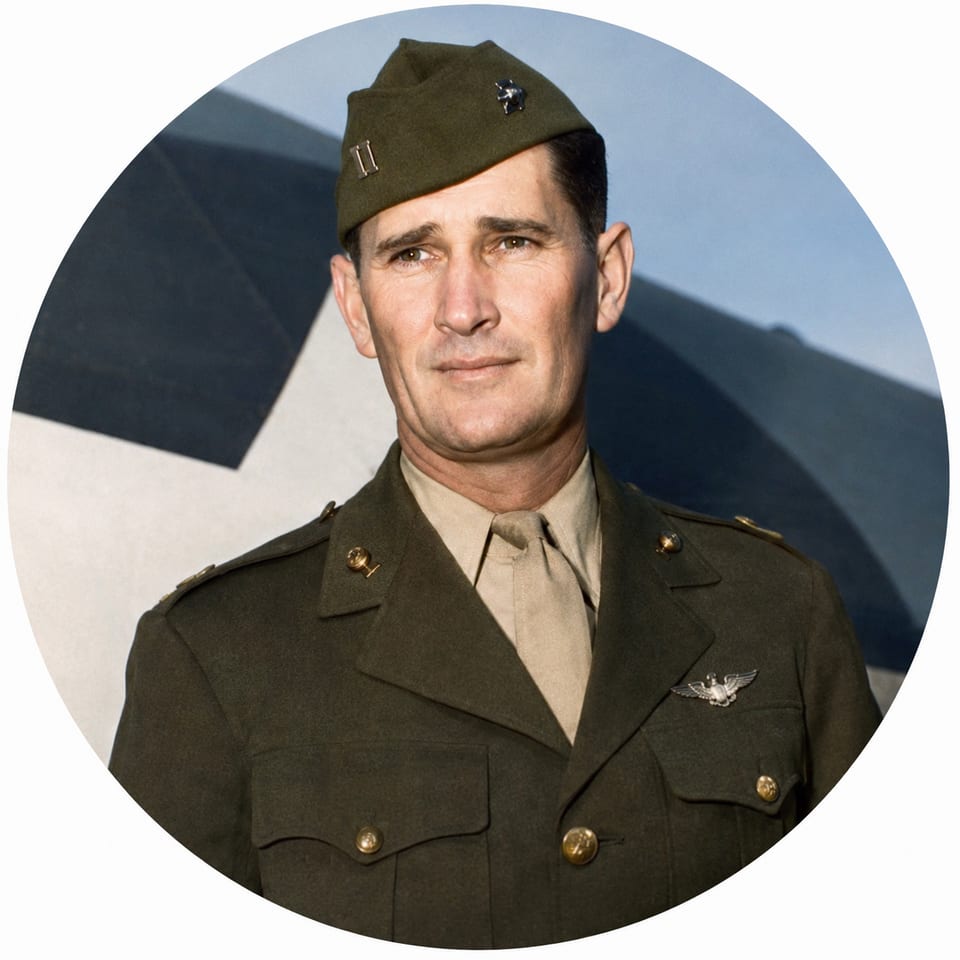
Brigadier General, U.S. Marine Corps
Support & adopt this hero ↓
Joseph Jacob “Joe” Foss was one of the most extraordinary fighter pilots of the Second World War. In the skies above Guadalcanal, he faced waves of Japanese aircraft, led his fellow Marines into relentless aerial combat, and became one of America's most celebrated flying aces. Credited with shooting down 26 enemy aircraft, Foss earned the Medal of Honor for his extraordinary courage, leadership, and fighting skill. His remarkable journey from a South Dakota farm boy to a legendary Marine aviator and Brigadier General remains one of the most inspiring stories in American military history.
Born on 17 April 1915 on a farm near Sioux Falls, South Dakota, Joseph Jacob Foss developed a fascination with aviation at an early age. Inspired by the achievements of Charles Lindbergh and the spectacle of Marine Corps aviators, he dreamed of becoming a military pilot. Despite financial hardship and family responsibilities following his father's death, Foss remained determined to pursue that ambition. He worked his way through college, earned a degree in Business Administration from the University of South Dakota in 1940, and secured his pilot's licence. He subsequently joined the United States Marine Corps Reserve and entered naval aviation training, earning his wings in March 1941.
When the United States entered the Second World War, Foss was initially assigned to instructional and reconnaissance duties. Determined to serve in combat, he repeatedly sought an opportunity to fly fighter aircraft. Despite being considered too old for frontline fighter service, his persistence eventually earned him an assignment as executive officer of Marine Fighting Squadron 121 (VMF-121). Flying the Grumman F4F Wildcat, he arrived at Guadalcanal in the Solomon Islands in October 1942, where American forces were engaged in a desperate struggle to defend their strategic airfield and surrounding positions.
It was above Guadalcanal that Joe Foss established his extraordinary reputation. Leading a group of aggressive Marine fighter pilots, his squadron became known as “Foss's Flying Circus.” During the campaign, Foss personally destroyed 23 Japanese aircraft between October and November 1942, adding three more victories in January 1943. His remarkable record of 26 aerial victories made him one of the leading American fighter aces of the war. His achievements were not limited to individual victories. He repeatedly led escort missions protecting reconnaissance aircraft, bombers, photographic flights, and surface vessels. On 25 January 1943, he led a small formation of Marine and Army fighters against a vastly superior Japanese force, helping repel the enemy attack and protect American positions on Guadalcanal.
For his extraordinary heroism and leadership during the Guadalcanal campaign, Foss was awarded the Medal of Honor, the United States' highest military decoration for valor. President Franklin D. Roosevelt personally presented the medal to him at the White House on 18 May 1943. His wartime decorations also included the Silver Star, Distinguished Flying Cross, Bronze Star Medal, Purple Heart, and Air Medal, reflecting his exceptional contributions to military aviation and the Pacific campaign.
After returning to the Pacific in 1944, Foss assumed command of Marine Fighting Squadron 115 (VMF-115), continuing his service as a combat aviation leader. He subsequently undertook training and operational assignments before leaving active Marine Corps service in December 1945. His military career, however, was far from over. In September 1946, he accepted a commission in the South Dakota Air National Guard and helped establish its postwar aviation organization. He continued serving in the National Guard, including a return to active duty during the Korean War, eventually rising to the rank of Brigadier General. His leadership helped shape the development of South Dakota's military aviation capabilities.
Beyond his military achievements, Foss became a prominent public figure and continued serving his country through politics and civic leadership. He was elected to the South Dakota House of Representatives and subsequently served two terms as Governor of South Dakota from 1955 to 1959. His career later took him into professional sports administration, where he became the first commissioner of the American Football League, helping guide the organisation during its formative years. He also served as president of the National Rifle Association and remained an influential advocate for veterans, aviation, and public service.
Joseph Jacob Foss died on 1 January 2003 in Scottsdale, Arizona, at the age of 87. He was laid to rest at Arlington National Cemetery, where his remarkable military legacy is permanently honoured. Remembered as the legendary Marine fighter ace of Guadalcanal, a Medal of Honor recipient, an Air National Guard Brigadier General, and a two-term governor, Joe Foss represented a lifetime of courage, determination, and service. His story stands as a powerful reminder that true leadership is measured not only by victories in battle, but also by the commitment to serve others long after the fighting has ended.
Become the named supporter for this profile and edit the tribute biography and portrait (Owner account required). Proceeds help keep the archive online.
$25 USD / year — annual sponsorship renewal. Keeps the page online and, where enabled, the family anniversary remembrance emails active.