★
Loading archive…
Loading archive…
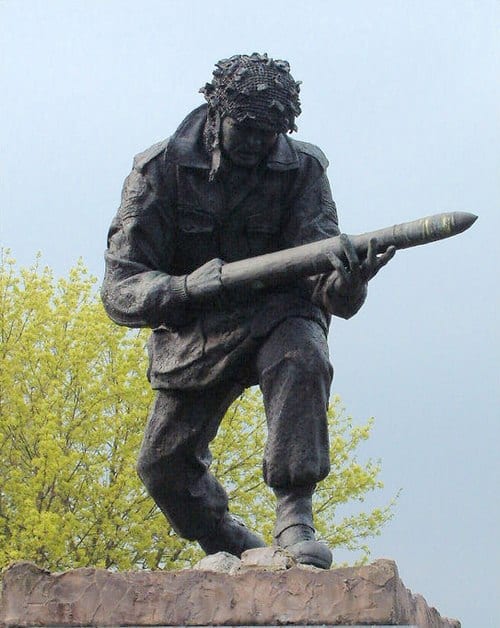
Lance sergeant, British Army
Support & adopt this hero ↓Manning a gun alone, he repeatedly stopped advancing armour.
John Daniel Baskeyfield was born at Burslem, Staffordshire, on 18 November 1922. His father worked in the pottery industry. After local schooling he worked for the Co-operative Society's butcher shops, studying at night and eventually managing the Pittshill branch.
Called up in February 1942, he joined the South Staffordshire Regiment and transferred to its 2nd Battalion. The battalion formed part of the 1st Airlanding Brigade. During the invasion of Sicily in 1943, his glider came down in the sea and he spent hours awaiting rescue. Service in Italy followed before the battalion returned to Britain.
By September 1944 Baskeyfield was a lance sergeant in the anti-tank platoon. On 20 September, at Oosterbeek during the Arnhem battle, his six-pounder gun position came under attack by German infantry and armoured vehicles. His crew destroyed tanks and a self-propelled gun before he was badly wounded and the other men became casualties.
He refused evacuation and continued firing alone, encouraging men in nearby trenches. When his gun was disabled, he crawled under fire to another gun whose crew had been killed. He brought it into action and hit an approaching self-propelled gun. While preparing another shot he was killed by fire from supporting German armour.
His posthumous Victoria Cross recognised both his fighting and the example that helped keep the surrounding defenders in action. His father received the cross from King George VI in July 1945. Baskeyfield has no known grave and is commemorated on the Groesbeek Memorial. A statue at Stoke-on-Trent and memorials near the battlefield also preserve his name.
Official Victoria Cross citation
On 20th September, 1944, during the battle of Arnhem, Lance-Sergeant Baskeyfield was the N.C.O. in charge of a 6-pounder anti-tank gun at Oosterbeek. The enemy developed a major attack on this sector with infantry, tanks and self-propelled guns with the obvious intent to break into and overrun the Battalion position. During the early stage of the action the crew commanded by this N.C.O. was responsible for the destruction of two Tiger tanks and at least one self-propelled gun, thanks to the coolness and daring of this N.C.O., who, with complete disregard for his own safety, allowed each tank to come well within 100 yards of his gun before opening fire. In the course of this preliminary engagement Lance-Sergeant Baskeyfield was badly wounded in the leg and the remainder of his crew were either killed or badly wounded. During the brief respite after this engagement Lance-Sergeant Baskeyfield refused to be carried to the Regimental Aid Post and spent his time attending to his gun and shouting encouragement to his comrades in neighbouring trenches. After a short interval the enemy renewed the attack with even greater ferocity than before, under cover of intense mortar and shell fire. Manning his gun quite alone Lance-Sergeant Baskeyfield continued to fire round after round at the enemy until his gun was put out of action. By this time his activity was the main factor in keeping the enemy tanks at bay. The fact that the surviving men in his vicinity were held together and kept in action was undoubtedly due to his magnificent example and outstanding courage. Time after time enemy attacks were launched and driven off. Finally, when his gun was knocked out, Lance-Sergeant Baskeyfield crawled, under intense enemy fire, to another 6-pounder gun nearby, the crew of which had been killed, and proceeded to man it single-handed. With this gun he engaged an enemy self-propelled gun which was approaching to attack. Another soldier crawled across the open ground to assist him but was killed almost at once. Lance-Sergeant Baskeyfield succeeded in firing two rounds at the self-propelled gun, scoring one direct hit which rendered it ineffective. Whilst preparing to fire a third shot, however, he was killed by a shell from a supporting enemy tank. The superb gallantry of this N.C.O. is beyond praise. During the remaining days at Arnhem stories of his valour were a constant inspiration to all ranks. He spurned danger, ignored pain and, by his supreme fighting spirit, infected all who witnessed his conduct with the same aggressiveness and dogged devotion to duty which characterised his actions throughout.
Supplement to The London Gazette of 21 November 1944. 23 November 1944, Numb. 36807, p. 5375
Become the named supporter for this profile and edit the tribute biography and portrait (Owner account required). Proceeds help keep the archive online.
$25 USD / year — annual sponsorship renewal. Keeps the page online and, where enabled, the family anniversary remembrance emails active.