★
Loading archive…
Loading archive…
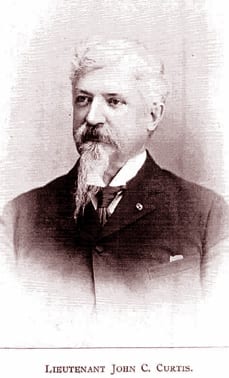
First Lieutenant, U.S. Army
Support & adopt this hero ↓
He Captured Two Soldiers Alone at Baton Rouge
John Calvin Curtis was born on April 19, 1845, in Bridgeport, Connecticut. During the American Civil War, he entered Union service and joined the 9th Connecticut Infantry. Although still very young, he advanced to the important enlisted position of Sergeant Major and served with his regiment during operations in the Gulf region.
By the summer of 1862, Union forces were attempting to maintain control over key positions along the Mississippi River and in Louisiana. Baton Rouge had become strategically important because of its location on the river and its value as a military and transportation center. Confederate forces sought to challenge the Union occupation of the city, leading to the Battle of Baton Rouge on August 5, 1862.
Curtis was serving as Sergeant Major of the 9th Connecticut Infantry when the battle began.
The position of Sergeant Major carried considerable responsibility. As one of the senior enlisted soldiers of a regiment, Curtis was expected to help maintain organization, discipline, communication, and battlefield control. During a rapidly changing engagement, those duties could bring him close to the most dangerous areas of the fight.
At Baton Rouge, Curtis went beyond the normal expectations of his position.
During the battle, he voluntarily moved toward the fighting line. There, acting alone, he confronted two Confederate soldiers and captured them. He then brought both prisoners back to his regimental headquarters at the point of his bayonet.
The act required extraordinary personal confidence and courage. Curtis had moved directly into an area of active combat without the protection of a larger group and gained control over two enemy soldiers by himself.
His action took place during a battle in which both armies were fighting for control of the city. Confederate forces launched an attack against the Union positions in an effort to drive Federal troops from Baton Rouge. The engagement became confused and intense as units fought through difficult terrain and changing lines.
Union forces ultimately maintained control of the city.
For Curtis, however, the defining moment of the battle was his decision to move forward alone and return with two enemy prisoners.
His conduct at Baton Rouge demonstrated the initiative expected of an experienced noncommissioned officer, but it also went well beyond routine duty. He was not merely transmitting orders or helping keep formations intact. He personally entered the dangerous ground between the opposing forces and captured enemy soldiers under combat conditions.
The action remained part of his military record long after the battle ended.
Curtis continued serving after Baton Rouge and later received a commission as First Lieutenant, the highest verified rank of his military career. His advancement from Sergeant Major to commissioned officer reflected the responsibility and experience he had gained during his wartime service.
The distinction between those ranks is important. His Medal of Honor action occurred while he was serving as Sergeant Major. His later promotion to First Lieutenant came afterward and should not be confused with the rank he held when he performed the deed for which he was decorated.
The Civil War continued for nearly three more years after Baton Rouge. The conflict expanded into campaigns across multiple theaters, while Union forces gradually increased their control of the Mississippi River and other strategic regions.
Curtis survived the war and returned to civilian life.
More than three decades later, his conduct at Baton Rouge received formal national recognition. On December 16, 1896, John Calvin Curtis was presented with the Medal of Honor for his actions on August 5, 1862.
The award recognized a specific act of battlefield courage: voluntarily moving to the fighting line, capturing two Confederate soldiers alone, and bringing them back to his regimental headquarters.
The long interval between the action and the presentation was not unusual for Civil War recipients. Many deeds were formally recognized years later as wartime records were reviewed and recommendations moved through the military system.
For Curtis, the delay did not change the nature of the act itself.
He had been a Sergeant Major in the middle of an active Civil War battle when he chose to advance alone toward the enemy. The risks were immediate. A single soldier attempting to capture multiple opponents could easily have been wounded, killed, or taken prisoner himself.
Curtis succeeded.
His Medal of Honor preserved that moment as the central episode of his military legacy.
The Battle of Baton Rouge did not become as widely remembered as Gettysburg, Antietam, or Vicksburg, but it formed part of the larger struggle for control of the Mississippi Valley. For soldiers serving there, the danger was no less real. Infantrymen fought at close range, units became separated, and individual initiative could influence the outcome of local fighting.
Curtis’s action represented exactly that kind of initiative.
He later lived for many decades after the Civil War, witnessing the transformation of the United States and the gradual passing of the generation that had fought in the conflict.
John Calvin Curtis died on January 17, 1917, in Bridgeport, Connecticut, the same city where he had been born. He was buried in Mountain Grove Cemetery.
His legacy remains tied to August 5, 1862.
During the Battle of Baton Rouge, Sergeant Major Curtis voluntarily went forward to the fighting line, confronted two Confederate soldiers alone, captured them, and brought them back to his headquarters.
More than thirty years later, the Medal of Honor formally recognized that act of courage.
It preserved the story of a young Sergeant Major who stepped beyond his ordinary responsibilities, entered the danger of the battlefield alone, and returned with two enemy prisoners.
Become the named supporter for this profile and edit the tribute biography and portrait (Owner account required). Proceeds help keep the archive online.
$25 USD / year — annual sponsorship renewal. Keeps the page online and, where enabled, the family anniversary remembrance emails active.