★
Loading archive…
Loading archive…
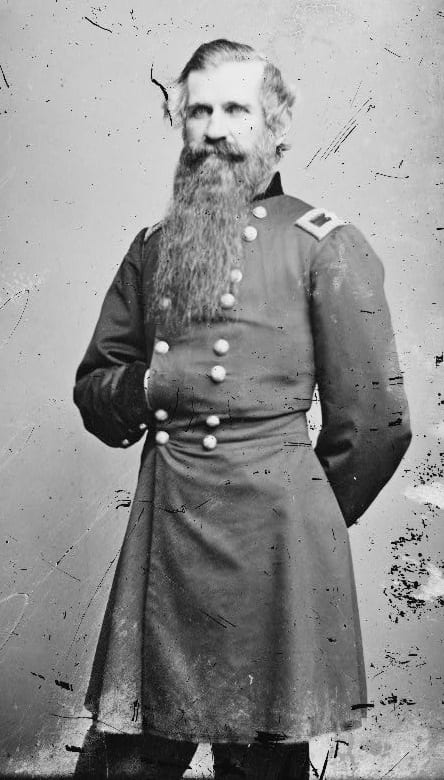
Major General, U.S. Army
Support & adopt this hero ↓
He Led the Charge Until a Bullet Shattered His Knee
John Cleveland Robinson was born on April 10, 1817, in Binghamton, New York. His military career would eventually span decades of service and several of the most important campaigns of the American Civil War. By 1864, he had become a Brigadier General commanding experienced Union troops in the Army of the Potomac, and it was during the brutal Overland Campaign that he performed the act of leadership for which he later received the Medal of Honor.
Robinson had already built a long military career before the Civil War began. He entered the United States Army in the years before the conflict and gained professional experience that later placed him among the Union officers entrusted with major battlefield commands.
When the Civil War erupted, Robinson continued in Federal service and rose rapidly through positions of greater responsibility. His assignments eventually brought him to command infantry formations in the Army of the Potomac.
By 1863, he was commanding a division in the V Corps. His troops fought during the Battle of Gettysburg, where Union forces confronted General Robert E. Lee’s Army of Northern Virginia during its invasion of Pennsylvania.
Robinson’s division was heavily engaged on July 1, 1863, during the desperate defense north and northwest of Gettysburg. His soldiers resisted strong Confederate attacks before the Union forces were eventually compelled to withdraw through the town and establish a new defensive position on Cemetery Hill.
The battle continued for two more days and ended in a Union victory. Robinson emerged from Gettysburg as an experienced division commander whose troops had endured some of the battle’s earliest and hardest fighting.
Less than a year later, he entered another devastating campaign.
In May 1864, Lieutenant General Ulysses S. Grant began the Overland Campaign against Lee’s army in Virginia. Unlike earlier Union campaigns that often withdrew after major battles, Grant intended to remain in continuous contact with the Confederate army and keep moving toward Richmond.
The opening fighting in the Wilderness was immediately followed by a race toward Spotsylvania Court House.
On May 8, 1864, Union and Confederate troops collided near Laurel Hill.
The Confederate army had reached strong defensive ground and established breastworks. Union forces attempted to break through before Lee’s position could become fully consolidated.
Brigadier General John Cleveland Robinson was directly involved in the attack.
During the fighting, Robinson personally moved to the front of the leading brigade.
Rather than directing the assault from the rear, he placed himself where his soldiers could see him and led them forward against the Confederate defenses.
The attack faced heavy enemy resistance.
As Robinson advanced with his men, he was struck by a bullet that passed through his left knee.
The wound was devastating.
Robinson was removed from the battlefield, and the injury proved so severe that his leg had to be amputated.
The wound effectively ended his active field command.
His Medal of Honor action, however, had already been performed.
Robinson had personally placed himself at the head of the attacking troops and led them toward the enemy breastworks during one of the opening engagements of the Spotsylvania Campaign.
The fighting around Laurel Hill was part of the broader struggle for Spotsylvania Court House, where the two armies would remain locked in some of the most violent combat of the war. The battle developed into days of assaults, counterattacks, artillery fire, and close fighting around heavily fortified positions.
Robinson’s part in that campaign ended on May 8 because of his wound, but his military career did not end entirely.
After recovering as much as possible from the amputation, he continued serving in the Army in non-field roles. His experience remained valuable even though his physical condition prevented a return to the type of active battlefield command he had exercised before Laurel Hill.
Robinson ultimately reached the rank of Major General, the highest verified rank of his career.
His advancement reflected decades of military service, but the act later recognized by the Medal of Honor belonged specifically to his time as a Brigadier General.
Nearly thirty years after the Civil War, Robinson’s conduct at Laurel Hill received formal recognition.
On March 28, 1894, he was presented with the Medal of Honor for his actions on May 8, 1864.
The decoration recognized his personal leadership in placing himself at the head of the leading brigade during the charge against the Confederate breastworks.
His severe wound became inseparable from the story of that action.
Robinson did not simply order soldiers toward a defended position. He went forward with them and remained exposed to the same fire until the bullet that struck his knee ended his participation in the battle.
The injury permanently changed his life.
Yet Robinson remained closely connected to military and veterans’ affairs after the war. Like many senior Civil War officers who survived into the postwar era, he became part of the generation responsible for preserving the memory of the conflict and the service of the soldiers who had fought in it.
He lived for more than three decades after the Battle of Laurel Hill.
John Cleveland Robinson died on February 18, 1897, in Binghamton, New York. He was buried in Spring Forest Cemetery in his hometown.
His military legacy stretches across many years of service and several major Civil War campaigns, including Gettysburg and the Overland Campaign.
But the Medal of Honor fixed one moment permanently in the historical record.
At Laurel Hill on May 8, 1864, Brigadier General Robinson placed himself at the head of the advancing troops and personally led them toward strongly defended Confederate positions. He continued forward until a bullet shattered his knee and ended his field command.
Almost thirty years later, the Medal of Honor formally recognized that act of leadership and courage.
Become the named supporter for this profile and edit the tribute biography and portrait (Owner account required). Proceeds help keep the archive online.
$25 USD / year — annual sponsorship renewal. Keeps the page online and, where enabled, the family anniversary remembrance emails active.