★
Loading archive…
Loading archive…
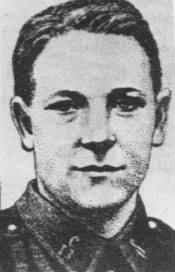
Private (or equivalent), Canadian Army
Support & adopt this hero ↓
Despite his wounds, he led a charge to capture machine guns.
John Bernard Croak was born at Little Bay, Newfoundland, on 18 May 1892, the son of James and Cecelia Croak. His family moved to Cape Breton while he was a child, and he grew up in New Aberdeen, now part of Glace Bay, Nova Scotia. He left school at fourteen and worked at the Dominion No. 2 Colliery. He later travelled to western Canada before returning east. On 7 August 1915 he attested at Sussex, New Brunswick, joining the 55th Battalion of the Canadian Expeditionary Force. His civilian occupation was recorded as labourer, and his service number was 445312.
Croak trained at Valcartier, Quebec, and crossed the Atlantic aboard the Corsican in the autumn of 1915. After arriving in England in November, he continued training with the 55th Battalion at Bramshott. In April 1916 he transferred to the 13th Battalion, the Royal Highlanders of Canada, which served in the 3rd Canadian Infantry Brigade of the 1st Canadian Division. He crossed to France on 15 April and reached the Canadian base depot at Le Havre the following day before joining the battalion in the field.
During more than two years on the Western Front, Croak served through the Somme fighting, Vimy Ridge and Passchendaele. Military discipline did not come easily to him: his service included repeated punishments for drunkenness, absence and other offences. Nevertheless, comrades remembered his fearlessness and trusted him on patrols and working parties. He remained a private. In the summer of 1918 his battalion prepared for the Allied offensive near Amiens, with the German positions around Hangard Wood among its first objectives.
On 8 August, during the opening advance, Croak became separated from his section. Encountering a German machine-gun nest, he attacked it with grenades, silenced the weapon and captured its crew. Soon afterwards he was severely wounded, but continued forward and rejoined his platoon.
The platoon then encountered another strongpoint containing several machine guns. Croak saw an opportunity and rushed it alone. His comrades followed almost immediately. He reached the trench first and led them into the position, where they captured three machine guns and overcame the defenders, killing or taking prisoner the entire garrison.
Croak was severely wounded a second time and died within minutes, aged twenty-six. His life and service ended in the action for which he received the Victoria Cross posthumously. He is buried in Hangard Wood British Cemetery, France, in Plot I, Row A, Grave 9. His award was announced in the London Gazette supplement of 27 September 1918.
Victoria Cross citation London Gazette, no. 30922, supplement of 27 September 1918, page 11430.
No. 445312 Pte. John Bernard Croak, late Quebec R.
For most conspicuous bravery in attack when having become separated from his section he encountered a machine-gun nest, which he bombed and silenced, taking the gun and crew prisoners. Shortly afterwards he was severely wounded, but refused to desist.
Having rejoined his platoon, a very strong point, containing several machine guns, was encountered. Private Croak, however, seeing an opportunity, dashed forward alone and was almost immediately followed by the remainder of the platoon in a brilliant charge. He was the first to arrive at the trench line, into which he led his men, capturing three machine guns and bayonetting or capturing the entire garrison.
The perseverance and valour of this gallant soldier, who was again severely wounded, and died of his wounds, were an inspiring example to all.
Become the named supporter for this profile and edit the tribute biography and portrait (Owner account required). Proceeds help keep the archive online.
$25 USD / year — annual sponsorship renewal. Keeps the page online and, where enabled, the family anniversary remembrance emails active.