★
Loading archive…
Loading archive…
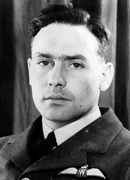
Wing Commander, Royal Air Force
Support & adopt this hero ↓
Led bombers through fighters and flak to strike at Augsburg.
John Dering Nettleton was born on 28 June 1917 at Nongoma in Natal, South Africa, the son of John Hennah and Ethel Nettleton. He grew up in Cape Town and attended Western Province Preparatory School. He then trained aboard the South African training ship General Botha, graduating as a teenager before entering the merchant service. After time at sea, he returned ashore to train in civil engineering and also served in the South African Division of the Royal Naval Volunteer Reserve.
He travelled to Britain in 1938 and joined the Royal Air Force. After flying training at Grantham and Shawbury, he qualified as a pilot in July 1939. He served with Nos. 207, 98 and 185 Squadrons before joining No. 44 Squadron at Waddington. He flew Hampden bombers on operations and became an acting squadron leader in 1941. The squadron subsequently converted to the new four-engined Avro Lancaster.
On 17 April 1942 he led six Lancasters in a daylight attack on the MAN diesel-engine factory at Augsburg in southern Germany. Another six aircraft from No. 97 Squadron also took part. The factory supplied engines for German U-boats, and the crews were required to fly deep into enemy territory at extremely low altitude. German fighters intercepted Nettleton's formation after it crossed into occupied territory. Four of his six aircraft were shot down, and his own rear guns were put out of action.
He continued towards Augsburg with the one other surviving Lancaster, flying much of the journey at about 50 feet above the ground. Both aircraft reached the factory and dropped their bombs despite intense anti-aircraft fire. The accompanying aircraft was hit, caught fire and crash-landed. Nettleton brought his badly damaged bomber back to Britain, the only one of his formation of six to return. The RAF Museum's later assessment found that the raid caused limited damage to the factory's machinery and did not halt U-boat production.
His Victoria Cross was announced on 28 April 1942 and was presented by King George VI. He made a goodwill visit to the United States and married Betty Isobel Havelock, an officer in the Women's Auxiliary Air Force, at Lincoln in July 1942. He subsequently helped train other bomber pilots, including service with No. 44 Conversion Flight and No. 1661 Heavy Conversion Unit. In 1943 he returned to operational service as a wing commander with No. 44 Squadron.
On the night of 12/13 July 1943 he captained Lancaster ED331 on a bombing operation against Turin. The aircraft failed to return. He was recorded as having died on 13 July, aged 26; neither his body nor those of his crew were recovered. His son, also named John Dering, was born in February 1944. Nettleton is commemorated on the RAF memorial to the missing at Runnymede.
Official Victoria Cross citation The London Gazette, Third Supplement, 28 April 1942, page 1851:
The KING has been graciously pleased to confer the VICTORIA CROSS on the undermentioned officer in recognition of most conspicuous bravery:
Acting Squadron Leader John Dering NETTLETON (41452), No. 44 (Rhodesia) Squadron.
Squadron Leader Nettleton was the leader of one of two formations of six Lancaster heavy bombers detailed to deliver a low-level attack in daylight on the diesel engine factory at Augsburg in Southern Germany on April 17th, 1942. The enterprise was daring, the target of high military importance. To reach it and get back, some 1,000 miles had to be flown over hostile territory.
Soon after crossing into enemy territory his formation was engaged by 25 to 30 fighters. A running fight ensued. His rear guns went out of action. One by one the aircraft of his formation were shot down until in the end only his own and one other remained. The fighters were shaken off but the target was still far distant. There was formidable resistance to be faced.
With great spirit and almost defenceless, he held his two remaining aircraft on their perilous course and after a long and arduous flight, mostly at only 50 feet above the ground, he brought them to Augsburg. Here anti-aircraft fire of great intensity and accuracy was encountered. The two aircraft came low over the roof tops. Though fired at from point blank range, they stayed the course to drop their bombs true on the target. The second aircraft, hit by flak, burst into flames and crash-landed. The leading aircraft, though riddled with holes, flew safely back to base, the only one of the six to return.
Squadron Leader Nettleton, who has successfully undertaken many other hazardous operations, displayed unflinching determination as well as leadership and valour of the highest order.
Become the named supporter for this profile and edit the tribute biography and portrait (Owner account required). Proceeds help keep the archive online.
$25 USD / year — annual sponsorship renewal. Keeps the page online and, where enabled, the family anniversary remembrance emails active.