Loading archive…
Loading archive…

Sergeant Major, British Army
Support & adopt this hero ↓
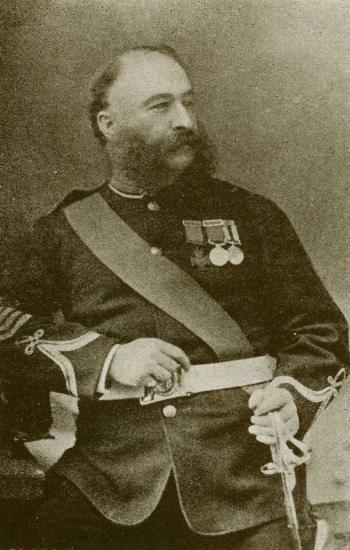
In the late afternoon of 18 March 1861, a skirmishing party from the 40th (2nd Somersetshire) Regiment of Foot advanced toward the dense cover of the Huirangi Bush, situated to the right of No. 7 Redoubt in the Taranaki region of New Zealand. At approximately four o'clock, concealed Māori warriors opened fire from the bush and adjacent high ground at a range of thirty yards. Three British soldiers dropped simultaneously in the opening volley. When a file moved forward to extricate them, another soldier fell and Lieutenant Rees was severely wounded. Colour-Sergeant John Lucas rushed forward under direct fire. Detaching a soldier to assist Lieutenant Rees to safety in the rear, Lucas remained at the forward position, gathered the arms and ammunition of the dead and wounded, and maintained continuous fire single-handed to hold the line until Lieutenants Gibson and Whelan arrived with reinforcements.
Lucas was born in 1826 in Clashganny, near Bagenalstown, County Carlow, Ireland. His family later resided in Dublin, where he enlisted in the British Army and was assigned to the 40th Regiment of Foot. His battalion deployed to New Zealand during the First Taranaki War, a campaign stemming from disputed land purchases at Waitara. Operating under Major-General Thomas Simson Pratt, British forces conducted extensive sapping operations toward Te Arei, a fortified line along the Waitara River guarding the hill pā of Pukewairangi. The engagement near Huirangi Bush took place on the final afternoon of active combat operations before a negotiated truce brought hostilities in the region to a close.
The action at No. 7 Redoubt resulted in Lucas becoming the first member of the 40th Foot to receive the Victoria Cross. Lieutenant-General Duncan Cameron formally presented the decoration to Lucas at Ellerslie Racecourse in Auckland on 2 October 1862.
Lucas completed twenty-one years of continuous military service, attaining the rank of Sergeant Major before receiving his discharge in December 1868. Upon his retirement, fellow non-commissioned officers stationed at Carlisle presented him with a gold watch. In contrast, the officers of the 40th Regiment presented him with a silver tea and coffee service. He returned to Ireland and was employed as a park keeper at Park Lodge on Parkgate Street in Dublin. Lucas died at his residence on 29 February 1892 at the age of sixty-six. He was interred in St. James's Churchyard in Dublin, escorted by a military detachment that included the dismounted band of the 3rd Hussars.
The citation for his Victoria Cross was published in The London Gazette on 19 July 1861:
"On the 18th of March, 1861, Colour-Serjeant Lucas acted as Sergeant of a party of the 40th Regiment, employed as skirmishers to the right of No. 7, Redoubt, and close to the Huirangi Bush, facing the left of the positions occupied by the natives. At about 4 o'clock P.M., a very heavy and well-directed fire was suddenly opened upon them from the Bush, and the high ground on the left. Three men being wounded simultaneously, two of them mortally, assistance was called for in order to have them carried to the rear: a file was immediately sent, but had scarcely arrived, when one of them fell, and Lieutenant Rees was wounded at the same time. Colour-Serjeant Lucas, under heavy fire from the rebels, who were not more than thirty yards distant, immediately ran up to the assistance of this Officer, and sent one man with him to the rear. He then took charge of the arms belonging to the killed and wounded men, and maintained his position until the arrival of supports under Lieutenants Gibson and Whelan."
Become the named supporter for this profile and edit the tribute biography and portrait (Owner account required). Proceeds help keep the archive online.
$25 USD / year — annual sponsorship renewal. Keeps the page online and, where enabled, the family anniversary remembrance emails active.