★
Loading archive…
Loading archive…

Captain, British Army
Support & adopt this hero ↓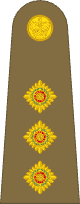
Blocking a bunker with his body, he opened the path forward.
John Niel Randle was born at Benares in India on 22 December 1917, the son of Herbert Niel Randle, later librarian of the India Office, and Edith, née Whitby. He attended the Dragon School, Colet Court and Marlborough College before studying at Merton College, Oxford.
He enlisted in the East Surrey Regiment in 1939 and was commissioned into the Royal Norfolk Regiment in May 1940. He helped rebuild the battalion after its losses in France. In January 1942 he married Maeve Manser, sister of the airman Leslie Manser, who would also receive a posthumous Victoria Cross. The couple had a son. Randle went to India in April 1942 and served with the 2nd Battalion, Royal Norfolks.
During the battle of Kohima in May 1944, he commanded a company attacking Japanese positions. Wounded on 4 May, he continued directing the fighting. On 6 May a bunker blocked his company's advance. Randle moved forward alone under fire, threw a grenade into the position and was struck again. He reached the firing slit and fell across it, stopping its fire with his body. His company could then advance and secure its objective.
He was killed in the action, aged twenty-six. His Victoria Cross citation recognised his leadership over the three days as well as his final assault. His widow received the decoration from King George VI on 17 July 1945. Randle lies in Kohima War Cemetery; his Victoria Cross is held by the Imperial War Museum.
Official Victoria Cross citation
On the 4th May, 1944, at Kohima in Assam, a Battalion of the Norfolk Regiment attacked the Japanese positions on a nearby ridge. Captain Randle took over command of the Company which was leading the attack, when the Company Commander was severely wounded. His handling of a difficult situation in the face of heavy fire was masterly and although wounded himself in the knee by grenade splinters he continued to inspire his men by his initiative, courage and outstanding leadership, until the Company had captured its objective and consolidated its position. He then went forward and brought in all the wounded men who were lying outside the perimeter. In spite of his painful wound Captain Randle refused to be evacuated and insisted on carrying out a personal reconnaissance with great daring in bright moonlight prior to a further attack by his Company on the positions to which the enemy had withdrawn. At dawn on 6th May the attack opened led by Captain Randle and one of the platoons succeeded in reaching the crest of the hill held by the Japanese. Another platoon, however, ran into heavy medium machine gun fire from a bunker on the reverse slope of the feature. Captain Randle immediately appreciated that this particular bunker covered not only the rear of his new position but also the line of communication of the Battalion and therefore the destruction of the enemy post was imperative if the operation was to succeed. With utter disregard of the obvious danger to himself Captain Randle charged the Japanese machine gun post single-handed with rifle and bayonet. Although bleeding in the face and mortally wounded by numerous bursts of machine gun fire he reached the bunker and silenced the gun with a grenade thrown through the bunker slit. He then flung his body across the slit so that the aperture should be completely sealed. The bravery shown by this officer could not have been surpassed and by his self sacrifice he saved the lives of many of his men and enabled not only his own Company but the whole Battalion to gain its objective and win a decisive victory over the enemy.
(Supplement to The London Gazette of 8 December 1944. 12 December 1944, Numb. 36833, p. 5673)
Become the named supporter for this profile and edit the tribute biography and portrait (Owner account required). Proceeds help keep the archive online.
$25 USD / year — annual sponsorship renewal. Keeps the page online and, where enabled, the family anniversary remembrance emails active.