★
Loading archive…
Loading archive…

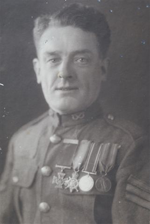
He braved enemy fire alone to expose the enemy counterattack
John Thomas was born in Manchester on 10 May 1886. Orphaned while young, he worked for the Cunard shipping company and joined the Army Service Corps in June 1909. He entered the reserve in 1912 and returned to the merchant service. He survived the sinking of Lusitania on 7 May 1915 and rejoined the army. In 1917 he transferred to the North Staffordshire Regiment and served with its 2/5th Battalion in France.
On 30 November 1917, near Fontaine-Notre-Dame during the Battle of Cambrai, Thomas volunteered to reconnoitre the enemy's position. Moving hundreds of yards ahead of his comrades, he encountered German soldiers and fought at close quarters. He then deliberately drew fire to discover the enemy's strength and dispositions. From an exposed position he fired and threw bombs, obtaining the information needed to bring artillery onto the threatened area. His reconnaissance helped protect his company's position and earned the Victoria Cross.
He was wounded near Bullecourt in March 1918 and suffered continuing effects from his wartime injuries. After the war he married Amelia Wood at Douglas on the Isle of Man in June 1919. They had five children.
Thomas worked in the motor industry, including at Willis Overland Crossley in Stockport, and later as a bus conductor for the North Western company. Ill health forced his early retirement. He died at Stockport on 28 February 1954 and was buried in Stockport Cemetery. His military service and local working life are commemorated in the town.
Official citation
For most conspicuous bravery and initiative in action. He saw the enemy making preparations for a counter-attack, and with a comrade, on his own initiative, decided to make a close reconnaissance. These two went out in broad daylight in full view of the enemy and under heavy machinegun fire. His comrade was hit within a few yards of the trench, but, undeterred, L./C. Thomas went on alone. Working round a small copse he shot three snipers and then pushed on to a building used by the enemy as a night post. From here he saw whence the enemy were bringing up their troops and where they were congregating. He stayed in this position for an hour, sniping the enemy the whole time and doing great execution. He returned to our lines, after being away three hours, with information of the utmost value, which enabled definite plans to be made and artillery fire to be brought on the enemy’s concentration, so that when the attack took place it was broken up.
Become the named supporter for this profile and edit the tribute biography and portrait (Owner account required). Proceeds help keep the archive online.
$25 USD / year — annual sponsorship renewal. Keeps the page online and, where enabled, the family anniversary remembrance emails active.