★
Loading archive…
Loading archive…
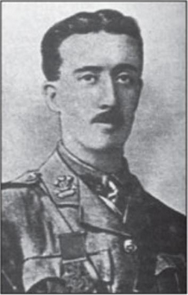
Major, British Army
Support & adopt this hero ↓
Irish Victoria Cross Hero of Guillemont and Veteran of Two World Wars
He began the attack with twenty-six bombers. Only five remained with him when it was over.
On 3 September 1916, Lieutenant John Vincent Holland led his men through their own artillery barrage and into the German-held village of Guillemont. Fighting through dugouts and shattered buildings, his small party captured about fifty prisoners and helped break the enemy resistance. Holland was seriously unwell at the time, yet he continued until the way forward had been opened. His courage earned the Victoria Cross and placed his name among the most remarkable Irish soldiers of the First World War.
John Vincent Holland was born at Athy, County Kildare, Ireland, on 19 July 1889. The son of a veterinary surgeon and farmer, he attended Clongowes Wood College between 1906 and 1909. He initially considered following his father into veterinary medicine, but a restless appetite for adventure drew him overseas. Before the First World War, he travelled through South America and worked in ranching and railway engineering.
When war engulfed Europe in 1914, Holland returned and enlisted in the 2nd Life Guards. He was soon commissioned into the 3rd Battalion of the Prince of Wales’s Leinster Regiment. Attached to the Royal Dublin Fusiliers, he served on the Western Front and was wounded during the fighting around Ypres in 1915. After recovering, he returned to France and joined the 7th Battalion of the Leinster Regiment as its bombing officer.
The Battle of Guillemont became the defining moment of his military life. During the assault, Holland was ordered to deal with German positions within the battalion’s objective. Instead of stopping after the nearby dugouts had been cleared, he drove deeper into the village. He led his bombers directly through the British barrage, where shell bursts, flying debris and enemy fire made every step potentially fatal.
The official Victoria Cross citation recorded that Holland had displayed “most conspicuous bravery” and had broken the spirit of the defenders. Starting with twenty-six bombers, he reached the end of the action with only five still beside him after taking approximately fifty prisoners. The citation concluded that his gallantry saved many casualties when the battalion resumed its advance. It also noted that he was far from well and required hospital treatment afterwards.
Holland later gave much of the credit to the courage and loyalty of the soldiers he commanded. His modest response stood in sharp contrast to the scale of what he had achieved. The capture of Guillemont became one of the most celebrated successes of the 16th Irish Division during the Battle of the Somme.
His Victoria Cross was announced in the London Gazette on 26 October 1916. King George V presented the decoration to Holland at Buckingham Palace on 5 February 1917. He was subsequently promoted to captain and served as an instructor with an officer cadet battalion for the remainder of the war.
Holland was also Mentioned in Despatches for his wartime service. The recognition is represented on his Victory Medal ribbon by a bronze oak leaf. His First World War entitlement comprised the 1914 to 1915 Star, British War Medal 1914 to 1920 and Victory Medal 1914 to 1919 with the Mention in Despatches emblem. Unlike the Victoria Cross, these campaign medals did not carry individual narrative citations. They recorded his overseas and operational service during the conflict.
After the war, Holland served with the Indian Army. He was appointed as a captain on probation and was associated with the Combined Depot of the Mahratta Light Infantry, later serving with Indian cavalry before retiring from the Army in 1922. He subsequently joined the Colonial Service in Kenya and remained there until the mid-1930s.
Military service called him back once more as Europe moved towards another war. In 1939, Holland received an appointment as a captain and administrative officer with a Territorial Army heavy anti-aircraft regiment. He later returned to the Indian Army, but ill health forced him to leave active service in 1941. He then worked for the Ministry of Food. His Second World War service was recognized by the Defence Medal and War Medal 1939 to 1945.
The war also brought profound personal loss. Holland’s eldest son, Major Niall Vincent Holland of the Indian Army, was killed in Burma in 1944 and was posthumously awarded the Military Cross. The father who had survived Guillemont and two periods of military service was forced to endure the death of a son in another world conflict.
Holland’s long association with the Crown was reflected by three royal commemorative medals: the King George V Silver Jubilee Medal of 1935, the King George VI Coronation Medal of 1937 and the Queen Elizabeth II Coronation Medal of 1953. Together with his two world war groups, they completed a recorded entitlement of nine honours and medals headed by the Victoria Cross.
In 1956, Holland and his wife, Frances, moved to Hobart, Tasmania. She died four years later, but Holland remained in Australia and continued to participate in Victoria Cross commemorations. His final recorded rank was major.
Major John Vincent Holland VC died in Hobart on 27 February 1975. Tasmania honoured him with a funeral conducted with full military ceremony. His coffin was carried on a gun carriage through the streets of Hobart, accompanied by troops and a military band, while young officers carried the medals that told the story of his service. He was buried at Cornelian Bay Cemetery beside his wife.
John Vincent Holland’s legacy rests on one extraordinary decision at Guillemont. He could have stopped after completing his immediate objective. Instead, he advanced through the barrage and carried the fight into the heart of the village.
That choice transformed a dangerous attack into a decisive success. It also revealed the qualities that defined his life: courage without hesitation, leadership through personal example and a refusal to ask his soldiers to face dangers he would not face himself.
Become the named supporter for this profile and edit the tribute biography and portrait (Owner account required). Proceeds help keep the archive online.
$25 USD / year — annual sponsorship renewal. Keeps the page online and, where enabled, the family anniversary remembrance emails active.