★
Loading archive…
Loading archive…

Storming a rifle pit, he stopped fire that delayed a battery
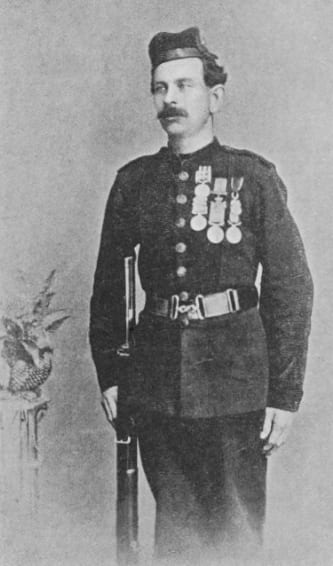
Joseph Bradshaw was born near Dromkeen in County Limerick in 1835, the son of a shopkeeper. A labourer before enlistment, he joined the army at Limerick in April 1853 and served in the Crimea with the 2nd Battalion, Rifle Brigade.
During the siege of Sevastopol, Russian riflemen occupied a rocky position above the Woronzoff Road each night. From it they could fire into the British works and impede the construction of a new battery. On 22 April 1855 Bradshaw and fellow rifleman Robert Humpston attacked the position in daylight and drove its occupants out. Both received the Victoria Cross. Bradshaw also accompanied Captain Forman on a reconnaissance of the Russian advanced works and received the French Médaille militaire.
Queen Victoria presented his VC at the first investiture in Hyde Park on 26 June 1857. His subsequent service took him to India during the uprising. He fought at Lucknow and joined the Rifle Brigade contingent of the Camel Corps in April 1858, taking part in the Central Indian campaign and the capture of Kalpi. During an earlier attack on the Yellow Bungalow, he and Lieutenant Cooper were among the first over its enclosing wall.
Bradshaw purchased his discharge in 1864 but re-enlisted later that year. He finally left the army in November 1871 as a corporal. He subsequently worked on Sir William Cope’s Bramshill estate. A married man with four sons, he died at Limerick on 29 August 1893. His surviving Victoria Cross and French decoration are held by the Royal Green Jackets Museum in Winchester.
Become the named supporter for this profile and edit the tribute biography and portrait (Owner account required). Proceeds help keep the archive online.
$25 USD / year — annual sponsorship renewal. Keeps the page online and, where enabled, the family anniversary remembrance emails active.