★
Loading archive…
Loading archive…

Before dawn near Stolberg, two German companies attacked a crossroads defended by Staff Sergeant Joseph Edward Schaefer’s platoon. With one squad driven back and another captured, Schaefer moved his men under fire to a house. He held the doorway against renewed assaults, then dashed across exposed ground to stop a flanking force. He later helped free the captured American squad.
Staff Sergeant Joseph Edward Schaefer was the last line of defense at an important crossroads near Stolberg, Germany. Before dawn on 24 September 1944, two German companies supported by machine guns attacked the position held by his platoon. One American squad had been driven back and another captured. Schaefer's squad was left to hold the crossroads. His Medal of Honor action began with a move to a house under heavy fire and ended with him crossing open ground to meet the final assault.
The stand near Stolberg
Schaefer served in the 2nd Platoon, Company I, 18th Infantry Regiment, 1st Infantry Division. As German small-arms and machine-gun fire swept the position, he crawled with his squad to a house that offered better protection, instructing each soldier as they moved. Enemy artillery then hit the strongpoint. Schaefer assigned his men their positions and chose the exposed doorway for himself. When the first German wave came forward, he met it with rifle fire and stopped the attack.
The enemy regrouped and returned with grenades and flamethrowers. Schaefer and his men drove them back a second time. For the final assault, the Germans divided their attack. One group advanced directly toward the house while another moved along a hedgerow. Schaefer fired on the attackers in front of him, then ran across ground with no cover to engage the second group. His accurate fire broke the attack and forced the Germans to withdraw.
Schaefer searched the battered position and took ten German soldiers prisoner. When the American counterattack began, he moved forward to help another platoon recover its ground. He continued through heavy fire, overtook the withdrawing enemy, and helped free the American squad captured earlier. The Medal of Honor citation credits his courage and determination with stopping an enemy breakthrough. It also records that he killed between 15 and 20 German soldiers, wounded at least as many, and took ten prisoners during the action.
After the medal
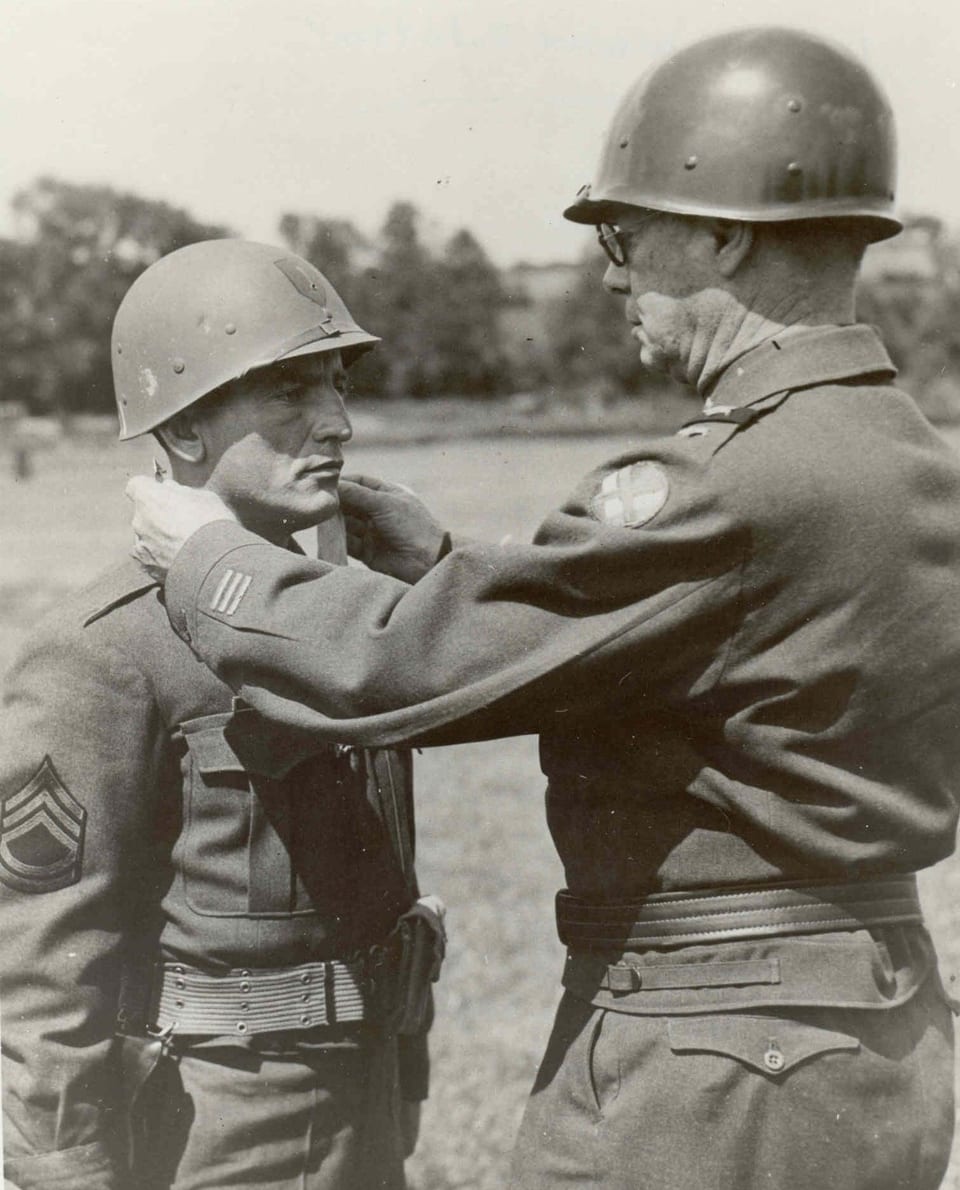
The Army presented Schaefer with the Medal of Honor at Neustadt, Germany, on 18 July 1945. He was not discharged immediately after the war. Contemporary biographical records report that he remained in Army service for about 20 years and later served in Korea.
Joseph Edward Schaefer died in Staten Island, New York, on 16 March 1987. He is buried at Long Island National Cemetery. His Medal of Honor story is a record of tactical leadership under pressure: he protected his squad, faced each renewed assault, and then carried the fight forward to help recover the men who had been captured.
Become the named supporter for this profile and edit the tribute biography and portrait (Owner account required). Proceeds help keep the archive online.
$25 USD / year — annual sponsorship renewal. Keeps the page online and, where enabled, the family anniversary remembrance emails active.