★
Loading archive…
Loading archive…

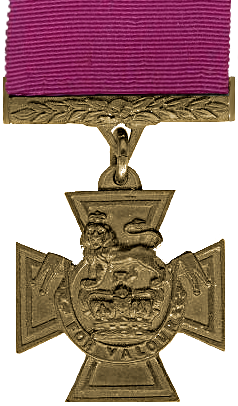
He captured a machine gun then led an attack against a farm.
Joseph Edward Woodall was born at Salford, Lancashire, on 1 June 1896, the son of a railway engine driver. He attended schools in Salford and Eccles and worked in newsagents and textile mills before the First World War. He enlisted in the Rifle Brigade on 2 September 1914 and reached France in July 1915.
By April 1918 he was a lance-sergeant commanding a platoon. On 22 April near La Pannerie, during the fighting around Hinges, a machine gun stopped his men's advance. Woodall rushed forward alone, captured the gun and took eight prisoners.
When fire from a farmhouse threatened the position, he gathered ten men and led them against it, capturing another thirty prisoners. The officer commanding was then killed. Woodall assumed command of both platoons, reorganised the men and arranged their defence. The sequence of attacks and his subsequent control of the position earned the Victoria Cross.
He received the decoration from King George V at Buckingham Palace in November 1918. After officer training, he was commissioned in March 1919 and remained in the army until retiring as an honorary captain in September 1921. He married Rosanna Leighton in 1923; they had a son and daughter.
A serious industrial accident interrupted his return to textile work when an unguarded machine took part of his arm. After retraining, he worked as a buyer for the United Turkey Red Company in Manchester. He later lived at Bramhall, Cheshire, before moving to Dun Laoghaire in 1955.
Woodall died at St Michael's Hospital there on 2 January 1962 after suffering burns during a seizure. He was buried at Deansgrange Cemetery. A later memorial stone commemorated him within the cemetery, separate from the family plot in which he lay.
Official Victoria Cross citation
For most conspicuous bravery and fine leadership during an attack. Sjt. Woodall was in command of a platoon which, during the advance, was held up by a machine gun. On his own initiative he rushed forward and, single-handed, captured the gun and eight men. After the objective had been gained, heavy fire was encountered from a farmhouse some 200 yards in front. Sjt. Woodall collected ten men and, with great dash and gallantry, rushed the farm and took thirty prisoners. Shortly afterwards, when the officer in charge was killed, he took entire command, reorganised the two platoons, and disposed them most skilfully. Throughout the day, in spite of intense shelling and machine-gun fire, this gallant N.C.O. was constantly on the move, encouraging the men and finding out and sending back invaluable information. The example set by Sjt. Woodall was simply magnificent, and had a marked effect on the troops. The success of the operation on this portion of the front is attributed almost entirely to his coolness, courage and utter disregard for his own personal safety.
Sixth Supplement to The London Gazette of 25 June 1918. 28 June 1918, Numb. 30770, p. 7619
Become the named supporter for this profile and edit the tribute biography and portrait (Owner account required). Proceeds help keep the archive online.
$25 USD / year — annual sponsorship renewal. Keeps the page online and, where enabled, the family anniversary remembrance emails active.