★
Loading archive…
Loading archive…
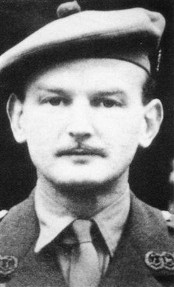
Major, British Army
Support & adopt this hero ↓
On 23 September 1950, Hill 282 had become a place of almost unimaginable confusion. North Korean troops were pressing the position, ammunition was running dangerously low, wounded soldiers were still being carried from the battlefield, and a supporting air strike had mistakenly struck the Argylls themselves. With only a small force still capable of fighting, Major Kenneth Muir refused to abandon the crest. He rallied the survivors, personally led them back into the position, and continued fighting until he was mortally wounded. His stand on Hill 282 became one of the most remarkable acts of British gallantry of the Korean War and earned him the Victoria Cross.
Kenneth Muir was born in Chester, Cheshire, on 6 March 1912, the son of Colonel Garnet Wolseley Muir and Mary Williamina Muir. Soldiering was already part of his family life. His father had commanded the Argyll and Sutherland Highlanders, the regiment with which Kenneth would build his own military career. Educated at Malvern College and later at the Royal Military College, Sandhurst, Muir entered the British Army at the age of twenty. The London Gazette of 29 January 1932 records Kenneth Muir among the newly appointed officers of the Argyll and Sutherland Highlanders. He would serve under the number 50980.
His first experience of active campaigning came far from Britain. From 1935 to 1938, Muir served on the North-West Frontier of India, one of the British Army's most demanding interwar theatres. That service brought entitlement to both of the India General Service Medals represented in his surviving medal group. It was an early introduction to mountain warfare, difficult terrain and operations against determined opponents, experience that would form part of a military career spanning nearly two decades.
The Second World War greatly expanded the scope of Muir's service. He served with the Sudan Defence Force and saw wartime service connected with North Africa, Italy, France and Germany. His career also included staff and provost duties, and he eventually reached acting lieutenant-colonel during the war. His service received official recognition when he was Mentioned in Despatches. The supplement to the London Gazette of 13 January 1944 specifically records "Capt. (temp. Maj.) K. Muir (50980)" among the Argyll and Sutherland Highlanders.
After the war, Muir continued as a Regular Army officer rather than leaving military life behind. He served in the Provost Marshal's Branch at the War Office before returning to regimental duty. By early 1950 he was second-in-command of the 1st Battalion, Argyll and Sutherland Highlanders in Hong Kong. When the Korean War erupted that summer, the battalion was ordered to join the rapidly forming British contribution to the United Nations Command. The Argylls sailed from Hong Kong in late August 1950 as part of the 27th British Brigade and were soon committed to combat in Korea.
Less than a month later came the battle that would define Kenneth Muir's name.
On the morning of 23 September 1950, B and C Companies of the 1st Battalion attacked Hill 282 near Songju and by 0800 hours had consolidated on the feature. Enemy mortar and shell fire quickly increased, casualties mounted, and the evacuation of the wounded became increasingly difficult. At about 0900, Muir arrived with a stretcher-bearing party. His original purpose was to help organise the removal of casualties, but the battle was rapidly moving beyond any normal evacuation operation.
As North Korean soldiers infiltrated the Argyll position and the two companies became mixed together under increasingly heavy fire, unified command was urgently needed. Muir took control. The official Victoria Cross citation records that he moved among the forward troops despite continuous enemy fire, encouraging the men and refusing repeated requests to take cover. Ammunition was already running short, but Muir's presence helped hold together a position that was becoming more precarious by the minute.
Then the situation deteriorated catastrophically.
An air strike had been arranged against the enemy, and recognition panels were displayed to identify the British position. At approximately 1215 hours, the aircraft attacked the Argylls instead. Fire bombs and machine-gun fire struck their main defensive position, causing further casualties and forcing the survivors about fifty feet below the crest. The official citation acknowledged that a complete withdrawal would have been understandable. Only about thirty fighting men remained, and their ammunition was critically low.
Muir saw something else. The enemy had not yet occupied the abandoned crest.
With the assistance of the remaining officers, he gathered the surviving troops into a small counter-attacking force and personally led them back uphill. The men responded, the crest was retaken, and the defence was re-established. The Victoria Cross citation described the effect of Muir's courage and example as decisive in making that counter-attack possible. From that point, the official record declared that Muir's actions were "beyond all possible praise."
He was determined both to prevent the enemy from immediately taking the crest and to give the wounded enough time to be evacuated. Grossly outnumbered and under heavy automatic fire, Muir moved through the dwindling position redistributing ammunition and encouraging his soldiers. When the ammunition for his own weapon was exhausted, he took over a 2-inch mortar and continued engaging the advancing enemy. Even while firing it, he continued directing and encouraging the men around him.
He was finally struck by two bursts of automatic fire and mortally wounded. Major Kenneth Muir died on Hill 282 on 23 September 1950. He was 38 years old.
His Victoria Cross was announced in the London Gazette on 5 January 1951. The citation credited his courage, determination and personal example with enabling the wounded to be evacuated and with sustaining the defence against a much stronger enemy. King George VI later presented Muir's posthumous Victoria Cross to his parents at Buckingham Palace.
The United States also recognised Muir's actions. He was first awarded the Silver Star posthumously under General Headquarters, Far East Command General Orders No. 59 of 15 November 1950. That award was subsequently superseded by the Distinguished Service Cross, one of the United States Army's highest decorations for combat heroism. Department of the Army General Orders No. 18, dated 18 February 1953, praised Muir's extraordinary heroism, his leadership during the counter-attack, his efforts to rebuild the defence after severe casualties, and his final use of the 2-inch mortar during the desperate fighting on the crest. The order explicitly states that the DSC replaced the earlier Silver Star for the same action.
Major Kenneth Muir VC now rests in the United Nations Memorial Cemetery in Busan, South Korea. His medal group is preserved by the Argyll and Sutherland Highlanders Museum at Stirling Castle, linking the young officer commissioned into the regiment in 1932 with the major whose final battle became part of its history.
Kenneth Muir's story is remembered not simply because he won the Victoria Cross, but because of what he did when the battle seemed to be collapsing around him. He had gone forward to help evacuate wounded soldiers. Within hours he was commanding a shattered position, rallying men after a devastating friendly air strike, leading them back onto the crest, sharing their ammunition crisis and finally taking up a mortar himself. On Hill 282, leadership was no longer something exercised from behind the line. For Major Kenneth Muir, it meant standing with the last men on the crest and refusing to abandon them.
Become the named supporter for this profile and edit the tribute biography and portrait (Owner account required). Proceeds help keep the archive online.
$25 USD / year — annual sponsorship renewal. Keeps the page online and, where enabled, the family anniversary remembrance emails active.