★
Loading archive…
Loading archive…
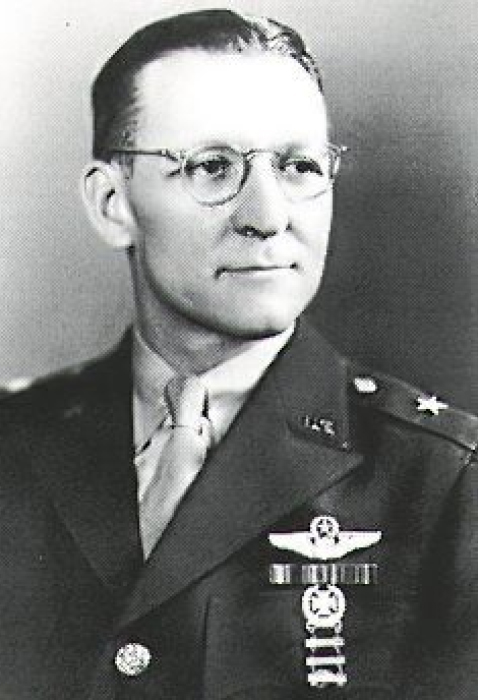
Brigadier General, U.S. Army
Support & adopt this hero ↓
Airpower Planner, Bomber Commander and Medal of Honor Recipient
Kenneth Newton Walker was an American military aviator, airpower planner, and combat commander whose career spanned the formative years of United States military aviation and the opening phase of the Second World War in the Southwest Pacific. Born in Cerrillos, New Mexico, on July 17, 1898, Walker enlisted in the United States Army at Denver on December 15, 1917. He trained at the University of California’s School of Military Aeronautics and at Mather Field, receiving his commission and flying wings in November 1918. He later received a commission in the Regular Army in 1920 and spent several of his early service years as a flying instructor.
During the 1920s and 1930s, Walker built experience in intelligence, bombardment operations, command, and professional military education. He served in the Philippines as commander of the Air Intelligence Section at Camp Nichols and later held assignments at Langley Field that included command of the 11th Bomb Squadron and operations duties with the 2nd Bomb Group. After graduating from the Air Corps Tactical School in 1929, he joined its faculty as an instructor, continuing his work with the school after its move to Maxwell Field before attending the Command and General Staff School. Subsequent assignments included duties with the 7th Bomb Group, command of the 9th Bomb Squadron, and aviation posts in Hawaii.
Walker became closely associated with the development of American bombardment doctrine. His years at the Air Corps Tactical School placed him among officers examining how long-range airpower might be used against an enemy’s military and industrial capacity. In January 1941 he returned to Washington as Assistant Chief, Plans, in the Office of the Chief of Air Corps. Later that year, following the creation of the Air War Plans Division, Walker joined Harold L. George and Haywood S. Hansell Jr., with Laurence S. Kuter temporarily assigned to the group, in the core planning team responsible for AWPD-1, a major Army Air Forces requirements and strategy plan prepared as the United States moved closer to global war. Air University’s historical study shows that the group addressed not only aircraft requirements, but also strategy, timing, targeting, production, manpower, training, organization, support, and basing.
In April 1942, Walker moved to the Operations Division of the War Department General Staff. He was promoted to brigadier general in July 1942 and sent to the Southwest Pacific, where on September 5 he became commanding general of V Bomber Command, commonly referred to in contemporary accounts as Fifth Bomber Command, of the Fifth Air Force. The command was operating in a difficult theater with limited aircraft, crews, and other resources under demanding operational conditions. Walker did not confine himself to headquarters work; he repeatedly accompanied bomber formations on combat missions so that he could observe their performance and use firsthand experience to improve tactics and training. Air University records that this practice contributed both valuable operational information and a noticeable improvement in the morale of bomber personnel.
His willingness to share the risks faced by his crews brought formal recognition. In August 1942, Walker received the Silver Star; Air University’s history records that the citation emphasized the value of the firsthand information he obtained during combat operations and the effect of his conduct on morale. Following his disappearance, he was also awarded the Legion of Merit in recognition of his earlier staff work, including his contribution to AWPD-1 and to the wartime reorganization of the American air forces.
On January 5, 1943, Walker participated in a bombing mission against Japanese shipping near Rabaul, New Britain. According to the Defense POW/MIA Accounting Agency, he was aboard B-17F Flying Fortress serial number 41-24458, nicknamed San Antonio Rose, which departed as the lead aircraft carrying nine crew members and two passengers. Walker was serving as an observer aboard the aircraft. After the attack, the bomber was last seen separating from the formation east of Vunakanau airdrome, heading south while being closely pursued by enemy aircraft. Searches for the aircraft, crash site, and survivors were unsuccessful. Walker’s remains have never been recovered, and DPAA currently lists him as Unaccounted For.
Walker’s actions as commander of V Bomber Command resulted in the award of the Medal of Honor. The official recipient record credits him with repeatedly accompanying bombing missions into enemy-held territory and with using experience gained under combat conditions to develop more effective bombing techniques against fighter and antiaircraft opposition. During the January 5 attack on Rabaul, his force achieved direct hits on nine enemy vessels despite extremely heavy antiaircraft fire and determined fighter opposition. The Medal of Honor was issued under General Orders No. 13 on March 11, 1943. President Franklin D. Roosevelt presented the medal to Walker’s 16-year-old son, Kenneth N. Walker Jr., in the Oval Office on March 25, 1943, while Walker remained officially missing.
Walker’s historical significance extends beyond his final mission. His work in air-war planning placed him among the small group that translated prewar American bombardment doctrine into a large-scale wartime air plan, while his command in the Southwest Pacific put those ideas into the far less predictable environment of active combat. The official U.S. Air Force biography identifies his AWPD-1 work as part of his lasting contribution to the development of American airpower. In January 1948, Roswell Army Air Field in New Mexico was redesignated Walker Air Force Base in his honor, and Walker Hall at Maxwell Air Force Base was likewise named for him.
Today, Kenneth N. Walker is memorialized on the Walls of the Missing at Manila American Cemetery in the Philippines. DPAA continues to classify his case as Active Pursuit, reflecting the fact that his loss has not been resolved through the recovery and identification of his remains. His record therefore combines two distinct legacies: his contribution to the development of American strategic air planning and his personal leadership of bomber forces in combat during one of the most difficult periods of the Pacific war.
Publication verdict: this corrected version is suitable to publish. The important changes were the proper January 1941 assignment, the formation and timing of AWPD, the historically precise designation of V Bomber Command, Walker's role as an observer aboard San Antonio Rose, and the distinction between the March 11 Medal of Honor award date and the March 25 presentation to his son. I would use this version over the original.
Become the named supporter for this profile and edit the tribute biography and portrait (Owner account required). Proceeds help keep the archive online.
$25 USD / year — annual sponsorship renewal. Keeps the page online and, where enabled, the family anniversary remembrance emails active.