★
Loading archive…
Loading archive…
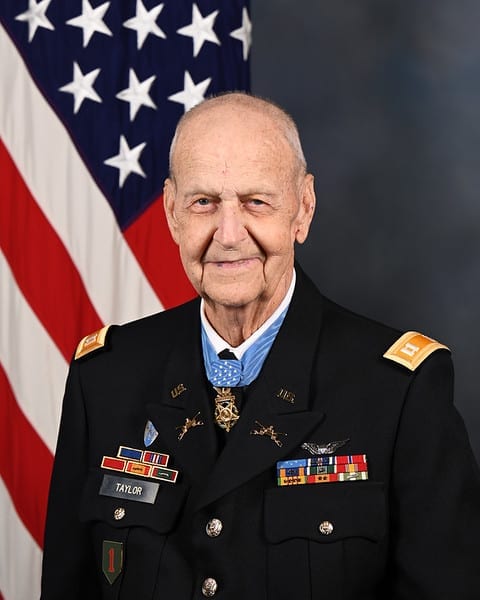
Captain, U.S. Army
Support & adopt this hero ↓
When four American soldiers were surrounded by enemy forces in a Vietnamese rice paddy, one helicopter pilot made a decision that seemed almost impossible. With ammunition running low, fuel nearly exhausted and enemy fire closing in, First Lieutenant Larry L. Taylor chose to risk everything. Rather than abandon the trapped men, he landed his two-seat Cobra attack helicopter under fire and carried all four soldiers to safety on its rocket pods and skids. His extraordinary courage on that night would eventually earn him the Medal of Honor, America's highest military decoration.
Born on February 12, 1942, in Chattanooga, Tennessee, Larry L. Taylor grew up in a family with a strong tradition of military service. Following his education at the University of Tennessee, Knoxville, he graduated in June 1966 and received his commission as a Second Lieutenant in the Army Reserve. He subsequently joined the Regular Army as an Armor officer before pursuing his ambition to become a helicopter pilot. After completing flight training at Fort Wolters, Texas, and Fort Rucker, Alabama, he qualified as an Army aviator in June 1967.
In August 1967, Taylor deployed to Vietnam, where he served with D Troop (Air), 1st Squadron, 4th Cavalry Regiment, 1st Infantry Division. Flying UH-1 Huey helicopters and the newly introduced Bell AH-1G Cobra attack helicopter, he participated in more than 2,000 combat missions. His aircraft came under enemy fire 340 times, and he was forced down on five occasions. Throughout his deployment, Taylor demonstrated exceptional flying skill, determination and an unwavering commitment to the soldiers he supported.
His defining moment came on June 18, 1968, near Ap Go Cong in Binh Duong Province, Republic of Vietnam. Commanding a team of two Cobra gunships, Taylor responded to an urgent request for assistance from a four-man long-range reconnaissance patrol surrounded by a much larger Viet Cong force. For approximately 45 minutes, he and his wingman made repeated low-level attack runs, using rockets and machine guns to suppress enemy positions. When the patrol's escape route proved too dangerous and both helicopters were running critically low on ammunition and fuel, Taylor devised an unprecedented extraction plan. After directing his wingman to return to base, he used his remaining ammunition to open an escape route, landed his Cobra under intense enemy fire and instructed the four soldiers to climb aboard wherever they could. With the men clinging to the helicopter's rocket pods and skids, he successfully flew them to safety.
The official Medal of Honor citation recognizes Taylor's conspicuous gallantry and intrepidity at the risk of his life, above and beyond the call of duty. Originally recognized with the Silver Star for this rescue, his award was upgraded to the Medal of Honor following a lengthy recognition effort. President Joseph R. Biden presented him with the nation's highest military decoration at the White House on September 5, 2023. His other documented combat decorations included two Distinguished Flying Crosses, a Bronze Star Medal, 43 Air Medals and the Republic of Vietnam Gallantry Cross with Bronze Star. His unit's Vietnam service was also recognized through the Valorous Unit Award, the Republic of Vietnam Gallantry Cross Unit Citation with Palm and the Republic of Vietnam Civil Actions Honor Medal First Class Unit Citation.
Following his Vietnam service, Taylor continued his military career with the 2nd Armored Cavalry Regiment in West Germany, ultimately attaining the rank of Captain. After leaving the Army, he returned to Tennessee, where he operated a roofing and sheet metal business and remained active in veterans' organizations and charitable activities. His dedication to fellow veterans and his community continued long after his military service ended.
Larry L. Taylor passed away on January 28, 2024, at his home in Signal Mountain, Tennessee, aged 81. His remarkable rescue of four American soldiers remains a powerful example of courage, ingenuity and the determination to leave no comrade behind. His Medal of Honor citation preserves the story of a helicopter pilot who, when faced with an almost impossible choice, refused to leave his fellow soldiers to their fate.
Medal of Honor citation: For conspicuous gallantry and intrepidity at the risk of his life above and beyond the call of duty:
First Lieutenant Larry L. Taylor distinguished himself by acts of gallantry and intrepidity above and beyond the call of duty while serving with Troop D (Air), 1st Squadron, 4th Cavalry, 1st Infantry Division, on June 18, 1968, near the village of Ap Go Cong, Republic of Vietnam. On this date, First Lieutenant Taylor commanded a light fire team of two Cobra helicopter gunships scrambled on a nighttime mission in response to an urgent call for aerial fire support from a four-man long range patrol team. Upon arrival, First Lieutenant Taylor found the patrol team surrounded and heavily engaged by a larger Viet Cong force. He immediately requested illumination rounds from supporting artillery to assist with identifying the enemy positions. Despite intense enemy ground fire, he flew at a perilously low altitude placing a devastating volume of aerial rocket and machine gun fire on the enemy forces encircling the friendly patrol. For approximately 45 minutes, First Lieutenant Taylor and his wingman continued to make low-level danger-close attack runs on the surrounding enemy positions. When enemy fire increased from the village of Ap Go Cong, he requested artillery rounds with lower illumination altitudes be fired on that portion of the village so that the burning rounds ignited the enemy positions. With both Cobra gunships nearly out of ammunition and the enemy still closing in on the patrol team, First Lieutenant Taylor flew the patrol team’s potential ground evacuation route, finding it unviable based on the heavy enemy fire encountered. Returning to the patrol team’s location, he continued to circle it at a low level under intense enemy fire, employing his search light to make fake gun runs on the enemy positions to distract them from the patrol team. Running low on fuel and with the patrol team nearly out of ammunition, First Lieutenant Taylor decided to extract the team with his two-man Cobra helicopter gunship, a feat never before accomplished. He directed his wingman to fire their remaining mini-gun rounds on the patrol team’s east flank. First Lieutenant Taylor then fired his own last mini-gun rounds on the enemy positions, opening an avenue of movement to the east for the patrol team. He directed the patrol team to move 100 yards towards the extraction point where First Lieutenant Taylor, still under enemy fire, landed his helicopter and instructed the patrol team to climb aboard anywhere they could. With the four-man long range patrol team seated on rocket-pods and skids, he evacuated them to the nearest friendly location, undoubtedly saving their lives. First Lieutenant Taylor’s conspicuous gallantry, his profound concern for his fellow soldiers, and his intrepidity at the risk of his life above and beyond the call of duty are in keeping with the highest traditions of military service and reflect great credit upon himself, his unit, and the United States Army.
Become the named supporter for this profile and edit the tribute biography and portrait (Owner account required). Proceeds help keep the archive online.
$25 USD / year — annual sponsorship renewal. Keeps the page online and, where enabled, the family anniversary remembrance emails active.