★
Loading archive…
Loading archive…
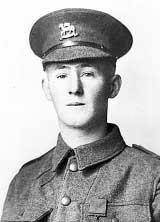
Corporal, British Army
Support & adopt this hero ↓
The Young Soldier Who Stood Alone on the German Parapet at Givenchy
For two hours, exposed to enemy fire and surrounded by German soldiers only yards away, one young British soldier refused to leave his position. As bullets and grenades tore through the battlefield, Lance-Corporal Leonard James Keyworth continued throwing bombs into the German lines, displaying extraordinary courage during one of the fiercest encounters of the First World War. His actions at Givenchy in May 1915 would earn him the Victoria Cross, Britain's highest award for gallantry in the face of the enemy. Yet his story is also one of sacrifice, because the young soldier who survived that remarkable act of bravery would not live to see the end of the war.
Leonard James Keyworth was born in Lincoln, England, in 1893. He was educated at Rosemary Lane Wesleyan School and the Municipal Technical School in Lincoln. Before the outbreak of the First World War, he worked for William Foster & Co, an engineering firm, and later as a clerk in the offices of Burton, Scorer and White, solicitors. Away from his employment, Keyworth enjoyed football and cricket, sang in the choir of the United Methodist Church in Silver Street and was associated with the local YMCA. He was a young man with an ordinary civilian life ahead of him, until the outbreak of war changed everything.
Eager to serve his country, Keyworth initially attempted to enlist in the Lincolnshire Regiment in 1914 but was rejected. Undeterred, he joined the 24th (County of London) Battalion, The London Regiment (The Queen's), in September 1914. He became part of the 1/24th Battalion, which was sent to France on 16 March 1915 as the British Expeditionary Force continued its struggle on the Western Front. The battalion soon found itself facing the brutal realities of trench warfare, where machine-gun fire, artillery bombardments and determined German resistance made even the smallest advance extraordinarily costly.
The defining moment of Keyworth's military service came during the night of 25-26 May 1915 at Givenchy, France. Following a successful assault against a German position, the 24th Battalion attempted to exploit its gains with a further bomb attack. The fighting quickly became devastating. Of the 75 men involved in the bombing operation, 58 became casualties. Amid the intense enemy fire, Keyworth displayed exceptional determination and disregard for his personal safety. He stood fully exposed on top of the German parapet for approximately two hours, throwing around 150 bombs among enemy soldiers who were only a few yards away. His extraordinary actions took place in full view of the enemy and under conditions in which survival seemed increasingly uncertain.
The official recognition of his courage followed swiftly. Keyworth was awarded the Victoria Cross for his conspicuous bravery at Givenchy, with the award announced in the London Gazette on 3 July 1915. On 12 July 1915, King George V personally invested him with the Victoria Cross at Buckingham Palace. His return to Lincoln was met with a hero's welcome. During his visit, he addressed staff and pupils at his former school, where his Victoria Cross was passed around for them to see. He also received an illuminated address and a purse of money in recognition of his remarkable achievement. His gallantry attracted international recognition as well, and he received the Imperial Russian Medal of St George, 2nd Class, for bravery.
But Keyworth's war was far from over. After returning to the Western Front, he continued serving with his battalion during the autumn operations of 1915. In October, the 24th Battalion became involved in fighting around Hulluch. On 15 October 1915, Keyworth was wounded in the head during the operations. He was evacuated through a field ambulance and transferred to a hospital at Abbeville, France. Despite medical attention, his injuries proved fatal. On 19 October 1915, aged just 22, Leonard James Keyworth died without regaining consciousness.
His death brought a tragic end to a life defined by extraordinary courage and devotion to duty. He was subsequently buried in Abbeville Communal Cemetery in France, where his grave remains a lasting place of remembrance. His name is commemorated on memorials in Lincoln, while in Southwark, London, a street was renamed Keyworth Street in 1919 in recognition of his sacrifice. His memory has also endured through the military and educational institutions associated with his name.
Leonard James Keyworth's honours reflected both his exceptional bravery and his service during the First World War. Alongside the Victoria Cross, his medal group included the 1914-15 Star, the British War Medal 1914-1920, the Victory Medal 1914-19 and the Imperial Russian Medal of St George, 2nd Class.
The story of Leonard James Keyworth VC is not simply the story of a soldier who performed an extraordinary act of bravery. It is the story of a young man who answered his country's call, faced overwhelming danger without hesitation and continued serving even after becoming one of Britain's most celebrated heroes. At Givenchy, he stood exposed above the enemy trenches for two hours, refusing to abandon his comrades or his mission. His life was tragically short, but his courage secured his place among the Victoria Cross recipients of the First World War. More than a century later, Leonard James Keyworth remains a powerful example of the extraordinary bravery and sacrifice shown by ordinary soldiers in the face of war.
Become the named supporter for this profile and edit the tribute biography and portrait (Owner account required). Proceeds help keep the archive online.
$25 USD / year — annual sponsorship renewal. Keeps the page online and, where enabled, the family anniversary remembrance emails active.