★
Loading archive…
Loading archive…
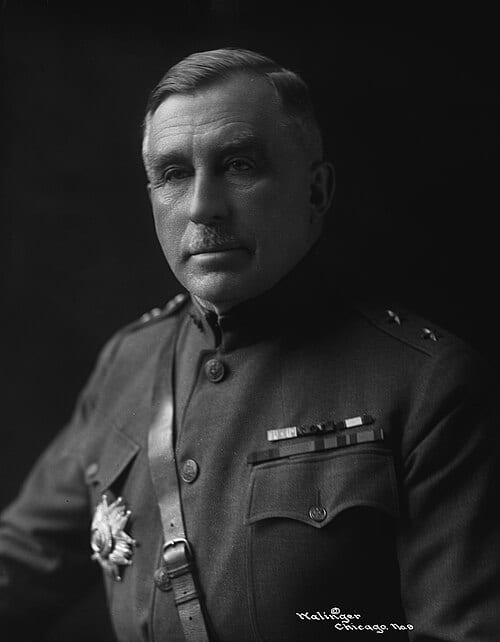
Major General, U.S. Army
Support & adopt this hero ↓
Before he became a Major General, commanded the legendary Rough Riders, and served as Chief of Staff of the United States Army, Leonard Wood was a physician who risked his life pursuing one of the most elusive Apache leaders in American history. His extraordinary courage during the campaign against Geronimo earned him the Medal of Honor, but it was only the beginning of a remarkable military and public career.
Leonard Wood was born on 9 October 1860 in Winchester, New Hampshire. Raised in Massachusetts, he pursued a medical education at Harvard Medical School, graduating with a medical degree in 1884. Although trained as a physician, Wood possessed a lifelong ambition to serve in the military. In 1885, he entered United States Army service as a contract surgeon, beginning a career that would eventually take him from the American frontier to the highest levels of military command.
In 1886, Wood was assigned to the Department of Arizona during the final campaigns against the Apache under Geronimo. His medical responsibilities did not prevent him from volunteering for dangerous field assignments. During the pursuit, he carried dispatches through hostile territory, travelling approximately 70 miles in one night and walking another 30 miles the following day. He also volunteered to command an infantry detachment that had been left without an officer. His courage and determination earned him the Medal of Honor, formally awarded on 8 April 1898. This remarkable achievement established his reputation as an officer willing to place himself in danger alongside the soldiers under his responsibility.
Wood's career took another dramatic turn during the Spanish-American War of 1898. Together with his close friend Theodore Roosevelt, he helped organize the 1st United States Volunteer Cavalry Regiment, famously known as the Rough Riders. As the regiment's commanding officer, Colonel Wood led his men during the Cuban campaign, including the engagements at Las Guasimas and San Juan Heights. His leadership and battlefield performance brought rapid promotion to brigadier general, after which Roosevelt assumed command of the regiment.
Following the American victory, Wood remained in Cuba and became military governor of Santiago before assuming responsibility for the administration of the island. Serving as military governor of Cuba from 1899 to 1902, he oversaw major reforms in public health, sanitation, education and government administration. His efforts included an important campaign against yellow fever, a disease that had long devastated the island. His Cuban administration became one of the defining chapters of his career, demonstrating his abilities as both a soldier and an administrator.
In 1903, Wood was transferred to the Philippines, where he became governor of Moro Province in Mindanao. He served in this position until 1906, overseeing a challenging period of military administration and resistance under American colonial rule. He subsequently commanded the Philippine Division from 1906 to 1908 and later the Department of the East. His service in the Philippines further established his reputation as an influential military commander and administrator.
In 1910, President William Howard Taft appointed Wood Chief of Staff of the United States Army. Serving from 1910 to 1914, he became the first and only medical officer to hold this prestigious position. Recognizing the need for a stronger and better-prepared military, he championed reforms in Army organization, professional education, officer training and national defence. Working alongside other advocates of military preparedness, including Theodore Roosevelt, Wood supported the development of training programmes that would help prepare American forces for the challenges of modern warfare. His advocacy for the Plattsburgh training camps became an important part of the American preparedness movement.
When the United States entered the First World War in 1917, Wood was eager to serve in an overseas command. Although he was not selected to lead the American Expeditionary Forces in Europe, he played an important role in preparing American troops for war. He commanded the 89th Division and supervised training activities at Camp Funston, Kansas, later contributing to the organization and training of the 10th Division. His experience as a physician, combat veteran and senior commander made him an influential figure in the Army's wartime mobilization.
After the war, Wood continued to serve in senior military responsibilities and became a leading contender for the Republican presidential nomination in 1920. Although he did not secure the nomination, his national reputation remained strong. In 1921, he retired from active military service and was appointed Governor-General of the Philippine Islands by President Warren G. Harding.
Wood returned to the Philippines for the final chapter of his public career, serving as Governor-General from 1921 until 1927. His administration operated during a significant period of political debate over American colonial governance and the future of Filipino self-government. He remained in office until his health deteriorated.
Leonard Wood died in Boston, Massachusetts, on 7 August 1927, following complications associated with a brain tumour. He was buried at Arlington National Cemetery, Virginia, among the nation's most distinguished military figures.
From a Harvard-trained physician on the Apache frontier to a Medal of Honor recipient, Rough Riders commander, Major General, Army Chief of Staff and Governor-General of the Philippines, Leonard Wood lived a career defined by ambition, courage, military preparedness and public service. His legacy remains an important part of American military history, particularly the transformation of the United States Army during the decades surrounding the Spanish-American War and the First World War.
Become the named supporter for this profile and edit the tribute biography and portrait (Owner account required). Proceeds help keep the archive online.
$25 USD / year — annual sponsorship renewal. Keeps the page online and, where enabled, the family anniversary remembrance emails active.