★
Loading archive…
Loading archive…
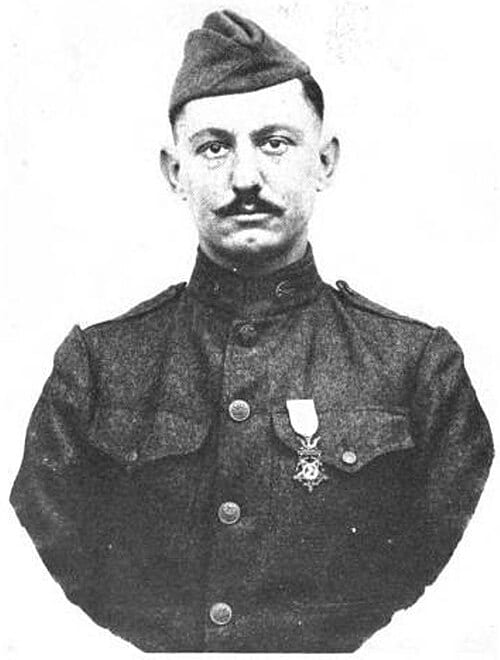
Sergeant and later Chief Warrant Officer, U.S. Army
Support & adopt this hero ↓
Already ill, wounded, and surrounded by devastating enemy fire, Sergeant Lloyd Martin Seibert faced a choice that would define his life. On September 26, 1918, near Épinonville, France, he could have withdrawn from the battlefield. Instead, he led his men into danger, attacked an enemy machine-gun position, and risked his life to save wounded comrades. His extraordinary courage earned him the Medal of Honor, America's highest military decoration. Yet what he did after being wounded made his actions even more remarkable.
Born on May 23, 1889, in Caledonia, Michigan, Lloyd Martin Seibert began his military career with the California National Guard in 1906. During World War I, he served with Company F, 364th Infantry Regiment, 91st Division, American Expeditionary Forces. His unit entered the brutal fighting of the Meuse-Argonne Offensive as Allied forces struggled to break through heavily defended German positions.
On September 26, 1918, despite suffering from illness, Seibert refused to leave his platoon. Under intense artillery and machine-gun fire, he demonstrated exceptional leadership, advancing with two fellow soldiers against a German machine-gun emplacement. Armed with a shotgun, he killed one enemy defender and captured two others. Wounded during the assault, he refused to abandon his responsibilities.
When American troops received orders to withdraw, Seibert remained with the last elements of his unit, assisting a wounded comrade. Later that evening, he volunteered to carry additional wounded soldiers to safety. He continued until physical exhaustion finally caused him to collapse. His Medal of Honor citation recognized both his battlefield leadership and his extraordinary devotion to his fellow soldiers. General John J. Pershing personally presented him with the Medal of Honor on January 27, 1919, in France, with the award recorded under War Department General Orders No. 445 of 1919.
Seibert's courage also earned international recognition. A contemporary 1931 account identified him as a recipient of a Silver Star Citation, the French Médaille militaire, the French Croix de Guerre with Palm, an Italian war cross, and the Montenegrin Medal for Military Bravery. His combat wound supports the Purple Heart, while his World War I Victory Medal reflected the campaign service credited to his military record. The Silver Star Medal later succeeded the earlier Silver Star Citation system.
His military career continued long after the guns of World War I fell silent. In August 1937, while assigned to the 1st Cavalry at Fort Knox, Kentucky, Seibert was appointed a warrant officer. He eventually attained the rank of Chief Warrant Officer and retired from the United States Army on June 30, 1944. According to the family account published by the National WWI Museum and Memorial, he returned to service with the Harbor Defenses in San Francisco in 1945 and retired again in April 1946. His service during the World War II era is reflected in the American Defense Service Medal, American Campaign Medal, and World War II Victory Medal.
Despite the decorations and recognition he received, Seibert rarely discussed his wartime experiences with his granddaughter. His family later helped preserve his legacy by donating his service medals, including his Medal of Honor and its citation, to the National WWI Museum and Memorial.
Lloyd Martin Seibert died on October 15, 1972, at the age of 83. He rests at San Francisco National Cemetery, where his service remains part of America's military heritage. His story is a reminder that true heroism is measured not only by courage in battle, but also by the willingness to risk everything for others. Wounded and exhausted, Seibert continued fighting and saving lives when he had every reason to stop.
Become the named supporter for this profile and edit the tribute biography and portrait (Owner account required). Proceeds help keep the archive online.
$25 USD / year — annual sponsorship renewal. Keeps the page online and, where enabled, the family anniversary remembrance emails active.