★
Loading archive…
Loading archive…
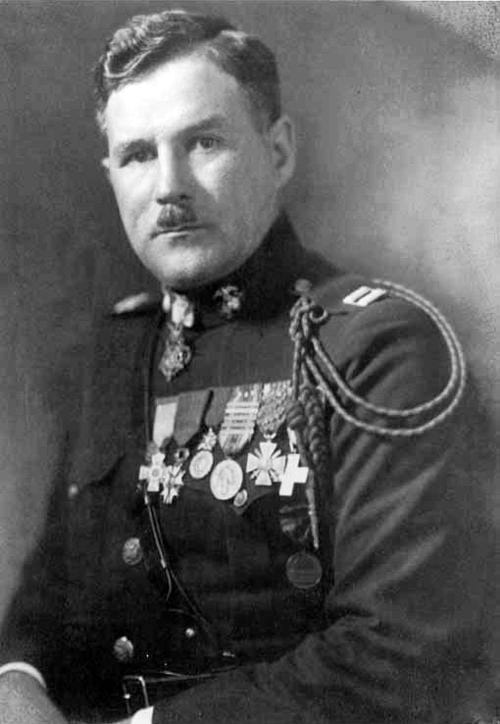
Corporal (Army) Major (Marine Corps), U.S. Marine Corps
Support & adopt this hero ↓
The Marine Who Earned Two Medals of Honor for One Astonishing Attack
Few American servicemen ever received the Medal of Honor twice. Major Louis Cukela was one of them. Even more extraordinary, both his Army and Navy Medals of Honor recognized the same fearless attack in France during World War I, when he advanced alone against a German strongpoint, fought through machine-gun fire, and shattered a position that had stopped his fellow Marines.
Born on 1 May 1888 in Sebenes, Austria, now Šibenik, Croatia, Louis Cukela immigrated to the United States in 1913 and settled with his brother in Minnesota. He entered military service on 21 September 1914, enlisting in the U.S. Army. Cukela served with Company H, 13th Infantry, rose to corporal, and received an honorable discharge in June 1916. He was not finished with military life. In January 1917 he enlisted in the United States Marine Corps, beginning the career that would make him one of the most highly decorated Marines of the First World War.
After the United States entered World War I, Cukela deployed to France with the 66th Company, 5th Regiment, 2nd Division, American Expeditionary Forces. He fought through some of the hardest campaigns faced by American troops on the Western Front. His record included service connected with the Aisne, Aisne-Marne, St. Mihiel, Meuse-Argonne and Defensive Sector campaigns. He was also wounded twice, first at Jaulny during the St. Mihiel fighting on 16 September 1918 and again during operations in the Champagne sector.
But it was 18 July 1918 near Villers-Cotterêts in the Forest de Retz that made Louis Cukela a legend. His company was advancing through woodland when a heavily defended German strongpoint stopped the attack. Instead of waiting for reinforcements, Cukela moved out alone. The official Navy Medal of Honor citation records that he ignored warnings from his comrades, crawled through heavy enemy fire, worked around the flank and reached the rear of the position. He then charged a machine-gun emplacement, killed or drove off its crew with his bayonet, used captured German hand grenades against the remaining defenders, and finished the assault by capturing four enemy soldiers and two machine guns.
The Army Medal of Honor citation, issued through War Department General Orders No. 34 of 7 March 1919, describes the same remarkable action. It emphasizes that Cukela made his way toward the German lines despite heavy fire, reached the rear of the enemy strongpoint, rushed the machine gun crew, and then bombed the remaining position with German grenades before taking prisoners and capturing the guns. For this one act of extraordinary heroism, both the U.S. Army and the U.S. Navy awarded Louis Cukela the Medal of Honor.
There is an important detail behind the rank recorded in those citations. Although the Medal of Honor documents identify him as a sergeant, Marine Corps historical records state that Cukela had actually been promoted to gunnery sergeant on 1 July 1918. His warrant did not reach the field until 20 August, which likely explains why the lower rank appeared in the official citations.
Cukela's courage was not confined to a single battle. His World War I record produced three 2nd Division citations for gallantry, later associated with his Silver Star entitlement. One citation recognized his conduct with the 5th Marines during operations at Toulon-Tryon from 14 March to 15 May 1918. Another recognized gallantry during the fighting around Soissons from 18 to 22 July 1918. The citation orders authorized a silver star to be worn on his Victory Medal for gallantry in action, the system from which the later Silver Star Medal developed.
His heroism also drew international recognition. France awarded Cukela the Médaille militaire, making him the first Marine officer recorded by the Marine Corps as receiving that distinction, as well as the Légion d'honneur in the rank of Chevalier and the Croix de Guerre, including awards represented by two palms and a silver star. Italy honored him with the Croce al Merito di Guerra, while Yugoslavia awarded him the Commander's Cross of the Royal Order of the Crown. He was also entitled to wear the French Fourragère associated with his distinguished World War I service.
War transformed Cukela from an enlisted Marine into an officer. He received a field appointment as a second lieutenant in the Marine Corps Reserve on 26 September 1918, followed by selection for a regular Marine Corps commission in March 1919. He became a first lieutenant that July and a captain in September 1921. His postwar service carried him through Haiti, Santo Domingo, the Philippines and China, as well as assignments at Quantico, Washington, Norfolk, Mare Island, Fort Knox and other American stations. In China he served with the 3rd Marine Brigade during an era when the Corps maintained forces to protect American interests amid political instability.
Cukela retired from active service on 30 June 1940 and was promoted to major on the retired list. Retirement lasted only a month. On 30 July 1940 he was recalled to active duty as international tensions moved the United States closer to another global war. During World War II, the veteran Marine served at the Navy yards at Norfolk, Virginia, and Philadelphia, Pennsylvania. He finally returned to inactive retired status on 17 May 1946, completing almost 32 years of combined active Army and Marine Corps service.
Major Louis Cukela died on 19 March 1956 at the U.S. Naval Hospital in Bethesda, Maryland. He was buried with full military honors at Arlington National Cemetery three days later. His grave marks the resting place of one of only a tiny number of Americans ever awarded two Medals of Honor.
Louis Cukela's legacy is larger than the extraordinary ribbon rack he left behind. He was an immigrant who entered the U.S. Army as an enlisted soldier, became a Marine, survived brutal combat on the Western Front, earned repeated citations for gallantry, received some of the highest military honors of several nations, and ultimately retired as a major. Yet his reputation still returns to one moment in a French forest in July 1918: one Marine, advancing alone through enemy fire, deciding that a German machine-gun strongpoint would not stop his company.
Become the named supporter for this profile and edit the tribute biography and portrait (Owner account required). Proceeds help keep the archive online.
$25 USD / year — annual sponsorship renewal. Keeps the page online and, where enabled, the family anniversary remembrance emails active.