★
Loading archive…
Loading archive…

Major James Capers Jr. was one of the most remarkable Marines of the Vietnam War: an enlisted Marine who became a commissioned officer, a Force Reconnaissance pioneer, a battlefield leader, and, nearly six decades after his defining action, a recipient of the Medal of Honor.
Capers was born in Bishopville, South Carolina, and enlisted in the United States Marine Corps in 1956. He served ten years as an enlisted Marine, rising to the rank of sergeant before earning a battlefield commission in 1966. His career path was rare even in a hard war: he moved from enlisted infantryman to officer, then to the command of an elite reconnaissance company, and retired in 1978 after twenty-two years of service as a major.
In Vietnam, Capers served with 3d Reconnaissance Battalion, 3d Marine Division. At the time of his Medal of Honor action, he was a second lieutenant serving as a team leader with 3d Force Reconnaissance Company. His work belonged to the dangerous world of long-range reconnaissance: small teams inserted deep into enemy territory to locate base camps, gather intelligence, call supporting fires, and survive long enough to get out.
His Medal of Honor action occurred from March 31 to April 3, 1967, near Phu Loc, Republic of Vietnam. Capers and his team were ordered to locate a suspected North Vietnamese regimental base camp. During the four-day reconnaissance patrol, they made contact with a numerically superior enemy force on three separate occasions. Despite this, Capers continued the mission and successfully directed fire onto the enemy base camp, disrupting an impending attack against a nearby Marine battalion.
On the final day of the patrol, Capers’ team was ambushed by a claymore mine and then hit by dense enemy fire. Capers was severely wounded and suffered significant blood loss, but he continued to lead. He coordinated supporting fire, directed the movement of his team toward extraction, and refused evacuation until his men were safe. Only after the team had been extracted did he board the helicopter himself.
For this action, Capers was originally awarded the Silver Star. In 2026, his award was upgraded to the Medal of Honor, the United States’ highest military decoration. President Donald J. Trump signed legislation authorizing the award on March 26, 2026, and presented the Medal of Honor to Major Capers at the White House on June 18, 2026.
Capers’ decorations reflect a career of repeated combat service and sacrifice. Publicly listed awards include the Medal of Honor, Silver Star, two Bronze Star Medals with Combat “V”, three Purple Hearts, the Republic of Vietnam Cross of Gallantry, Joint Service Commendation Medal, Combat Action Ribbon, three Good Conduct awards, Navy Commendation Medal, Navy Achievement Medal, and other commendations and letters.
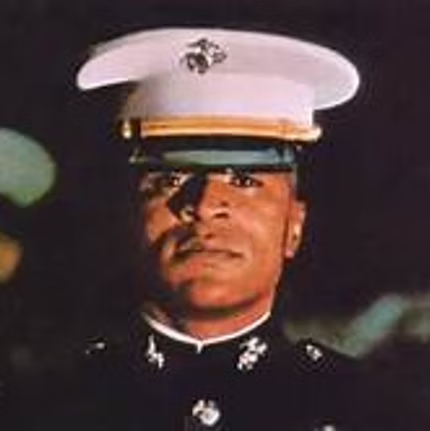
Capers also holds a special place in Marine Corps history beyond the medals. He is described as the first African American to command a Marine Recon company and the first enlisted African American Marine officer to receive a battlefield commission. After Vietnam, while still recovering from combat injuries, he was selected to represent the Marine Corps in a national recruiting campaign, making his image one of the most recognizable Marine recruiting portraits of the era.
Major James Capers Jr.’s story is not simply the story of one ambush or one medal. It is the story of a Marine who earned trust the hardest way possible: by leading from the front, staying on mission under impossible pressure, and refusing to leave his men behind. At Phu Loc, badly wounded and losing blood, he still acted as a commander first. That is why his Medal of Honor belongs in the highest rank of military history: not only as recognition of gallantry, but as recognition of leadership, endurance, and absolute loyalty to his team.
Become the named supporter for this profile and edit the tribute biography and portrait (Owner account required). Proceeds help keep the archive online.
$25 USD / year — annual sponsorship renewal. Keeps the page online and, where enabled, the family anniversary remembrance emails active.