★
Loading archive…
Loading archive…
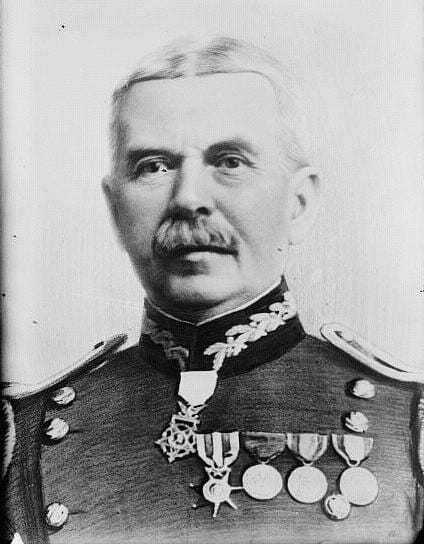
Brigadier general, U.S. Army
Support & adopt this hero ↓
When an American military expedition deep in Mexico lost its commander in a deadly confrontation, a young lieutenant faced an extraordinary test of courage and leadership. Marion Perry Maus stepped forward, took command, and led his men through danger and uncertainty. His actions became part of a remarkable military career that earned him the Medal of Honor and carried him from the American frontier to the rank of brigadier general.
Born on August 25, 1850, in Burnt Mills, Maryland, Marion Perry Maus graduated from the United States Military Academy at West Point in 1874 and received a commission in the 1st U.S. Infantry. His early service unfolded during the American Indian Wars, when the United States Army conducted campaigns across the western territories.
During the Nez Perce campaign of 1877, Maus commanded scouts under Colonel Nelson A. Miles. He helped locate the retreating Nez Perce force and participated in the fighting at Bear Paw Mountain, Montana. During the engagement, he distinguished himself through personal courage and played a role in securing the release of a captured American officer. For his conduct at Bear Paw on October 1, 1877, Maus received a War Department silver star citation recognizing his gallantry in action.
His most famous military exploit came during the pursuit of Apache leaders Geronimo and Natchez in the Sierra Madre Mountains of Mexico. In January 1886, Maus accompanied Captain Emmet Crawford's expedition and commanded Apache scouts. The force engaged hostile Apache fighters near the Aros River before encountering Mexican troops in a confrontation that fatally wounded Crawford.
With the expedition's commander lost, Maus assumed responsibility for the surviving force. Despite dangerous conditions, uncertain supplies and the threat of further hostilities, he successfully directed the expedition back toward the United States.
For his distinguished gallantry during the operations at Rio Aros on January 11, 1886, First Lieutenant Maus received the Medal of Honor on November 27, 1894. His official Medal of Honor citation praised his "most distinguished gallantry in action with hostile Apaches led by Geronimo and Natchez." His earlier Bear Paw citation represented a separate act of gallantry, recorded in the historical military register.
Maus subsequently served as an aide to General Nelson A. Miles and participated in military operations during the unrest at Pine Ridge in 1890 and 1891. His military experience also carried him overseas during the Spanish-American War of 1898. Accompanying Miles to Cuba, he participated in the conferences surrounding the surrender of Spanish forces at Santiago and then accompanied the American expedition to Puerto Rico. His documented service established qualifying periods for the Spanish Campaign Medal and the Army's Cuban and Puerto Rican occupation medals.
In 1903, Maus deployed to the Philippines as a lieutenant colonel of the 22nd Infantry. He participated in combat operations against Moro forces in the Lake Lanao region of Mindanao, including field operations in April 1904. Promoted to colonel of the 20th Infantry, he continued commanding American troops in the Philippines. This service qualified him for the Philippine Campaign Medal.
Returning to California in 1906, Maus was assigned to military duties during the devastating San Francisco earthquake and fire. He commanded troops protecting the city's financial district and received praise for the effective performance of his command.
On June 10, 1909, Maus was promoted to brigadier general. He commanded the Department of the Columbia and later held senior assignments, including brigade command in the 1st Division. He retired in August 1913 following nearly four decades of commissioned Army service.
Marion Perry Maus died on February 9, 1930, at New Windsor, Maryland, and was buried with military honors at Arlington National Cemetery. From his gallantry at Bear Paw Mountain to his Medal of Honor actions during the pursuit of Geronimo, his military career reflected personal courage, adaptability and responsibility under extraordinarily difficult circumstances. His legacy remains that of an American Medal of Honor recipient whose service spanned some of the most significant military campaigns of the late nineteenth and early twentieth centuries.
Become the named supporter for this profile and edit the tribute biography and portrait (Owner account required). Proceeds help keep the archive online.
$25 USD / year — annual sponsorship renewal. Keeps the page online and, where enabled, the family anniversary remembrance emails active.