★
Loading archive…
Loading archive…
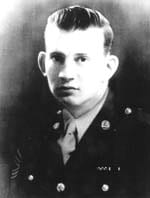
Master Sergeant, U.S. Army
Support & adopt this hero ↓
Master Sergeant Melvin Oscar Handrich earned the Medal of Honor for holding a forward position under relentless enemy attacks near Sobuk San Mountain during the Korean War. Already a veteran of the First Special Service Force and the airborne infantry of World War II, he directed supporting fire, rallied threatened defenders and refused evacuation after being wounded before being killed on 26 August 1950.
Melvin Oscar Handrich was born at Manawa, Wisconsin, on 26 January 1919. He entered the Army in August 1942 and served with the First Special Service Force, the joint American and Canadian formation known as the Devil's Brigade. His wartime service included the Aleutians and fighting in Europe, followed by service with the 508th Parachute Infantry Regiment. The 508th personnel history records him wounded in action and evacuated on 29 January 1945. He left the Army in September 1945.
Handrich reenlisted in January 1949 and went to the Far East that March. During the Korean War he served as a master sergeant with Company C, 5th Infantry Regiment. On the night of 25 August 1950, near Sobuk San Mountain, his company faced an enemy force attempting to infiltrate and overrun its position.
He voluntarily moved beyond the defensive perimeter to observe and direct mortar and artillery fire. For eight hours he remained forward despite heavy fire and enemy troops approaching within a few yards. When another attack developed the next morning, he stood in full view to fire his rifle and continue adjusting supporting fire.
Seeing some of his company's men preparing to withdraw, Handrich crossed the fire-swept ground to rally them. He reorganized the defence and restored their resistance. Although severely wounded, he refused evacuation and returned to his observation position. A further assault overran it and killed him on 26 August. The company later recovered the position.
General Omar Bradley presented Handrich's posthumous Medal of Honor to his father at the Pentagon on 21 June 1951. He was buried in Little Wolf Cemetery at Manawa. His hometown's memorial recognizes a career that began in the Second World War and ended while helping his company survive the opening campaign in Korea.
Become the named supporter for this profile and edit the tribute biography and portrait (Owner account required). Proceeds help keep the archive online.
$25 USD / year — annual sponsorship renewal. Keeps the page online and, where enabled, the family anniversary remembrance emails active.