★
Loading archive…
Loading archive…
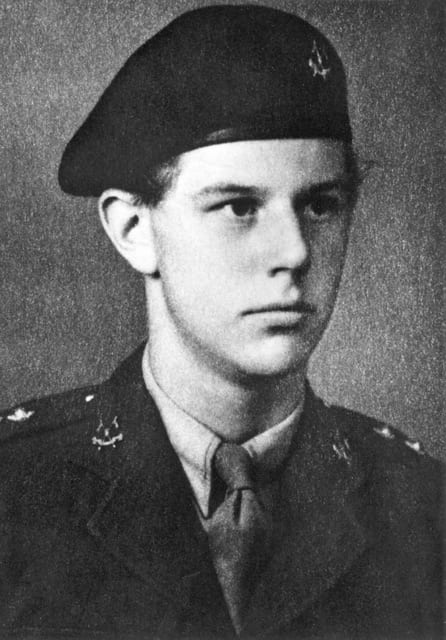
Captain, British Indian Army
Support & adopt this hero ↓
How far would a soldier go when his men were exhausted, the ground was flooded, and enemy machine guns stood between them and victory? For Captain Michael Allmand, the answer was simple. He would go first. Despite severe illness, overwhelming physical exhaustion and relentless enemy fire, this young British Indian Army officer repeatedly placed himself at the head of his men during some of the fiercest fighting of the Burma Campaign. His extraordinary courage, leadership and determination earned him the Victoria Cross, Britain's highest award for gallantry.
Michael Allmand was born on 22 August 1923 at Golders Green, London. He was the son of Arthur John Allmand, a professor of chemistry at King's College London. Educated at Ampleforth College, Michael entered Oriel College, Oxford, in 1941 to study history. However, the Second World War soon interrupted his academic ambitions. Drawn by the call of military service, he joined the armed forces and was subsequently posted to India. Commissioned into the Indian Armoured Corps on 4 April 1943, he served with the 6th Duke of Connaught's Own Lancers (Watson's Horse). His early military career included instructional duties, but Allmand was determined to experience active service rather than remain behind the lines.
His opportunity came when volunteers were sought for the Second Chindit Expedition into Japanese-occupied Burma. Allmand volunteered and was attached to the 3rd Battalion, 6th Gurkha Rifles, serving under the 77th Indian Infantry Brigade. The Chindits operated deep behind enemy lines, relying on endurance, determination and unconventional tactics to disrupt Japanese communications and military positions. Their campaign demanded extraordinary physical resilience. Dense jungle, monsoon rain, flooded rivers, disease and relentless enemy resistance made every advance a struggle for survival.
In June 1944, as the Allied forces fought to capture Mogaung, the 6th Gurkha Rifles encountered determined Japanese resistance around strategically important roads and bridges. One of the most difficult obstacles was the bridge at Pin Hmi. With the enemy defending the crossing and his men struggling to advance under intense fire, Allmand moved forward ahead of his platoon. Armed with grenades and his kukri, he personally attacked the Japanese defenders and helped clear the position, enabling his men to continue the assault. His fearless example inspired the Gurkhas to press forward despite the danger.
But the fighting was far from over. During another attack, Allmand again demonstrated exceptional leadership after other officers had become casualties. Rather than allowing the advance to collapse, he took the initiative and led his men into the enemy positions. His determination under fire became a powerful example of the courage expected of a battlefield commander.
The final act of his extraordinary service came during the fighting for the railway bridge at Mogaung. By this stage, Allmand was suffering severely from trench foot and could barely walk. The harsh conditions of the Burmese campaign had taken a terrible physical toll, yet he refused to abandon his men. As Japanese machine-gun fire threatened the advancing Gurkhas, he moved forward alone across the muddy, shell-pitted ground towards the enemy position. Despite his condition and the intense danger, he pressed home his attack against the machine-gun post. He was mortally wounded and died shortly afterwards, having demonstrated courage of the highest order.
For his outstanding gallantry and inspiring leadership during the June 1944 operations, Michael Allmand was posthumously awarded the Victoria Cross. His actions were recognised not simply for one moment of bravery, but for his repeated willingness to lead from the front under extraordinarily difficult circumstances. He was only twenty years old.
King George VI presented the Victoria Cross to his family at Buckingham Palace in July 1945. Allmand was laid to rest at Taukkyan War Cemetery in Burma, among the thousands who gave their lives during the campaign. His decoration was later entrusted by his family to the Gurkhas, preserving a lasting connection between the young officer and the soldiers whose courage he had helped lead into battle.
Captain Michael Allmand's story is one of extraordinary devotion, selflessness and battlefield leadership. He had every reason to withdraw when his body was failing him, yet he chose to continue advancing alongside his men. In the brutal conditions of the Burma Campaign, he demonstrated that true leadership is not measured by rank or age, but by the willingness to share danger and sacrifice everything for those under one's command. His Victoria Cross remains a lasting tribute to a young officer whose courage became part of the proud history of the Gurkhas and the Allied struggle in Burma.
Become the named supporter for this profile and edit the tribute biography and portrait (Owner account required). Proceeds help keep the archive online.
$25 USD / year — annual sponsorship renewal. Keeps the page online and, where enabled, the family anniversary remembrance emails active.