★
Loading archive…
Loading archive…

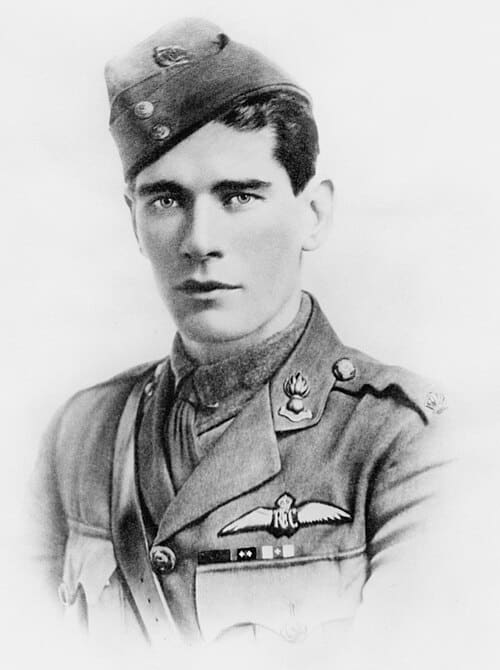
Few fighter pilots of the First World War combined personal combat success, tactical leadership and repeated recognition for gallantry as remarkably as Major Edward Corringham “Mick” Mannock VC, DSO and Two Bars, MC and Bar. In little more than a year of operational flying on the Western Front, Mannock rose from a newly trained Royal Flying Corps pilot to command No. 85 Squadron of the newly formed Royal Air Force. By the time he was killed on 26 July 1918, current Royal Air Force Museum research credits him with 61 aerial victories, placing him among the most successful British fighter pilots of the First World War.
Born on 24 May 1887, Mannock spent an important part of his early adult life in Wellingborough, Northamptonshire. He worked for the National Telephone Company and became active in the local community, playing cricket, participating in musical life and becoming involved in local politics. He also served with the local Territorial detachment of the Royal Army Medical Corps, an early connection with military service that would later become far more significant.
When the First World War began, Mannock was working in the Ottoman Empire as a telephone engineer. After the Ottoman Empire entered the war against Britain, he was interned as a British civilian. Conditions damaged his health and he was eventually repatriated to Britain. His detention was therefore civilian wartime internment rather than military prisoner-of-war service, an important distinction in understanding his wartime career.
After recovering, Mannock returned to military service. On 1 April 1916, the London Gazette recorded Edward Mannock among those appointed temporary Second Lieutenants on probation in the Corps of Royal Engineers. He subsequently entered the Royal Flying Corps and trained as a pilot, beginning the transformation from Army officer to one of the most formidable air fighting leaders of the war.
Mannock reached the Western Front in 1917 with No. 40 Squadron RFC. His early progress was not instantaneous, but once he began to master aerial combat his combination of close-range shooting, aggression and tactical awareness became increasingly evident. His first Military Cross recognized precisely those qualities. The citation, published in the London Gazette on 17 September 1917, credited him with driving off numerous enemy aircraft and forcing down three balloons, while emphasizing his willingness to attack at close range and low altitude despite heavy fire from the ground.
His reputation continued to grow. A Bar to the Military Cross followed. Its citation recorded that Mannock had destroyed several hostile aircraft and driven others down out of control. It singled out an occasion when he attacked five enemy machines alone and another fight in which two additional aircraft joined an opponent already engaging him. The citation concluded by emphasizing the courage and initiative he had shown consistently in combat. The award was announced in October 1917, with the fuller citation subsequently published in the Gazette record.
Mannock's value, however, extended well beyond his personal victories. He developed into an exceptional patrol and flight leader. After returning to operational flying with No. 74 Squadron, he placed increasing emphasis on formation discipline, tactical positioning and mutual protection. Instead of treating aerial combat simply as a contest between individual aces, he worked to give his pilots an advantage before combat began and to improve the chances that inexperienced men would return alive.
That leadership formed a central part of the citation for his Distinguished Service Order. Published in September 1918, it recorded that during a period of only seven days Mannock destroyed seven enemy aircraft while leading patrols and fighting in general engagements, bringing the total then recognized to 30. The citation praised his leadership, dash and courage as being of the highest order.
The First Bar to his DSO documented an even more concentrated series of actions. Fighting alongside another scout, Mannock attacked eight enemy aircraft and destroyed one in flames. On the following day, while leading his flight against another formation of eight, he destroyed three himself. Further combats followed against enemy formations and two-seat aircraft. Across five days, the citation credited him with eight enemy machines and concluded with an extraordinary assessment of his abilities as a patrol leader.
His Second Bar to the Distinguished Service Order was announced on 3 August 1918, after his death. The citation emphasized his shooting, his determination to close with the enemy, and above all his skilful leadership and unfailing courage. It described an action in which he attacked six hostile scouts and brought down three, followed later that day by the destruction of a two-seat aircraft that crashed into a tree. The citation originally stated that he had accounted for 48 enemy machines, but Mannock's later Victoria Cross notice specifically corrected that contemporary figure, stating that the total at that point should have been 41.
By the summer of 1918, Mannock had progressed from flight leadership to squadron command. He succeeded Canadian ace William Avery Bishop as commanding officer of No. 85 Squadron RAF, holding the rank of Captain with the acting rank of Major. His influence was quickly evident. Under Mannock, formation tactics and collective fighting became central to the squadron's operations. Rather than encouraging pilots to hunt independently, he sought to make the squadron function as a coordinated combat unit. Historical research into No. 85 Squadron records him as its commanding officer from June 1918 until his death the following month.
The creation of the Royal Air Force on 1 April 1918 placed Mannock's final months of service within the world's first independent air force. His career therefore spanned the British Army, the Royal Flying Corps and the Royal Air Force, but aviation became the arena in which his leadership and courage were most clearly demonstrated.
His final and greatest honour was the Victoria Cross. Awarded posthumously and published in the London Gazette on 18 July 1919, the citation recognized what it described as “bravery of the first order in Aerial Combat.” It detailed a remarkable sequence of operations between 17 June and 22 July 1918. Mannock destroyed a Halberstadt near Armentières, attacked and destroyed Fokker aircraft near Doulieu, crashed another Fokker near Merville, brought a two-seat aircraft down damaged, sent an Albatros two-seater to the ground in flames, destroyed another two-seater east of La Bassée, drove a Fokker down out of control near Steenwercke, and destroyed an enemy triplane near Armentières.
The Victoria Cross notice also summarized his extraordinary previous record, listing the Military Cross, Bar to the Military Cross, Distinguished Service Order, First Bar and Second Bar. It described Mannock as an outstanding example of courage, skill, devotion to duty and self-sacrifice. The same notice stated that 50 enemy machines had been definitely accounted for by the date of his death.
That figure of 50 is historically important because it was the official total printed in his Victoria Cross citation, but it is not the only total associated with Mannock. Victory accounting in First World War air combat was complicated, and later researchers have produced different totals. The Royal Air Force Museum's current historical timeline states that modern research identifies the German LVG destroyed on Mannock's final flight as his 61st victory. For a modern biography, 61 is therefore the appropriate figure when clearly attributed to current RAF Museum research, while the Gazette's official contemporary figure of 50 should be retained as part of the historical record rather than replaced or ignored.
On 26 July 1918, Mannock flew his final mission over France. After destroying a German LVG at very low altitude near the German front line around Lestrem, his aircraft was struck by ground fire. He was killed at the age of 31. His body was not recovered, and today he is commemorated by the Commonwealth War Graves Commission on the Arras Flying Services Memorial.
Edward Corringham “Mick” Mannock's place in First World War aviation history rests on more than a victory total. His combat record was exceptional, but so too was the development of his leadership. He evolved from an aggressive individual fighter pilot into a commander who understood that disciplined formations, tactical preparation and responsibility for other pilots could be as important as personal marksmanship. His Military Cross and Bar documented his courage and initiative, his DSO and two Bars increasingly emphasized his leadership and sustained success, and his posthumous Victoria Cross brought together the final record of a pilot whose operational career had lasted only a fraction of the war.
Mannock did not live to wear the Victoria Cross that now defines his name. Yet more than a century later, Major Edward Corringham “Mick” Mannock VC, DSO and Two Bars, MC and Bar remains one of the defining figures of British First World War aviation, remembered as a fighter ace, tactical leader, squadron commander and one of the Royal Air Force's most highly decorated combat pilots.
Become the named supporter for this profile and edit the tribute biography and portrait (Owner account required). Proceeds help keep the archive online.
$25 USD / year — annual sponsorship renewal. Keeps the page online and, where enabled, the family anniversary remembrance emails active.