★
Loading archive…
Loading archive…
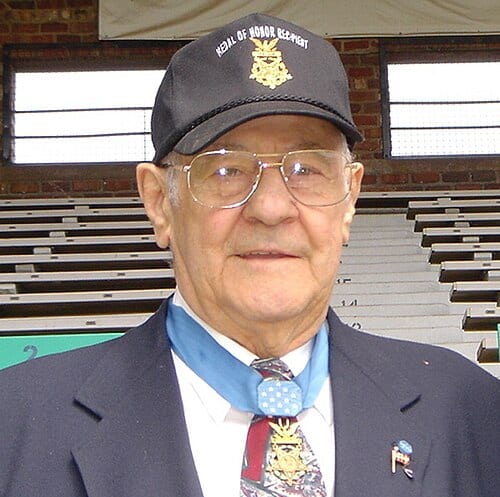
Sergeant, U.S. Army
Support & adopt this hero ↓
At just 19 years old, Michael “Mike” Colalillo stood up under devastating German fire and led an attack that would earn him America's highest military decoration. With his weapon destroyed, enemy machine guns firing and his comrades pinned down, he refused to retreat. Yet the most remarkable part of his courage came when he risked his life to save a wounded fellow soldier. His actions on 7 April 1945, near Untergriesheim, Germany, made him one of the celebrated American Medal of Honor recipients of World War II.
Born in Hibbing, Minnesota, in December 1925, Colalillo grew up in a working-class Italian American family in Duluth. After his mother's death, he left school to help support his family. Drafted into the United States Army in March 1944, he joined Company C, 1st Battalion, 398th Infantry Regiment, 100th Infantry Division. Deployed to France later that year, he encountered fierce combat and suffered an injury that required months of hospitalization. Returning to the front, he distinguished himself through determination and extraordinary bravery.
Before his Medal of Honor action, Colalillo and fellow soldier Clay Landahl reportedly worked together to eliminate two German machine-gun positions that had pinned down American troops. An officer subsequently recommended Colalillo for the Silver Star, recognizing his gallantry in combat.
On 7 April 1945, near Untergriesheim, Colalillo's company came under intense artillery, mortar and machine-gun fire. Rather than remain pinned down, he rose and advanced behind an American tank, urging his fellow soldiers forward. When shrapnel destroyed his weapon, he climbed onto the tank and operated its exposed machine gun while enemy bullets struck around him. He destroyed multiple German positions before the gun jammed, then obtained another weapon and continued fighting on foot.
When American armor exhausted its ammunition and the withdrawal order came, Colalillo made another extraordinary decision. Hearing a wounded comrade calling for help, he remained behind and assisted the soldier across hundreds of yards of exposed ground under enemy artillery and mortar fire. His official Medal of Honor citation credited him with killing or wounding 25 enemy soldiers, inspiring his company's advance and rescuing a wounded American at immense personal risk.
His bravery was formally recognized in War Department General Orders No. 4, dated 9 January 1946. President Harry S. Truman personally presented Colalillo with the Medal of Honor at the White House on 18 December 1945. His other documented honours included the Silver Star, two reported Bronze Star Medals, the Purple Heart, Army Good Conduct Medal, European–African–Middle Eastern Campaign Medal with campaign stars, World War II Victory Medal and Combat Infantryman Badge. Together, they reflected his battlefield gallantry, wartime injury and military service.
After leaving the Army as a Sergeant in October 1945, Colalillo returned to Duluth, where he raised a family and worked in industry and as a longshoreman. Despite receiving the nation's highest award for courage, he remained modest about his wartime achievements. His hometown honoured him through memorials, a park and a scholarship established in his name.
Michael Colalillo died on 30 December 2011, aged 86, and was laid to rest at Forest Hill Cemetery in Duluth. Minnesota's last surviving World War II Medal of Honor recipient, he left a legacy that reaches beyond battlefield victories. His defining act was not simply confronting the enemy against overwhelming odds, but refusing to abandon a wounded comrade when his own life was in danger.
Become the named supporter for this profile and edit the tribute biography and portrait (Owner account required). Proceeds help keep the archive online.
$25 USD / year — annual sponsorship renewal. Keeps the page online and, where enabled, the family anniversary remembrance emails active.