★
Loading archive…
Loading archive…
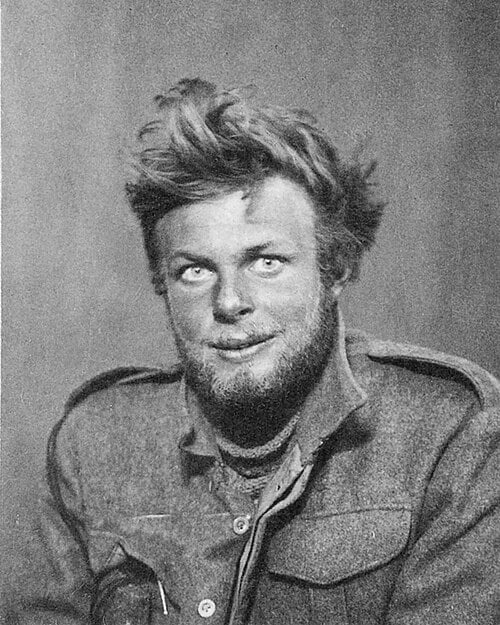
Major, British Army
Support & adopt this hero ↓
SAS Navigator and Second World War Special Forces Pioneer
Before GPS, satellite imagery or modern navigation systems, Mike Sadler guided SAS raiders hundreds of miles across the North African desert using little more than the sun, stars and his own calculations. His ability to find a route across virtually featureless terrain helped the fledgling Special Air Service survive its dangerous early months and strike deep behind Axis lines. Willis Michael “Mike” Sadler was born in Kensington, London, on 22 February 1920 and educated at Bedales School. In 1937 he left Britain for Southern Rhodesia, now Zimbabwe, where he worked on a farm. Following the outbreak of the Second World War, he joined the Rhodesian Army before transferring to the Long Range Desert Group, whose mastery of desert movement introduced him to celestial navigation and brought him into close cooperation with David Stirling, Paddy Mayne and the newly formed Special Air Service.
Sadler soon became one of the key navigators behind the SAS's first successful desert operations. In December 1941, after the SAS had suffered disastrous losses during its first parachute operation, the Long Range Desert Group was asked to carry the surviving raiders to their targets. Sadler was attached as navigator to the party commanded by Lieutenant Robert Blair “Paddy” Mayne and guided it across the desert to Wadi Tamet, where the raiders destroyed 24 enemy aircraft, fuel installations and other targets. The success helped demonstrate that the SAS concept could work when its raiders were delivered and recovered by experienced desert navigators. Sadler's service was recognised with the Military Medal. His surviving National Archives award record identifies him as Gunner Michael Sadler, service number 1095726, Royal Artillery, serving in the Middle East, Egypt and Libya. The award was formally announced in the London Gazette on 24 February 1942, where he appears under the heading “The Military Medal.”
More extraordinary operations followed. In July 1942, Sadler navigated 18 armed SAS jeeps across the desert without headlights or conventional road maps for the celebrated attack on Sidi Haneish airfield, where the raiders destroyed an estimated 37 German aircraft. He also took part in the attempted Benghazi operation known as Operation Bigamy. In January 1943 he joined David Stirling's small party attempting to cross enemy-held territory and link with Allied forces in Tunisia. The group was captured by German forces, but Sadler and two companions escaped. With little water and without maps or a compass, they crossed roughly 100 miles of desert before reaching Allied forces. It was an extraordinary demonstration of the navigational skill that had already made Sadler indispensable to the early SAS.
By then Sadler had also made the transition from the ranks to commissioned service. His appointment was backdated to 10 October 1942, when Lance-Bombardier Willis Michael Sadler of the Royal Horse Artillery was commissioned as a second lieutenant in the King's Royal Rifle Corps. The appointment was formally published in the London Gazette on 23 July 1943. The Gazette entry gives his officer service number as 282465, providing a direct documentary link between the decorated gunner of the desert campaign and the officer who would later serve with 1st Special Air Service Regiment in north-west Europe.
In 1944, Sadler returned to special operations as an officer of 1st SAS Regiment and parachuted into occupied France during Operation Houndsworth. Serving in an intelligence role, he had to move between dispersed SAS elements through territory controlled by German forces. During one encounter east of Orléans, Sadler's two jeeps unexpectedly met a heavily armed German patrol. He drove past at extremely close range before the Germans realised the vehicles were British. When they opened fire, Sadler turned his jeep back toward the enemy and covered the withdrawal of the second vehicle while his gunners knocked out two German machine-gun crews. His conduct in France led to the award of the Military Cross. The National Archives preserves his recommendation under 1 Battalion, Special Air Service Regiment, and the London Gazette of 22 March 1945 formally listed “Captain (temporary) Willis Michael Sadler, M.M. (282465), Army Air Corps” among recipients of the Military Cross.
War had taken Sadler across the deserts of North Africa and behind German lines in Europe, but his next expedition carried him to an entirely different wilderness. After the wartime SAS was disbanded, Sadler volunteered for the Falkland Islands Dependencies Survey, the organisation that later became the British Antarctic Survey. He travelled south and helped establish the British base on Stonington Island in Marguerite Bay. His Antarctic service was recognised with the silver Polar Medal with the clasp “ANTARCTIC 1946.” Decades later, the retreat of the glacier separating Stonington Island from the mainland created a new marine passage. In 2021 it was named Sadler Passage in recognition of his Antarctic work.
Sadler's appetite for difficult assignments did not end with Antarctica. After returning to Britain, he briefly worked for the United States Embassy before being recruited into the Secret Intelligence Service, MI6, where he became involved in Cold War intelligence operations and remained for much of his postwar career. More than seven decades after his wartime service in France, the French government appointed him a Chevalier de la Légion d'honneur in 2018, recognising his contribution to the liberation of France. His former school remembered him not simply as a decorated soldier but as one of the original wartime SAS figures whose extraordinary navigation had enabled British special forces to operate deep behind enemy lines.
In his final years, Major Mike Sadler, MC, MM became the last surviving member of the original wartime SAS and one of the last living links to the men who transformed a fragile experimental raiding force into one of the most famous special forces units in military history. He died on 4 January 2024, aged 103. Sadler's legacy rests on more than his Military Cross, Military Medal, Polar Medal and Légion d'honneur. It rests on a rare skill that repeatedly made the impossible possible. Across blacked-out deserts and occupied countryside, other men could fight only if they first reached the target. Mike Sadler was the man who found the way.
Become the named supporter for this profile and edit the tribute biography and portrait (Owner account required). Proceeds help keep the archive online.
$25 USD / year — annual sponsorship renewal. Keeps the page online and, where enabled, the family anniversary remembrance emails active.