★
Loading archive…
Loading archive…
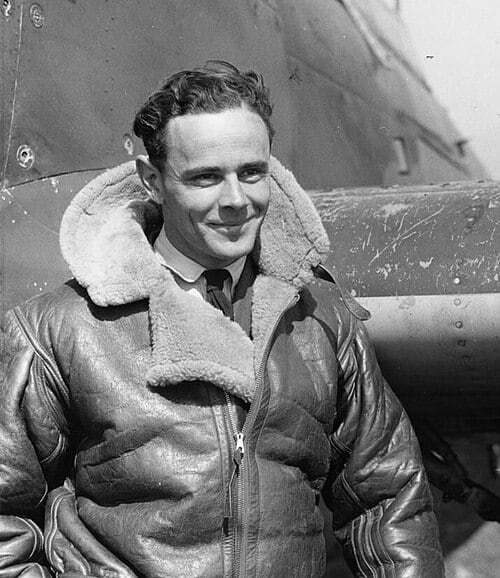
Squadron leader, Royal Air Force
Support & adopt this hero ↓
At twenty-six years old, weakened by illness and exhausted by weeks of almost continuous combat, Squadron Leader Marmaduke Thomas St John “Pat” Pattle climbed into a Hawker Hurricane for one more battle over Greece. He never returned. By then his second gallantry citation had already recorded at least 23 enemy aircraft destroyed, and later reconstruction of the fragmentary wartime record would place his probable score above 40. Today he is widely regarded as one of the most successful fighter pilots ever to serve in the Royal Air Force during the Second World War.
Marmaduke Thomas St John Pattle was born at Butterworth in the Cape Province of South Africa on 3 July 1914. Known throughout his RAF career as “Pat,” he developed an early ambition to fly. In 1933 he applied for entry to the South African Air Force but was not selected. Three years later, after seeing an RAF recruitment opportunity, he sailed for Britain and entered flying training for a short-service career in the Royal Air Force. Contemporary biographical research records an exceptional training performance, including 99 per cent in gunnery and bombing and 91 per cent in airmanship.
Pattle was granted a short-service commission in 1936 and completed his flying training in Britain before joining No. 80 Squadron RAF in 1937. The squadron, equipped with Gloster Gladiator biplane fighters, moved to Egypt in April 1938. A surviving RAF Museum photograph places Pattle with No. 80 Squadron in Egypt in February 1940 and confirms the squadron's earlier move there.
Italy's entry into the war on 10 June 1940 brought No. 80 Squadron into sustained operations in the Western Desert. Pattle's first major air combat came on 4 August. During a series of engagements near the Libyan frontier, he fought against numerically superior Italian aircraft, destroyed at least two, and was himself shot down. He then spent approximately twenty-four hours making his way through the desert before reaching friendly forces.
That action later formed the centrepiece of the citation for his Distinguished Flying Cross, announced in the London Gazette on 11 February 1941. The official citation recorded that Pattle had been attacked by superior numbers on three separate occasions, had fought his way back toward the frontier and destroyed at least two aircraft before being brought down. It further praised his fearlessness when facing superior enemy forces and recorded that he had by then destroyed at least thirteen enemy aircraft, three of them in a single day.
In November 1940, No. 80 Squadron was transferred to Greece to support the campaign against the Italian invasion. Flying from increasingly primitive and exposed airfields, Pattle fought over Greece and southern Albania through the winter. He became particularly successful in the Gloster Gladiator, with approximately fifteen personal victories generally attributed to him in the type before his conversion to the Hurricane. Much of his reputation was therefore established in a biplane fighter that was already being superseded by faster monoplane aircraft.
No. 80 Squadron began operating the Hawker Hurricane in February 1941, and Pattle immediately demonstrated that his success was not dependent on the Gladiator. On 4 March, during fighting over Himara, he claimed three enemy fighters destroyed. That action brought another official recognition of his combat record.
Only five weeks after the announcement of his first DFC, Pattle was awarded a Bar to the Distinguished Flying Cross, signifying a second award of the decoration. The Bar was announced in the London Gazette on 18 March 1941. The official citation stated that during an engagement over Himara he had shot down three enemy fighters and described him as a courageous and skilful fighter pilot. Most importantly for establishing his wartime score, the citation recorded that he had now destroyed at least twenty-three enemy aircraft.
On 12 March 1941, Pattle was promoted to acting squadron leader and given command of No. 33 Squadron RAF. Imperial War Museums photographs from Greece identify him as the squadron's commanding officer, and contemporary historical accounts emphasize the leadership role he assumed as the Allied position deteriorated.
The situation changed dramatically when Germany invaded Yugoslavia and Greece in April 1941. RAF fighter strength was increasingly overwhelmed by the Luftwaffe, while airfields, communications and records were lost during the withdrawal. This destruction of operational documentation is one of the principal reasons why Pattle's final combat record can no longer be reconstructed with certainty. Later assessments have therefore had to combine surviving documents with logbooks, personal diaries, squadron recollections and enemy loss records.
Despite worsening illness and exhaustion, Pattle continued to fly. Later reconstructions attribute six destroyed aircraft to him on 19 April 1941, together with additional shared or probable claims. Those claims should not, however, be presented with the same certainty as the 23 victories documented in his March gallantry citation because the surviving April record is incomplete and some individual claims cannot be matched conclusively to Axis losses.
On 20 April 1941, Pattle again flew during the great air battle over the Athens area while seriously unwell. Contemporary and later accounts describe the surviving Hurricanes engaging a much larger German force. During the fighting, Pattle was seen attacking Messerschmitt Bf 110 heavy fighters, apparently while attempting to assist another Hurricane that was under attack. His own Hurricane was subsequently seen going down in flames, and he was lost in the waters of the Eleusis Bay and Athens area. The precise sequence of his final combat cannot now be established beyond doubt.
Pattle was 26 years old. He has no known grave. The Commonwealth War Graves Commission records Squadron Leader Marmaduke Thomas St. John Pattle, service number 39029, of No. 33 Squadron RAF, as having died on 20 April 1941. He is commemorated on Column 239 of the Alamein Memorial in Egypt, and the CWGC records his decorations as the Distinguished Flying Cross and Bar.
The disputed victory total
Pattle's final score cannot be established conclusively, and any biography that assigns him an exact total without qualification risks overstating the evidence. The strongest contemporary official benchmark is the citation for his Bar to the DFC, which recorded at least 23 enemy aircraft destroyed by March 1941. He continued to claim victories after that date, but many of the relevant operational records were lost during the collapse of the Allied position in Greece.
Post-war reconstruction has produced several totals. A figure of at least 40 or 41 victories has considerable historical support, while other reconstructions place his total at approximately 50. Much higher figures approaching 60 derive heavily from recollections and post-war reconstruction and cannot be verified aircraft by aircraft. For a museum-grade biography, those higher totals should therefore be presented as claims rather than established fact.
There is nevertheless strong institutional support for regarding Pattle as the leading RAF and Commonwealth ace of the war. In material produced jointly with the Royal Air Force Museum, The National Archives identifies Pattle as the leading ace of the RAF and Commonwealth Air Forces and states that his record exceeded 40 enemy aircraft in North Africa and Greece.
The safest and strongest wording for the hero page is:
Pattle is generally credited with more than 40 aerial victories and may have achieved approximately 50. Because operational records were lost or destroyed during the British withdrawal from Greece, an exact final total cannot now be established. He is widely regarded as the highest-scoring fighter pilot of the RAF and British Commonwealth air forces during the Second World War.
I prefer this version to the original because it gives the reader the dramatic story without converting the disputed parts of the Pattle legend into fact. It also makes both gallantry awards central to the narrative rather than leaving the Gazette citations hanging as references. The opening now immediately establishes his age, final battle, documented 23-victory benchmark and later reputation, which gives the page a much stronger hook while remaining historically defensible.
Become the named supporter for this profile and edit the tribute biography and portrait (Owner account required). Proceeds help keep the archive online.
$25 USD / year — annual sponsorship renewal. Keeps the page online and, where enabled, the family anniversary remembrance emails active.