★
Loading archive…
Loading archive…
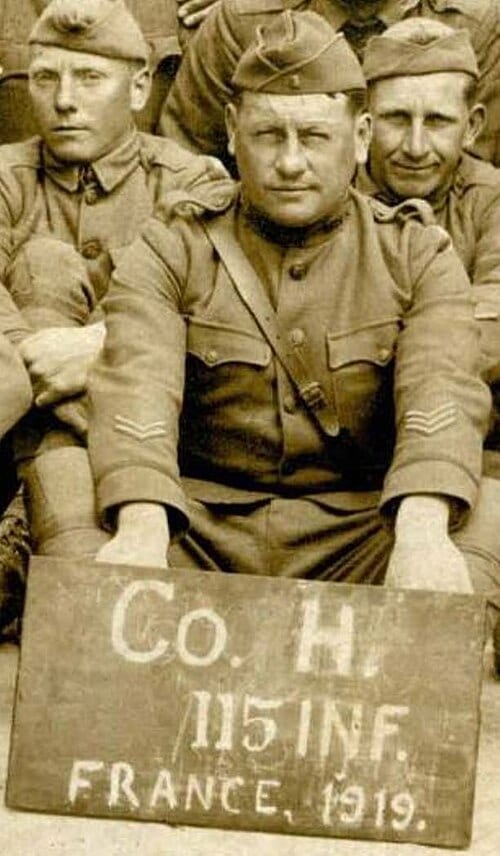
Second Lieutenant, U.S. Army
Support & adopt this hero ↓
He charged an enemy machine-gun nest with an empty pistol. He was seriously wounded, his fellow soldiers had fallen, and the advance of two American companies had been brought to a deadly halt. Yet when retreat seemed the only hope of survival, Second Lieutenant Patrick J. Regan did the unthinkable. He advanced alone, captured 30 enemy soldiers and four machine guns, and earned a place among America's greatest World War I heroes.
Patrick J. Regan (March 25, 1882 – October 30, 1943) was a United States Army officer and Medal of Honor recipient whose extraordinary courage during World War I became a remarkable example of battlefield leadership and personal sacrifice. Serving with the 115th Infantry Regiment, 29th Infantry Division, Regan demonstrated that true heroism is measured not by the absence of fear, but by the determination to act when the lives of others depend upon it.
Born in Massachusetts and associated with the town of Middleborough, Regan began his military career on June 14, 1899. His Army service spanned approximately two decades, carrying him through some of the most turbulent chapters of American military history. Accounts of his early career describe service during the Philippine Insurrection, the Boxer Rebellion period, and subsequent assignments in the Philippines, Alaska, and along the Mexican border. These experiences helped shape the seasoned soldier who would later face the devastating battlefields of Europe.
When the United States entered World War I in 1917, Regan served with the American Expeditionary Forces in France. As a Second Lieutenant in the 115th Infantry Regiment, he was responsible not only for leading his soldiers into battle but also for making life-or-death decisions under intense enemy fire. On October 8, 1918, near Bois-de-Consenvoye, France, that responsibility would lead him into one of the most extraordinary moments of his military career.
During an American advance, a heavily defended enemy machine-gun position unleashed devastating fire, stopping the progress of two companies. Recognizing the danger to his fellow soldiers, Regan organized his platoon into three attacking groups. He directed men toward both enemy flanks while personally leading an automatic rifle team in a frontal assault.
The attack quickly became a desperate struggle for survival. Two members of his team were killed, and Regan and another soldier were seriously wounded. With his assault team effectively shattered and his own pistol empty, Regan faced a choice that would define his legacy.
He could fall back, or he could continue alone.
Regan chose to advance.
Despite his severe wounds, he rushed directly into the enemy position with his unloaded pistol and compelled 30 Austrian soldiers to surrender. Four machine guns were captured, eliminating the deadly obstacle that had prevented the American companies from advancing. His astonishing action broke the enemy resistance and allowed the stalled assault to move forward.
But Regan's courage did not end with the capture. Although wounded and physically exhausted, he continued leading his platoon until his commanding officer ordered him to withdraw for medical attention. Even in pain, his concern remained with the soldiers under his command.
For his extraordinary heroism at Bois-de-Consenvoye, Patrick J. Regan received the Medal of Honor, the United States' highest military decoration, under War Department General Orders No. 50, dated April 12, 1919. His wartime service also brought recognition for wounds sustained in action. His story stands among the memorable acts of individual bravery during the Meuse-Argonne Offensive, one of the largest and most consequential American military operations of the First World War.
Regan's service to his country was honored again on November 11, 1921, when he participated as an honorary pallbearer in the ceremonies surrounding the burial of America's Unknown Soldier at Arlington National Cemetery. The occasion carried profound significance. A man who had survived the horrors of war and witnessed its terrible human cost was helping honor an unidentified fellow serviceman who had made the ultimate sacrifice.
Patrick J. Regan died on October 30, 1943, at the age of 61. He was laid to rest at Mount Olivet Cemetery in Bloomfield, New Jersey. His memory has also been preserved in Middleborough, Massachusetts, where local veterans and community members have honored his extraordinary service.
What makes Patrick Regan's legacy so powerful is not simply that he captured 30 enemy soldiers. It is that he acted when his weapon was empty, his body was wounded, and the odds were overwhelmingly against him. His courage helped save fellow Americans from deadly machine-gun fire and demonstrated the highest ideals of military leadership.
More than a century after his heroic stand in France, Second Lieutenant Patrick J. Regan remains an enduring symbol of American courage, sacrifice, and devotion to duty. His Medal of Honor tells the story of one extraordinary moment, but his lasting legacy lies in the lives he helped protect and the example he left for generations of soldiers.
When everything seemed lost, Patrick J. Regan moved forward. That is why his story deserves to be remembered.
Become the named supporter for this profile and edit the tribute biography and portrait (Owner account required). Proceeds help keep the archive online.
$25 USD / year — annual sponsorship renewal. Keeps the page online and, where enabled, the family anniversary remembrance emails active.