★
Loading archive…
Loading archive…

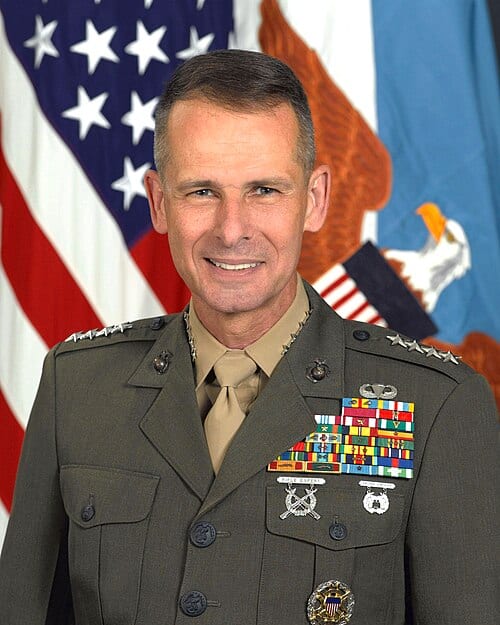
From the battlefields of Vietnam to the highest levels of American military leadership, General Peter Pace built a remarkable career defined by combat experience, command responsibility, and more than four decades of service to the United States. A Marine infantry officer who rose to become the 16th Chairman of the Joint Chiefs of Staff, Pace made history as the first United States Marine to hold this prestigious position. His journey from a rifle platoon in Vietnam to the Pentagon's highest military leadership office stands as one of the most significant careers in modern Marine Corps history.
Born on 5 November 1945 in Brooklyn, New York, and raised in Teaneck, New Jersey, Peter Pace graduated from the United States Naval Academy in 1967 and received his commission as a second lieutenant in the United States Marine Corps that June. Following his training at The Basic School in Quantico, Virginia, he deployed to the Republic of Vietnam in February 1968. Assigned to the 2nd Battalion, 5th Marines, 1st Marine Division, he served as a rifle platoon leader with Company G and subsequently as the battalion's assistant operations officer. During the closing stages of the Battle of Hue City and the demanding operations that followed, Pace demonstrated exceptional courage and leadership under fire. On 18 August 1968, he earned the Bronze Star Medal with Combat V for leading his platoon in a flanking manoeuvre against a fortified enemy position that had halted his company's advance. His platoon crossed a stream and exposed rice paddies under enemy fire to outflank the position and enable the company to continue its mission. His Vietnam service established the foundation for a military career that would span infantry command, operational planning, international assignments, and strategic leadership.
After returning from Vietnam in March 1969, Pace served in a variety of operational, ceremonial, staff, and command assignments. His career took him to Washington, D.C., Japan, Thailand, South Korea, and Europe. He commanded Marine Corps Recruiting Station Buffalo, where his leadership helped raise the station from forty-third to fifth in the national rankings. He later commanded the 2nd Battalion, 1st Marines, and Marine Barracks Washington, D.C., before assuming increasingly senior responsibilities. His experience also extended to Somalia, where he served as Deputy Commander, Marine Forces Somalia, and Deputy Commander of Joint Task Force Somalia during the military operations of 1992 to 1994. These assignments broadened his experience in multinational operations, crisis management, and joint military leadership.
In September 2000, Pace received his fourth star and assumed command of United States Southern Command, responsible for American military engagement across Latin America and the Caribbean. On 1 October 2001, he became the sixth Vice Chairman of the Joint Chiefs of Staff, making history as the first Marine to hold that office. In this role, he contributed to national military planning, joint force requirements, defence policy, and strategic responses following the terrorist attacks of 11 September 2001. His responsibilities expanded further on 30 September 2005, when President George W. Bush appointed him the 16th Chairman of the Joint Chiefs of Staff. Once again, Pace broke new ground as the first Marine Corps officer to become the nation's senior uniformed military officer. Serving until 30 September 2007, he advised the President, the Secretary of Defense, and the National Security Council during a critical period encompassing the wars in Afghanistan and Iraq. His leadership priorities included strengthening joint warfighting capabilities, modernising the armed forces, improving cooperation across government agencies, and supporting the welfare of American service members and their families.
General Peter Pace's distinguished military decorations reflect his service in combat and his extensive responsibilities at the highest levels of national defence. His honours include the Defense Distinguished Service Medal, Defense Superior Service Medal, Legion of Merit, Bronze Star Medal with Combat V, Defense Meritorious Service Medal, Meritorious Service Medal, Navy and Marine Corps Commendation Medal with Combat V, Navy and Marine Corps Achievement Medal, and Combat Action Ribbon. His international recognition includes major decorations from South Korea, Japan, and Canada, reflecting his contribution to military cooperation and international defence relationships. Following his retirement, President Bush awarded him the Presidential Medal of Freedom on 19 June 2008, recognising his distinguished service to the United States.
After more than forty years of active military service, General Pace retired from the United States Marine Corps on 1 October 2007. His career remains a landmark in American military history, not only because he became the first Marine to serve as Chairman of the Joint Chiefs of Staff, but also because his professional journey connected frontline infantry leadership with the responsibilities of national and international military strategy. From the rice paddies of Vietnam to the highest councils of American defence, Peter Pace's life in uniform reflects the demanding progression of a Marine officer whose service helped shape the United States military during a defining period of the twenty-first century.
Become the named supporter for this profile and edit the tribute biography and portrait (Owner account required). Proceeds help keep the archive online.
$25 USD / year — annual sponsorship renewal. Keeps the page online and, where enabled, the family anniversary remembrance emails active.