Loading archive…
Loading archive…
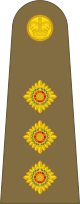
Captain, British Army
Support & adopt this hero ↓Rambahadur Limbu was born on 8 July 1939 in the remote village of Chyangthapu, East Nepal, belonging to the Begha Clan of the Limbu people. Determined to join the Brigade of Gurkhas, he initially faced rejection at age 17 but persisted, officially enlisting in the British Army on 1 November 1957 and receiving the service number 21148786.
Following intensive jungle training during the Malayan Emergency, he joined the 2nd Battalion, 10th Princess Mary's Own Gurkha Rifles (2/10 GR) in October 1958. By August 1965, the battalion deployed to Sarawak to counter Indonesian cross-border incursions during the Indonesia-Malaysia Confrontation.
On 21 November 1965, during the Battle of Bau, Limbu's 'C' Company was tasked with eliminating a fortified Indonesian force on the sheer-sided Gunong Tepoi. Advancing along a restrictive knife-edge ridge, the 26-year-old Lance Corporal led a 16-man advance guard to within ten yards of an enemy machine-gun pit. When an Indonesian sentry opened fire, wounding a Gurkha, Limbu charged and neutralised the trench with a fragmentation grenade. Under concentrated automatic fire, Limbu repeatedly exposed himself to reposition his men and report to his platoon commander. Realising two of his men were severely wounded and exposed in the kill zone, Limbu executed three supremely gallant rescue attempts, braving a hail of point-blank fire to carry both men to safety. Though the casualties succumbed to their wounds, Limbu then recovered their abandoned Bren gun and provided critical covering fire, killing four escaping enemy soldiers and ensuring the destruction of the Indonesian position.
For his extraordinary courage, leadership, and self-sacrifice, Lance Corporal Rambahadur Limbu was recommended for the Victoria Cross, the highest military decoration awarded for valour in the presence of the enemy within the British honours system. The full official citation for his award was published in the Second Supplement to The London Gazette of Thursday, 21 April 1966 (Issue 43959, page 4947), and reads exactly as follows:
"The QUEEN has been graciously pleased to approve the award of the VICTORIA CROSS to: 21148786 Lance Corporal RAMBAHADUR LIMBU, 10th Princess Mary's Own Gurkha Rifles. On 21st November 1965 in the Bau District of Sarawak Lance Corporal RAMBAHADUR LIMBU was with his Company when they discovered and attacked a strong enemy force located in the Border area. The enemy were strongly entrenched in Platoon strength, on top of a sheer sided hill the only approach to which was along a knife edge ridge allowing only three men to move abreast. Leading his support group in the van of the attack he could see the nearest trench and in it a sentry manning a machine gun. Determined to gain first blood he inched himself forward until, still ten yards from his enemy, he was seen and the sentry opened fire, immediately wounding a man to his right. Rushing forward he reached the enemy trench in seconds and killed the sentry, thereby gaining for the attacking force a first but firm foothold on the objective. The enemy were now fully alerted and, from their positions in depth, brought down heavy automatic fire on the attacking force, concentrating this onto the area of the trench held alone by Lance Corporal RAMBAHADUR. Appreciating that he could not carry out his task of supporting his platoon from this position he courageously left the comparative safety of his trench and, with a complete disregard for the hail of fire being directed at him, he got together and led his fire group to a better fire position some yards ahead. He now attempted to indicate his intentions to his Platoon Commander by shouting and hand signals but failing to do so in the deafening noise of exploding grenades and continuous automatic fire he again moved out into the open and reported personally, despite the extreme dangers of being hit by the fire not only from the enemy but by ricochets from the weapons of his own force. It was at the moment of reporting that he saw both men of his own fire group seriously wounded. Knowing that their only hope of survival was immediate first aid and that evacuation from their very exposed position so close to the enemy was vital he immediately commenced the first of his three supremely gallant attempts to rescue his comrades. Using what little ground cover he could find he crawled forward, in full view of at least two enemy machine gun posts who concentrated their fire on him and which, at this stage of the battle, could not be effectively subdued by the rest of his platoon. For three full minutes he continued to move forward but when almost able to touch the nearest casualty he was driven back by the accurate and intense weight of fire covering his line of approach. After a pause he started again, but realising that speed was essential he abandoned his attempt to crawl and after a series of forward rushes he was once more driven back by the enemy fire. However, despite this Lance Corporal RAMBAHADUR again moved out into the open for his final effort. In a series of short forward rushes and once being pinned down for some minutes by the intense and accurate automatic fire which could be seen striking the ground all round him he eventually reached the wounded man. Rushing forward he hurled himself on the ground beside one of the wounded and calling for support from two light machine guns which had now come up to his right in support he picked up the man and carried him to safety out of the line of fire. Without hesitation he immediately returned to the top of the hill determined to complete his self imposed task of saving those for whom he felt personally responsible. It was now clear from the increased weight of fire being concentrated on the approaches to and in the immediate vicinity of the remaining casualty the enemy were doing all they could to prevent any further attempts at rescue. However, despite this Lance Corporal RAMBAHADUR again moved out into the open for his final effort. In a series of short forward rushes and once being pinned down for some minutes by the intense and accurate automatic fire which could be seen striking the ground all round him he eventually reached the wounded man. Picking him up and unable now to seek cover he carried him back as fast as he could through the hail of enemy bullets. It had taken twenty minutes to complete this gallant action and the events leading up to it For all but a few seconds this young Non-Commissioned Officer had been moving alone in full view of the enemy and under the continuous aimed fire of their automatic weapons. That he was able to achieve what he did against such overwhelming odds without being hit is miraculous. His outstanding personal bravery, selfless conduct, complete contempt of the enemy and determination to save the lives of the men of his fire group set an incomparable example and inspired all who saw him. Finally rejoining his section on the left flank of the attack, Lance Corporal RAMBAHADUR was able to recover the light machine gun abandoned by the wounded and with it won his revenge, initially giving support during the later stages of the prolonged assault and finally being responsible for killing four more enemy as they attempted to escape. This hour long battle which had throughout been fought at point blank range and with the utmost ferocity by both sides was finally won. At least twenty-four enemy are known to have died at a cost to the attacking force of three killed and two wounded. In scale and in achievement this engagement stands out as one of the first importance and there is no doubt that, but for the inspired conduct and example set by Lance Corporal RAMBAHADUR at the most vital stage of the battle, much less would have been achieved and greater casualties caused. He displayed heroism, self sacrifice and a devotion to duty and to his men of the very highest order. His actions on this day reached a zenith of determined, premeditated valour which must count amongst the most notable on record and is deserving of the greatest admiration and the highest praise."
The formal recognition of his courage was overshadowed by the death of his first wife shortly before the announcement, leaving him with two young sons. On 12 July 1966, Queen Elizabeth II invested him with the Victoria Cross at Buckingham Palace. Though his original medal was stolen in 1967, Limbu's distinguished military career continued. He was commissioned as a Queen's Gurkha Officer, reached the rank of Captain, and was appointed a Member of the Royal Victorian Order (MVO) in 1984 following his service as Queen's Gurkha Orderly Officer. Retiring from the British Army in 1985, he served with the Sultan of Brunei's Gurkha Reserve Unit until 1992 before returning to Nepal. Captain Limbu passed away on 22 April 2023 at the age of 83, remembered as the last living Gurkha recipient of the Victoria Cross.
Become the named supporter for this profile and edit the tribute biography and portrait (Owner account required). Proceeds help keep the archive online.
$25 USD / year — annual sponsorship renewal. Keeps the page online and, where enabled, the family anniversary remembrance emails active.