★
Loading archive…
Loading archive…

He rallied wounded men and fought off a heavy enemy assault.
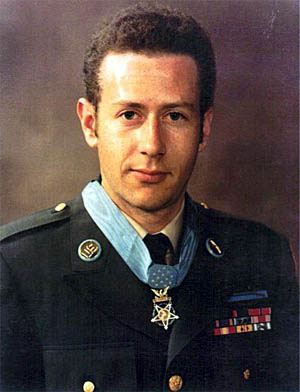
On 31 January 1970, Sergeant Richard Penry served with Company C, 4th Battalion, 12th Infantry, 199th Infantry Brigade, in Binh Tuy Province, South Vietnam. When his platoon came under attack, he treated wounded men and moved the command post to cover. He gathered radios, established communications and helped direct the defence.
Penry repeatedly exposed himself to enemy fire to obtain ammunition and reach isolated comrades. He helped repel further attacks and assisted the evacuation of eighteen wounded soldiers before continuing the pursuit of the enemy. His leadership and courage earned the Medal of Honor, presented by President Richard Nixon on 15 June 1971.
Born in Petaluma, California, on 18 November 1948, Penry served in the United States Army during the Vietnam War. He died in Petaluma on 9 May 1994 and is buried at Cypress Hill Memorial Park.
Medal of Honor citation
For conspicuous gallantry and intrepidity in action at the risk of his life above and beyond the call of duty. Sergeant. Penry, Company C, distinguished himself while serving as a rifleman during a night ambush mission. As the platoon was preparing the ambush position, it suddenly came under an intense enemy attack from mortar, rocket, and automatic weapons fire which seriously wounded the company commander and most of the platoon members, leaving small isolated groups of wounded men throughout the area. Sergeant. Penry, seeing the extreme seriousness of the situation, worked his way through the deadly enemy fire to the company command post where he administered first aid to the wounded company commander and other personnel. He then moved the command post to a position which provided greater protection and visual communication and control of other platoon elements.
Realizing the company radio was damaged and recognizing the urgent necessity to reestablish communications with the battalion headquarters, he ran outside the defensive perimeter through a fusillade of hostile fire to retrieve a radio. Finding it inoperable, Sergeant. Penry returned through heavy fire to retrieve 2 more radios. Turning his attention to the defense of the area, he crawled to the edge of the perimeter, retrieved needed ammunition and weapons and resupplied the wounded men. During a determined assault by over 30 enemy soldiers, Sergeant. Penry occupied the most vulnerable forward position placing heavy, accurate fire on the attacking enemy and exposing himself several times to throw hand grenades into the advancing enemy troops. He succeeded virtually single-handedly in stopping the attack.
Learning that none of the radios were operable, Sergeant. Penry again crawled outside the defensive perimeter, retrieved a fourth radio and established communications with higher headquarters. Sergeant. Penry then continued to administer first aid to the wounded and repositioned them to better repel further enemy attacks. Despite continuous and deadly sniper fire, he again left the defensive perimeter, moved to within a few feet of enemy positions, located 5 isolated wounded soldiers, and led them to safety. When evacuation helicopters approached, Sergeant. Penry voluntarily left the perimeter, set up a guiding beacon, established the priorities for evacuation and successively carried 18 wounded men to the extraction site. After all wounded personnel had been evacuated, Sergeant. Penry joined another platoon and assisted in the pursuit of the enemy. Sergeant. Penry's extraordinary heroism at the risk of his own life are in keeping with the highest traditions of the military service and reflect great credit on him, his unit, and the U.S. Army.
Become the named supporter for this profile and edit the tribute biography and portrait (Owner account required). Proceeds help keep the archive online.
$25 USD / year — annual sponsorship renewal. Keeps the page online and, where enabled, the family anniversary remembrance emails active.