★
Loading archive…
Loading archive…

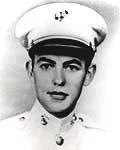
He pressed home a final attack in a blazing plane at Midway.
Richard Eugene Fleming was born on 2 November 1917 in St. Paul, Minnesota. He attended Saint Thomas Military Academy and graduated from the University of Minnesota in 1939. He entered Marine Corps Reserve aviation training in 1940, earned his wings that December, and joined a Marine scouting squadron in San Diego. By the summer of 1941 he was serving at Ewa Field, Hawaii, with the squadron later designated VMSB-231.
On 5 December 1941, Fleming flew aboard USS Lexington as his squadron prepared to reinforce Midway. The carrier was at sea when Pearl Harbor was attacked. After returning to Hawaii, he took part in the long flight to Midway on 17 December. He subsequently joined VMSB-241 and became a captain shortly before the battle.
Richard Eugene Fleming earned a posthumous Medal of Honor with Marine Scout-Bombing Squadron 241 at Midway on 4 and 5 June 1942. After his squadron commander was shot down, Fleming led the remaining aircraft in an attack and brought his badly damaged plane back. The next day, after little rest, he led another bombing mission. Although his aircraft caught fire during its approach, he continued toward the Japanese target and released his bomb before crashing into the sea. His award recognizes perseverance through successive hazardous missions.
Fleming died on 5 June 1942, aged 24; his remains were not recovered. President Franklin D. Roosevelt presented his posthumous Medal of Honor to his mother at the White House on 24 November 1942. The destroyer escort USS Fleming later carried his name.
Medal of Honor citation — U.S. Navy, as reproduced by the Congressional Medal of Honor Society
For extraordinary heroism and conspicuous intrepidity above and beyond the call of duty as flight officer, Marine Scout-Bombing Squadron 241, during action against enemy Japanese forces in the battle of Midway on 4 and 5 June 1942. When his squadron commander was shot down during the initial attack upon an enemy aircraft carrier, Capt. Fleming led the remainder of the division with such fearless determination that he dived his own plane to the perilously low altitude of 400 feet before releasing his bomb. Although his craft was riddled by 179 hits in the blistering hail of fire that burst upon him from Japanese fighter guns and antiaircraft batteries, he pulled out with only two minor wounds inflicted upon himself. On the night of 4 June, when the squadron commander lost his way and became separated from the others, Capt. Fleming brought his own plane in for a safe landing at its base despite hazardous weather conditions and total darkness. The following day, after less than four hours' sleep, he led the second division of his squadron in a coordinated glide-bombing and dive-bombing assault upon a Japanese battleship. Undeterred by a fateful approach glide, during which his ship was struck and set afire, he grimly pressed home his attack to an altitude of 500 feet, released his bomb to score a near miss on the stern of his target, then crashed to the sea in flames. His dauntless perseverance and unyielding devotion to duty were in keeping with the highest traditions of the U.S. Naval Service.
Become the named supporter for this profile and edit the tribute biography and portrait (Owner account required). Proceeds help keep the archive online.
$25 USD / year — annual sponsorship renewal. Keeps the page online and, where enabled, the family anniversary remembrance emails active.