★
Loading archive…
Loading archive…

He flew into danger and brought down eight hostile aircraft.
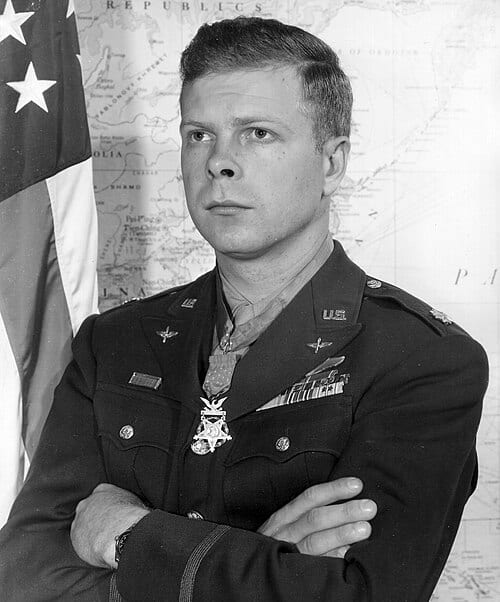
Major Richard Ira “Dick” Bong (1920–1945) was a U.S. Army Air Forces fighter pilot credited with 40 aerial victories, the highest total recorded by an American ace in the Second World War. Raised near Poplar, Wisconsin, he developed an early interest in aviation and learned to fly through the Civilian Pilot Training Program while attending the Superior State Teachers College. He left college for military flight training in 1941 and earned his wings in 1942. After serving as an instructor, he joined the 9th Fighter Squadron of the 49th Fighter Group in the Southwest Pacific, flying the Lockheed P-38 Lightning.
Bong’s first confirmed victory came in December 1942. He went on to fly more than 200 combat missions across New Guinea and the Philippines, usually in a P-38. He combined careful formation flying and gunnery with aggressive attacks, and his tally grew steadily through 1943 and 1944. He scored his 40th victory in December 1944, establishing the wartime American record. His Medal of Honor recognized a period from 10 October to 15 November 1944, when, although assigned to gunnery instruction and not required to fly combat, he repeatedly volunteered for dangerous missions. These included sorties over Balikpapan, Borneo, and the Leyte area of the Philippines. The citation praised his persistent combat flying and effectiveness against enemy aircraft and installations.
Bong received the Medal of Honor from General Douglas MacArthur in December 1944 and returned to the United States at the end of the year. He was assigned to test and acceptance work at Lockheed, where he flew the new P-80 Shooting Star jet. On 6 August 1945, during a P-80 test flight near Burbank, California, the aircraft crashed shortly after takeoff and Bong was killed. He was 24. The same day, news of the atomic bombing of Hiroshima dominated headlines, but Bong was mourned across the country as a national hero. His combat record made him a leading symbol of Army Air Forces fighter operations in the Pacific, while his final assignment placed him at the threshold of the transition from piston-engine fighters to jets.
The Medal of Honor citation recognizes Bong’s repeated voluntary combat missions between 10 October and 15 November 1944, when he was assigned as a gunnery instructor and not expected to engage in combat. It highlights his unusually hazardous sorties over Balikpapan and Leyte and credits his aggressiveness and daring with achieving decisive results against the enemy.
Sources: Air Force Historical Support Division, “Bong — Maj Richard Ira Bong”; U.S. Air Force, “Medal of Honor: Bong, Richard I.”; National Museum of the United States Air Force, “America’s Top Two Aces”; U.S. Army, General Orders No. 90, 8 December 1944, Medal of Honor citation for Major Richard I. Bong.
Become the named supporter for this profile and edit the tribute biography and portrait (Owner account required). Proceeds help keep the archive online.
$25 USD / year — annual sponsorship renewal. Keeps the page online and, where enabled, the family anniversary remembrance emails active.