★
Loading archive…
Loading archive…

America’s Deadliest Ace of World War II
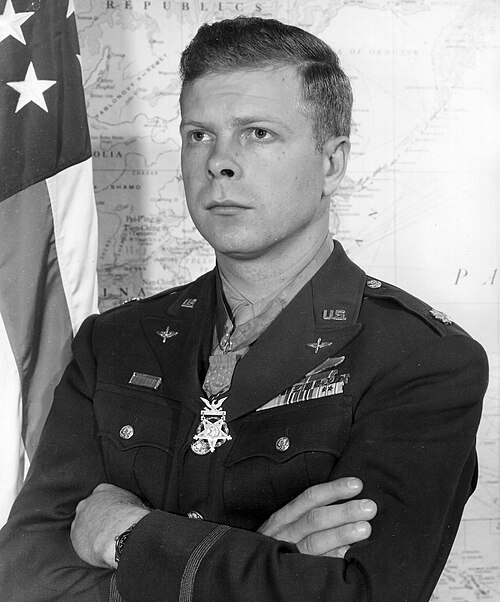
In the skies over the Pacific during World War II, one pilot became a legend—not through propaganda, but through sheer combat dominance. Major Richard Ira Bong, America’s highest-scoring fighter ace, destroyed 40 enemy aircraft in aerial combat, a record unmatched by any other U.S. pilot. Flying the powerful Lockheed P-38 Lightning, Bong turned dogfights into demonstrations of instinct, aggression, and extraordinary marksmanship. By the age of just 24, he had become one of the most celebrated airmen in American history.
Born on 24 September 1920 in Superior, Wisconsin, Bong grew up in the rural Midwest, where his fascination with aviation began early. Like many boys of the interwar era, he was captivated by aircraft and dreamed of flying. That dream became reality when he enrolled in the Civilian Pilot Training Program before joining the United States Army Air Forces in 1941, just months before America entered the war.
After earning his wings, Bong was assigned to the Pacific Theater, where Allied forces were locked in brutal combat against Imperial Japan. Flying with the 49th Fighter Group, he quickly proved himself an exceptional pilot. His aggressive attack style, unmatched situational awareness, and deadly accuracy allowed him to dominate aerial engagements. Unlike reckless thrill-seekers, Bong fought with disciplined aggression—calculated, patient, and devastating.
His combat record escalated rapidly. Mission after mission, Bong scored victories against Japanese aircraft, particularly the agile Mitsubishi A6M Zero. Despite the Zero’s reputation for maneuverability, Bong’s mastery of the P-38’s speed, firepower, and climb performance gave him a lethal edge. He learned to exploit every advantage, often striking with lightning-fast precision before enemy pilots could react.
By 1944, Bong had surpassed the victory total of Eddie Rickenbacker, America’s top ace of World War I. This achievement made national headlines and elevated him into a symbol of American air superiority. Yet fame did not change him. Fellow pilots remembered him as modest, quiet, and deeply focused on his mission rather than celebrity.
For his extraordinary gallantry and combat achievements, Bong received the Medal of Honor, presented personally by Franklin D. Roosevelt. The citation praised his “aggressiveness and daring” in aerial combat. He also earned the Distinguished Service Cross, Silver Star, multiple awards of the Distinguished Flying Cross, and numerous Air Medal awards—decorations that reflected both valor and sustained excellence in combat.
Bong’s tally of 40 confirmed aerial victories stood as the pinnacle of American fighter aviation. More impressive than the number itself was the context: these victories came in some of the Pacific War’s most dangerous air battles, against skilled and determined opponents. Every victory represented a life-or-death engagement at high speed.
Yet Bong’s story carries a tragic final chapter.
After the war in the Pacific was nearing its conclusion, Bong returned to the United States and became involved in testing advanced aircraft. On 6 August 1945, while serving as a test pilot for the revolutionary Lockheed P-80 Shooting Star, disaster struck. During takeoff from Burbank, California, the jet suffered a catastrophic failure. Bong attempted to bail out, but he was too low to deploy safely. He was killed instantly at only 24 years old.
The date of his death carried a haunting coincidence—it was the same day the United States dropped the atomic bomb on Hiroshima, an event that dominated global headlines and overshadowed news of Bong’s death.
Richard Ira Bong’s legacy endures because he embodied the ideal fighter pilot: skilled, fearless, disciplined, and deadly in combat, yet humble in character. His medal rack tells the story of remarkable service, but numbers alone cannot capture his impact. He inspired fellow pilots, boosted wartime morale, and set a standard of excellence few have approached.
More than eight decades later, Richard Bong remains the benchmark for American fighter aces—the pilot against whom all others are measured. In the history of military aviation, his name still soars above the rest.
Become the named supporter for this profile and edit the tribute biography and portrait (Owner account required). Proceeds help keep the archive online.
$25 USD / year — annual sponsorship renewal. Keeps the page online and, where enabled, the family anniversary remembrance emails active.