Loading archive…
Loading archive…

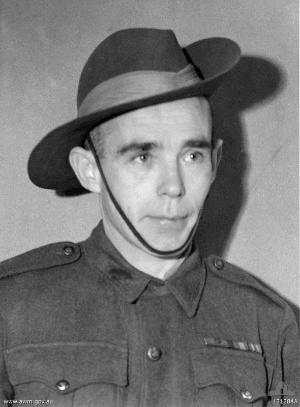
Private, Australian Army
Support & adopt this hero ↓Richard Kelliher was born on 1 September 1910 at Ballybeggan near Tralee, County Kerry, Ireland, the son of Michael Kelliher, a labourer, and Mary Anne Talbot. Educated locally at technical college, he worked as a mechanic in his brother’s garage before emigrating to Queensland in 1929 alongside his fifteen-year-old sister Norah. During the severe economic depression that gripped Australia, he travelled widely through regional districts as a bush labourer and farmhand, also serving for a period as sacristan at the Cathedral of St Stephen in Brisbane despite enduring debilitating bouts of illness. Kelliher enlisted in the Second Australian Imperial Force on 21 February 1941 under service number QX20656. Sailing for the Middle East in June 1941 with reinforcement drafts, he was posted that October to the 2/25th Infantry Battalion, carrying out garrison duties in Syria following the Allied campaign against Vichy French forces. The battalion returned to Australia in March 1942 and deployed to Papua six months afterwards, committing directly to the operations across the Owen Stanley Range and the bitter attritional actions around Buna and Gona. During the advance near Gorari, an uncorroborated battlefield misunderstanding prompted a court-martial for cowardice; the conviction was immediately quashed by higher authority for absence of evidence, leaving Kelliher resolve-bound to vindicate his standing among his peers.
Severe recurrences of malaria required extensive hospitalisation in Queensland through the first half of 1943, after which Kelliher rejoined the 2/25th Battalion in August for the airborne advance into the Markham Valley. On 13 September 1943, as the unit pressed towards Lae following the Allied drops at Nadzab, his platoon was pinned down near Heath’s Plantation by intense fire from an entrenched Japanese bunker. Confronting heavy casualties that disabled his section commander, Corporal William Richards, Kelliher acted entirely on his own initiative, rushing the fortified post, returning to retrieve an automatic weapon to eliminate the remaining defenders, and crawling out into hostile fire to extract his wounded commander. His actions earned him the Victoria Cross. The verbatim official citation promulgated in the Supplement to The London Gazette of 28 December 1943 (published 30 December 1943, Issue 36305, page 5649) records:
"During an attack by this soldier’s platoon on an enemy position at Nadzab, New Guinea, on the morning of 13th September, 1943, the platoon came under heavy fire from a concealed enemy machine-gun post approximately 50 yards away. Five of the platoon were killed and three wounded and it was found impossible to advance without further losses. In the face of these casualties Private Kelliher suddenly, on his own initiative, and without orders, dashed towards the post and hurled two grenades at it, killing some of the enemy but not all. Noting this, he then returned to his section, seized a Bren gun, again dashed forward to within 30 yards of the post, and with accurate fire completely silenced it. Returning from his already gallant action Private Kelliher next requested permission to go forward again and rescue his wounded section leader. This he successfully accomplished, though under heavy rifle fire from another position. Private Kelliher, by these actions, acted as an inspiration to everyone in his platoon, and not only enabled the advance to continue but also saved his section leader’s life. His most conspicuous bravery and extreme devotion to duty in the face of heavy enemy fire resulted in the capture of this strong enemy position."
Persistent bouts of malaria and diminished physical strength permanently closed Kelliher’s operational service. Medically downgraded to base roles, he served with advanced ordnance and workshop units in Brisbane before receiving his discharge from the Australian Military Forces under service number QX500601 on 20 August 1945. In 1946, he sailed for the United Kingdom with the Australian Victory Contingent, receiving his Victoria Cross from King George VI at Buckingham Palace. He revisited London in 1953 as an official guest for the coronation of Queen Elizabeth II, receiving the Coronation Medal. Making his home in Melbourne with his wife Olive and their three children, Kelliher worked as a gardener at the Burnley Horticultural School until severe physical disability forced his retirement. He suffered a fatal stroke at the Repatriation General Hospital in Heidelberg on 28 January 1963 at fifty-two years of age, receiving burial with military honours in Springvale Botanical Cemetery. His decorations were later purchased by his battalion association and presented to the Australian War Memorial in Canberra.
Become the named supporter for this profile and edit the tribute biography and portrait (Owner account required). Proceeds help keep the archive online.
$25 USD / year — annual sponsorship renewal. Keeps the page online and, where enabled, the family anniversary remembrance emails active.